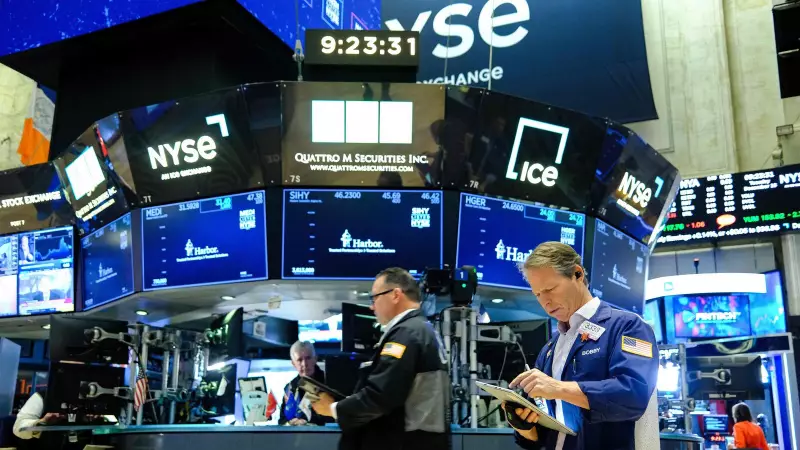
Wall Street exhibited a largely flat performance on Tuesday, December 16, 2025, as investors carefully assessed new economic data indicating a cooling US labor market. The major indices presented a mixed picture in early trading.
Market Movement and Key Economic Indicators
As of 10 A.M. Eastern Time, the S&P 500 was virtually unchanged. The Dow Jones Industrial Average experienced a slight dip of 0.1%, while the technology-focused Nasdaq Composite managed a gain of 0.3%. This cautious sentiment followed the release of a jobs report from the US Labor Department.
The data revealed that non-farm payrolls rebounded in November after an October decline linked to government spending cuts. However, a critical detail pointed to underlying weakness: the unemployment rate climbed to 4.6% in November. This deceleration in labor market health adds to existing economic uncertainties, partly fueled by former President Donald Trump's aggressive trade policies.

Bond Market Reaction and Corporate Highlights
In the bond market, yields softened in response to the economic signals. The yield on the benchmark 10-year Treasury note eased to 4.16%, down from 4.18% recorded late on Monday. Similarly, the 2-year Treasury yield dropped to 3.48% from 3.51%.
Corporate news drove significant individual stock movements. Shares of pharmaceutical behemoth Pfizer tumbled 3.3% after the company issued a profit forecast for 2026 that fell short of Wall Street's expectations. In contrast, Kraft Heinz saw its stock rise 0.6% following the announcement that Steve Cahillane, former CEO of Kellanova, will take over as its chief executive next month.
Other notable movers included:
- Oracle, which gained 1%.
- Broadcom, adding 0.7%.
- CoreWeave, a firm specializing in AI chip rentals, declined 2.4%.
Investor Focus Shifts to Inflation Data
With the jobs data now public, market participants are turning their attention to the next major economic release. The consumer inflation report for November is scheduled for Thursday, and it is expected to heavily influence future market direction. A preliminary report from S&P Global has already suggested building price pressures, noting that average selling prices for businesses increased at one of the fastest paces since mid-2022. The same report indicated a slowdown in overall business activity growth to its weakest level since June.
In a separate positive note, a key underlying measure of revenue strength for US retailers showed more growth in October than markets had anticipated, offering a glimmer of resilience in consumer spending.