

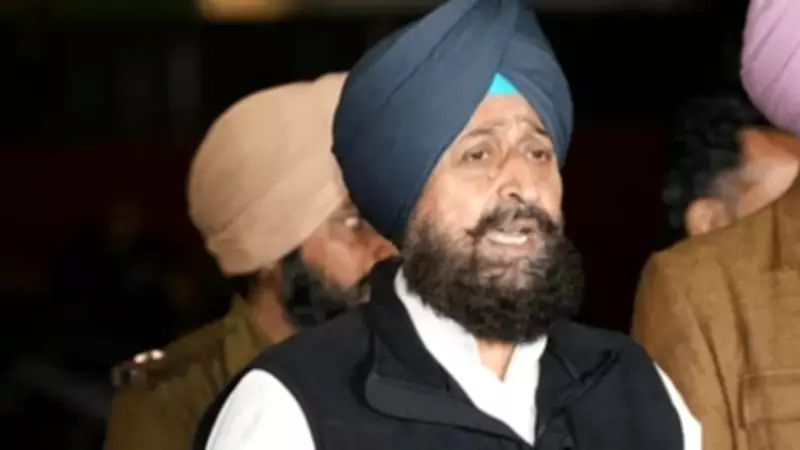
Congress Leader Bajwa Raises Alarm Over Punjab's Export Infrastructure Deficiencies
Senior Congress leader and Leader of Opposition in Punjab, Partap Singh Bajwa, has expressed profound skepticism regarding Prime Minister Narendra Modi's recent assertions about export-led growth for Punjab following the India–European Union Free Trade Agreement (FTA). Bajwa contends that without substantial infrastructure development and targeted policy interventions, Punjab risks being marginalized from the anticipated economic benefits of this landmark trade pact.
Rhetoric Versus Reality: Questioning Ground-Level Preparedness
Addressing a press conference, Bajwa referenced Prime Minister Modi's Sunday address in Jalandhar, where he highlighted new export opportunities to Europe. "The Prime Minister spoke about sending goods to Europe under the India–EU FTA," Bajwa stated, "but the ground reality in Punjab makes such assurances deeply questionable." He posed a critical question on behalf of the state: "How can our goods be sent competitively when Punjab itself remains commercially chained?"
Bajwa elaborated that Punjab's inherent geographical advantage as a land-linked border state has been effectively neutralized. "The land border remains closed," he emphasized, noting that the most cost-effective and efficient overland trade routes to Eurasia and onward to Europe are currently inaccessible. This forces local exporters to rely on protracted and expensive sea routes, severely compromising their competitiveness long before products even reach European markets.

Critical Gaps in Air Cargo and Logistics Infrastructure
A significant portion of Bajwa's critique focused on the dire state of air cargo infrastructure within Punjab. He highlighted several airports that are operating far below their potential:
- Halwara, Adampur, and Bathinda airports function largely as token facilities with negligible cargo movement.
- Even major airports in Chandigarh and Amritsar suffer from limited flight connectivity and weak cargo operations.
"Without reliable and efficient logistics networks," Bajwa observed, "Punjabi exporters simply cannot meet the stringent timelines or competitive cost benchmarks demanded by European markets." This infrastructure deficit, he argued, creates a fundamental disconnect between national trade ambitions and local operational capabilities.
Alleged Neglect in Union Budget and Agricultural Policy
Expanding his criticism to broader economic policy, Bajwa alleged that the recent Union Budget offered no meaningful support for Punjab's revival. "Punjab does not figure anywhere in the budget," he claimed, listing several omissions:
- No comprehensive roadmap for economic revival.
- Absence of a dedicated industrial push.
- Lack of an employment package for the state's unemployed youth.
- No serious strategy to integrate agriculture with processing and export value chains.
On agriculture, a cornerstone of Punjab's economy, Bajwa expressed deep disappointment. He noted the Budget's silence on providing a legal guarantee for Minimum Support Prices (MSP), despite farmers grappling with rising input costs, mounting debt, and increasing climate-related stresses. "Agriculture continues to be treated as a sector for charity, not as a genuine growth engine for the state and the nation," he remarked.
Call for Fair Partnership and Strategic Integration
Bajwa also pointed out that the unique challenges faced by Punjab—including its fiscal stress and status as a sensitive border state—have been consistently overlooked in national planning. He criticized the gap between the rhetoric of cooperative federalism and the reality of allocations and policy support.

"Punjab is not asking for special favours," Bajwa asserted. "It is asking for a fair and equitable partnership in India's growth story." He concluded with a powerful statement on the prerequisites for realizing the FTA's potential: "If the central government genuinely wants Punjab to benefit from the India–EU FTA, it must take concrete steps: unlock the state's borders, decisively strengthen its logistics backbone, and fully integrate Punjab into India's national export strategy. An opportunity without the means to access it is not empowerment—it is merely an illusion."





