

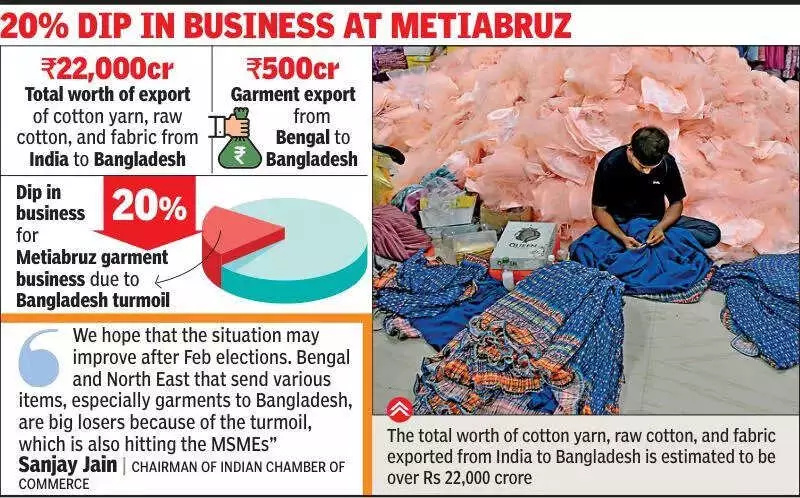
The recent resurgence of violence and political unrest in Bangladesh has sent shockwaves through the textile and garments industry in the Indian state of West Bengal. The bilateral trade, heavily reliant on land routes through Bengal, is facing severe disruption, putting exports worth thousands of crores in jeopardy.
A Vital Trade Corridor Under Strain
The economic link between India and Bangladesh in the textile sector is substantial. The total export of cotton yarn, raw cotton, and fabric from India to Bangladesh is estimated to be over Rs 22,000 crore annually. A significant portion of this trade historically moved through West Bengal, which hosts six land ports facilitating this exchange. Additionally, Bengal's direct garment exports to Bangladesh, valued at over Rs 500 crore, have also taken a hit.
Industry veteran Sushil Patwari, former regional chairman of the Federation of Indian Export Organisations (FIEO), highlighted the dependency. Having exported cotton to Bangladesh since 1972, he confirmed it remains the biggest buyer of Indian cotton, fabric, and yarn. India's cotton yarn exports to Bangladesh are worth $1.2 billion, while cotton and fabric exports stand at $1.5 billion. Mills from North India traditionally used Bengal's land routes, but Bangladesh has already imposed a ban on cotton yarn imports via these paths, compounding the logistical crisis.

Ground Zero: Kolkata's Garment Hubs Feel the Heat
The impact is acutely felt in manufacturing clusters like Metiabruz in Kolkata. Manufacturers here are grappling with cancelled export orders from Bangladeshi agents. Sajjan Ali Mollah, a manufacturer and president of the West Bengal Garment Association, stated that with orders from Bangladesh drying up, producers are now forced to look towards domestic markets in other Indian states.
The sentiment is echoed by other local businessmen. Dilawar Mondal, another Metiabruz manufacturer, revealed, "Ever since the turmoil started, our business with them slumped to just 20% through agents." Alamgir Fakir, secretary of the Bangla Readymade Garments Manufacturers and Traders Welfare Association, pointed out a longer-term decline: "From last year, our bulk orders that used to pour from Bangladesh dropped, and with the outbreak of unrest again, it is no business for us."
Industry Leaders Weigh In: Losses and a Silver Lining?
Sanjay Jain, chairman of the Indian Chamber of Commerce's national textiles committee, agreed that the sudden events, including anti-India marches, are slowing down bilateral trade. He expressed hope for improvement after Bangladesh's February elections but noted that Bengal and the North East, which send various items, especially garments, to Bangladesh, are the big losers. He emphasized that the turmoil is particularly damaging for Micro, Small, and Medium Enterprises (MSMEs).
However, some industry figures see a potential opportunity amidst the crisis. Rajesh Goel, CEO of Neon Creations, believes the instability could erode buyer confidence in Bangladesh, potentially shifting business to India. Ramesh Agarwal, director of Rupa & Co, concurred, suggesting that exports from Bengal and other parts of India might grow as international buyers from the Bangladesh market start searching for stable alternatives.
The situation remains fluid, with West Bengal's textile economy caught in the crossfire of geopolitical instability. The industry's hope is pinned on a swift return to normalcy across the border to revive this critical trade relationship.






