

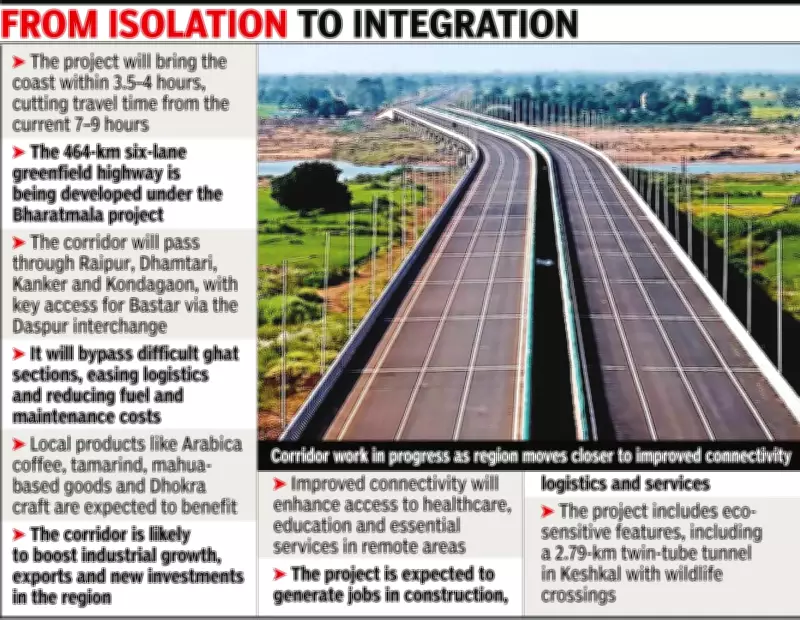
Bastar's Economic Transformation: Raipur-Visakhapatnam Corridor to Cut Travel Time to Sea
For generations, the story of Bastar has been shaped by its remoteness—dense forests, challenging terrain, and the logistical hurdles of Left Wing Extremism (LWE) have kept this resource-rich region isolated from major economic hubs. That narrative is now on the brink of a profound transformation, thanks to a monumental infrastructure project set to redefine connectivity and opportunity in Chhattisgarh.
A Game-Changing Infrastructure Project
The ₹16,491-crore Raipur–Visakhapatnam economic corridor, a six-lane greenfield highway being developed under the Bharatmala project, promises to slash the current 7–9 hour journey between Jagdalpur and Visakhapatnam to a mere 3.5–4 hours. This 464-kilometer access-controlled highway will traverse through Raipur, Dhamtari, Kanker, and Kondagaon districts, with a critical link at the Daspur interchange in Nabarangpur, Odisha, placing Jagdalpur just 50–60 kilometers from the corridor.
According to Pradeep Kumar Lal, Regional Officer at the National Highways Authority of India (NHAI), this corridor is poised to be a game-changer for Bastar. "By providing seamless access to Visakhapatnam port, we are integrating local produce into global markets," he explained. The existing route through the difficult ghats of Koraput and Jeypore has long been a logistical bottleneck, especially for heavy vehicles burdened with high fuel and maintenance costs.

Unlocking Economic Potential
The economic implications are vast and multifaceted:
- Agricultural and Artisan Boost: Products like Arabica coffee, organic tamarind, mahua-based items, and the renowned Dhokra craft will now travel faster and more affordably, enhancing returns for farmers, forest gatherers, and artisans.
- Mineral Wealth Evacuation: Faster transport of iron ore and other minerals to the port is expected to boost exports and attract new industrial investments, fostering value addition within Bastar.
- Tourism Growth: Easier access to iconic sites such as Chitrakote and Tirathgarh waterfalls, Kutumsar caves, Danteshwari temple, and the unique Bastar Dussehra festival could draw increased domestic and international visitors, amplifying the region's cultural footprint.
Broader Socio-Economic Impact
Beyond trade, the corridor is anticipated to drive significant socio-economic changes. Improved connectivity will enhance access to healthcare, education, and essential services in remote areas, while creating employment opportunities across logistics, construction, services, and emerging industrial clusters along the route.
"This project is a gateway to development for Bastar," stated Chief Minister Vishnu Deo Sai. Deputy CM Arun Sao emphasized its role in boosting industrial growth and connectivity, highlighting the government's commitment to regional progress.
Engineering and Environmental Safeguards
The project blends ambitious engineering with environmental consciousness. Notably, Chhattisgarh's first 2.79-kilometer twin-tube tunnel in the Keshkal region is being constructed through an eco-sensitive zone. It incorporates wildlife-friendly features such as underpasses, overpasses, and canopy bridges to minimize disruption to animal movement, ensuring sustainable development.
As construction accelerates, officials believe this corridor could herald a new chapter for Bastar—one where the region is no longer defined by its distance from opportunity, but by its newfound proximity to global markets and economic vitality.






