

BMS Delegation Witnesses China's Transition from Maoist Ideology to Capitalist Mall Culture
A recent visit by top leaders of the Bharatiya Mazdoor Sangh (BMS) to Beijing has revealed significant observations about China's evolving societal and economic landscape. The BMS, the trade union wing of the Rashtriya Swayamsevak Sangh (RSS), was invited by the All China Federation of Trade Unions (ACFTU) in January, and their findings, published in the February issue of the newsletter Vishwakarma Sanket, highlight a notable shift away from Maoist ideology towards what they term 'mall culture' and capitalism.
Delegation Composition and International Recognition
The delegation included prominent figures such as the then BMS chief Hiranmay Pandya, general secretary Ravindra Hite, and vice-president Neeta Choube. BMS was the sole invitee from India by ACFTU, a government-backed organization in China, underscoring the international acceptance of BMS as a respected trade union. This exclusive invitation reflects the growing global stature of BMS in labor movements.
Observations on Discipline and Civic Responsibility
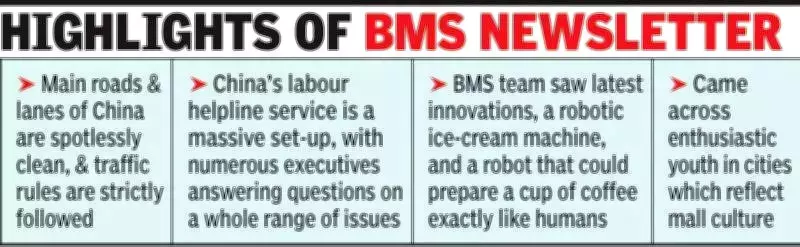
In an article written by BMS regional organization secretary CV Rajesh, who was part of the delegation, the union expressed admiration for China's discipline and time management. Rajesh noted that China could serve as a perfect example for India in fostering a sense of responsibility for civic duties. The delegation observed that roads and lanes in China are impeccably clean, and traffic rules are strictly adhered to, showcasing a high level of public order and efficiency.

Shift Towards Mall Culture and Urban Youth Enthusiasm
The article emphasized that China is rapidly moving away from its Maoist roots and embracing a 'mall culture' indicative of capitalist trends. Although the team did not visit rural areas, they encountered enthusiastic youth in cities who embody this new cultural shift. This observation points to a generational change, with urban centers becoming hubs of consumerism and modern lifestyles, contrasting with the ideological past.
Technological Innovations and AI Advancements
During their visit, the delegation explored cutting-edge technological facilities, including a humanoid robot invention incubator center. They witnessed innovative creations such as a robotic ice-cream machine and a robot capable of preparing coffee with human-like precision. At Sense Time Technology Company, they were introduced to the latest artificial intelligence techniques, particularly in defense applications. These experiences sparked reflections on the future, especially from a trade union perspective, as noted by Rajesh.
Labor Helpline Service and Trade Union Differences
BMS vice-president Neeta Choube highlighted China's labor helpline service as a model worth emulating. She described it as a massive setup with numerous executives handling calls to address a wide range of worker issues. Choube also acknowledged a fundamental difference between trade unionism in India and China: while India allows multiple trade unions, China's system is more centralized, with ACFTU playing a dominant role.
State-Level Treatment and Diplomatic Implications
The BMS delegation was treated as state guests during their four-day trip, with officials from the union's foreign department accompanying them throughout. This high-level reception not only facilitated in-depth exchanges but also reinforced the diplomatic and collaborative potential between Indian and Chinese labor organizations. The visit underscores the importance of international dialogue in understanding global economic shifts and labor practices.
Overall, the BMS visit to China provides a unique insight into the country's transformation from Maoist ideology to a capitalist-driven society, with lessons in discipline, technology, and labor services that could inform Indian approaches. The observations serve as a testament to the evolving dynamics in global trade unionism and economic development.






