

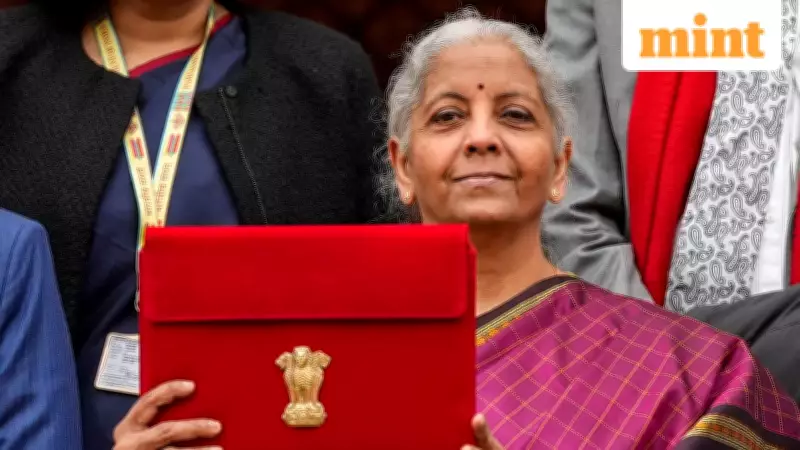
India's 2026-27 Budget: A Strategic Pivot in Export Policy
New Delhi: The Union Budget for the fiscal year 2026-27 represents a fundamental transformation in India's approach to supporting exports, signaling a decisive move away from traditional interest subsidies and fragmented incentive programs. Instead, the government is embracing a comprehensive model centered on export insurance, robust trade defense mechanisms, and manufacturing-linked infrastructure development. This strategic shift is poised to significantly alter how Indian exporters access state support, particularly in an increasingly volatile and uncertain global trade environment.
Phasing Out Interest Subsidies: The End of an Era
Budget documents reveal a clear departure from older support mechanisms, with funding being systematically redirected towards more sustainable initiatives. The most prominent indicator of this change is the complete withdrawal of the Interest Equalization Scheme (IES), which had been a cornerstone of export support for years. This scheme, which assisted exporters in managing high borrowing costs, was especially crucial for micro, small, and medium enterprises (MSMEs) and labor-intensive sectors. With an actual outlay of ₹2,482 crore in 2024-25, the IES received no allocation in either the FY26 budget or the FY27 budget estimates, marking its full exit from the government's policy toolkit.
Experts argue that this move indicates the Centre no longer views blanket credit subsidies as the optimal tool for bolstering exports. Instead, the focus is shifting towards building long-term resilience and competitiveness through structural reforms and targeted interventions.

New Focus: Insurance, Infrastructure, and Trade Defense
According to Agneshwar Sen, trade policy leader at EY India, the government is now enhancing trade infrastructure, reforming special economic zones (SEZs), and facilitating duty-free imports of key inputs to reduce export costs, particularly in sectors like seafood. "Allowing DTA (domestic tariff area) sales, albeit with conditions, for SEZ units will enable them to compete with imports," Sen explained. "Thus, while existing incentive schemes remain in place, there is a clear tilt toward export insurance, logistics reforms, and manufacturing-linked support to build long-term export resilience. This approach is certainly more sustainable as it aligns policy with global demand and domestic capacity building."
The budget allocates ₹5,873 crore to the Department of Commerce for 2026-27 (BE), which is lower than the revised estimate of ₹6,606 crore in 2025-26. In contrast, the Department for Promotion of Industry and Internal Trade (DPIIT) has received a significantly higher allocation of ₹11,970.83 crore for FY27 (BE), representing an increase of approximately 39% over the previous year's revised estimate. This brings the total allocation for the Ministry of Commerce to ₹17,843.83 crore in FY27 (BE), up by about 17.2% from FY26 (RE).
Industry Concerns and MSME Challenges
However, the shift away from interest subsidy schemes has raised concerns among industry leaders, particularly those representing the MSME sector, for whom the IES was a critical lifeline. Vinod Kumar, president of the India SME Forum, highlighted the potential adverse impacts: "The withdrawal of the IES significantly increases the cost of export credit for MSMEs at a time when global demand is weak, interest rates remain high, and liquidity pressures are acute." He emphasized that for lakhs of small exporters in labor-intensive sectors such as textiles, leather, engineering goods, handicrafts, and gems and jewellery, the scheme provided essential cushioning against rising financing costs. "Its discontinuation risks eroding India's export competitiveness, discouraging first-time exporters, and pushing many MSMEs out of global value chains," Kumar warned.

In response, the budget has strengthened the Export Promotion Mission, which focuses on MSMEs, with an allocation of ₹2,300 crore for 2026-27, compared to a revised estimate of ₹2,250 crore in the previous year. A government official noted that this mission consolidates earlier schemes, including the Market Access Initiative and interest equalization, into a unified framework that combines access to trade finance with non-financial support such as compliance assistance, market diversification, and exporter preparedness.
Emphasizing Risk Management and Enforcement
A key aspect of the new policy direction is the increased focus on managing global trade risks. With geopolitical tensions, sanctions, and payment uncertainties on the rise, the government is placing greater reliance on export insurance rather than subsidies to protect exporters. Amit Singh, associate professor at the Special Centre for National Security Studies, Jawaharlal Nehru University, observed: "What stands out in this budget is the clear move away from open-ended export subsidies towards a system that protects exporters through insurance, trade remedies, and stronger manufacturing ecosystems. The emphasis is now on managing risk and enforcing trade rules, rather than subsidizing costs, which marks a structural change in how export support is being designed."
Alongside risk mitigation, the budget places greater emphasis on enforcement. Allocations for trade remedies and trade defense have increased to ₹23.9 crore in FY27, reinforcing the government's growing reliance on anti-dumping, countervailing, and safeguard measures to protect domestic industry and exporters as import competition intensifies.
Linking Exports to Manufacturing Infrastructure
The reorientation of export support is further reinforced by the DPIIT's allocations, which closely link export competitiveness to manufacturing infrastructure. DPIIT has earmarked ₹3,000 crore each for national industrial corridors and for the new plug-and-play industrial parks scheme in 2026-27. The latter scheme, which had seen its allocation sharply reduced to ₹250 crore in the revised estimates for FY2025-26 due to project readiness issues, has been significantly scaled up in the current budget.
Amardeep Singh Bhatia, secretary of DPIIT, stated: "The budget continues on the path towards achieving the goal of Viksit Bharat by deepening reforms and supporting manufacturing-led growth. Several schemes announced in the budget are aimed at strengthening domestic value chains across sectors and integrating them more closely with global value chains." He added that these measures will help build skills aligned with modern, technology-driven industry needs, improve productivity, and strengthen infrastructure. Bhatia also highlighted steps to attract foreign investment and facilitate exports by reducing compliance burdens, including through easier customs processes, enabling domestic manufacturers to better leverage recent free trade agreements.
Capital outlay on industries has crossed ₹5,100 crore, underscoring the push to embed export growth within large, integrated industrial ecosystems rather than through standalone trade incentives.
Sector-Specific Benefits and New Initiatives
Rahul Ahluwalia, founder and director at the Foundation for Economic Development (FED), noted: "The budget takes some steps in the direction of strengthening exports - like providing duty exemptions to a few capital goods, providing some clarity on taxation liabilities for component warehousing and capital goods consignment. Some incentives for specific sectors like textiles, footwear, electronics components, and sporting goods will also benefit the export ecosystem."
Ravi Saxena, CEO and founder of Wonderchef, a kitchen appliances maker, highlighted additional reforms: "This budget reshapes India's trade approach by shifting from passive support to active efficiency. The removal of the ₹10 lakh courier export cap, digitization of customs through the CIS platform, and the introduction of the Credit Guarantee Scheme for Exporters (CGSE) will make it easier for MSMEs to access credit." Under the CGSE, well-run MSME exporters will be able to avail collateral-free loans of up to ₹20 crore to support expansion and working capital needs, Saxena added.
Overall, the 2026-27 budget represents a paradigm shift in India's export policy, moving from short-term subsidies to long-term strategies focused on risk management, infrastructure development, and global integration. While this transition poses challenges for MSMEs, it aims to create a more sustainable and resilient export ecosystem capable of thriving in a complex global trade landscape.





