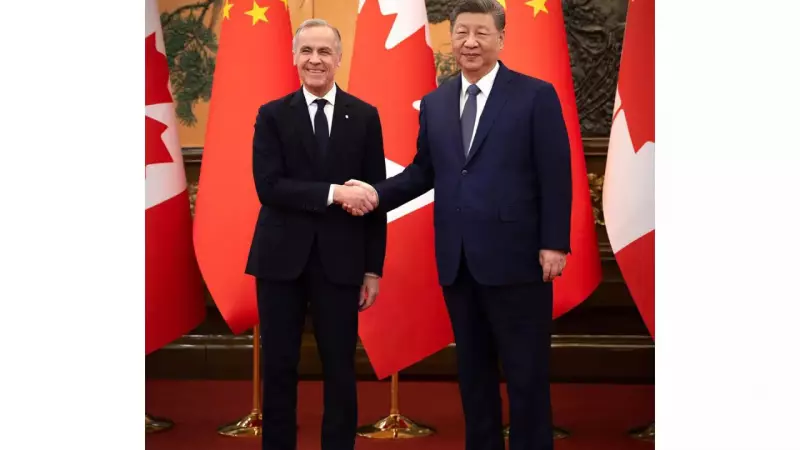
Canada Forges New Trade Partnership with China
Canadian Prime Minister Mark Carney has announced a significant new trade agreement with China. This deal promises to open substantial export markets for Canadian businesses and workers. Carney revealed the agreement through a post on social media platform X.
"We have secured a new trade agreement with China," Carney stated. "This unlocks more than $7 billion in export markets for Canadian workers and businesses."
A Strategic Economic Move
The Canadian Prime Minister's Office released a detailed statement explaining the rationale behind this partnership. "In a more divided and uncertain world, Canada is building a stronger, more independent, and more resilient economy," the statement read.

It further emphasized that Canada's government is working with urgency to diversify trade partnerships and catalyze massive new investment levels. As the world's second-largest economy, China presents enormous opportunities for Canada in this mission.
Historic Visit and High-Level Meetings
To forge this new Canada-China partnership, Prime Minister Carney visited Beijing this week. This visit marked the first trip to China by a Canadian Prime Minister since 2017.
During his time in Beijing, Carney held crucial meetings with top Chinese leaders:
- President Xi Jinping
- Premier Li Qiang
- Chairman Zhao Leji of the Standing Committee of the National People's Congress
Following these discussions, Prime Minister Carney and President Xi released a joint statement. This document outlined the core pillars of the new strategic partnership between Canada and China.
Key Tariff Reductions and Market Access
The trade agreement includes specific tariff concessions that benefit both nations. According to CBS News reports, Canada has agreed to eliminate its 100% tariff on Chinese electric vehicles. In return, China will lower tariffs on Canadian agricultural products.
Carney provided details on the electric vehicle arrangement. There will be an initial annual cap of 49,000 vehicles on Chinese EV exports to Canada. This cap is set to grow to approximately 70,000 vehicles over the next five years.
On the agricultural front, China will significantly reduce its total tariff on canola seeds. This major Canadian export will see tariffs drop from 84% to about 15%, as reported by CBS News.
China as a Predictable Partner
Prime Minister Carney highlighted China's reliability as a trading partner. He noted that China has become a more predictable partner to deal with than the United States.
"Our relationship has progressed in recent months with China," Carney told CBS News. "It is more predictable, and you see results coming from that."
Broader Trade Context
This new agreement comes against a complex backdrop of international trade tensions. Canada currently faces significant trade challenges, including a 35% levy on its goods in certain markets. The country is also affected by broader tariffs, such as the blanket 50% levy on imported metals and 25% on non-US automobiles.
Meanwhile, China and the United States have engaged in their own trade disputes. Both nations previously threatened each other with 100% tariffs. However, after a meeting between US President Donald Trump and President Xi Jinping, tariffs were exempted on a portion of Chinese products until November 10, 2026.
Canada's new trade deal with China represents a strategic shift. It aims to secure market access and economic stability in an increasingly volatile global trade environment.