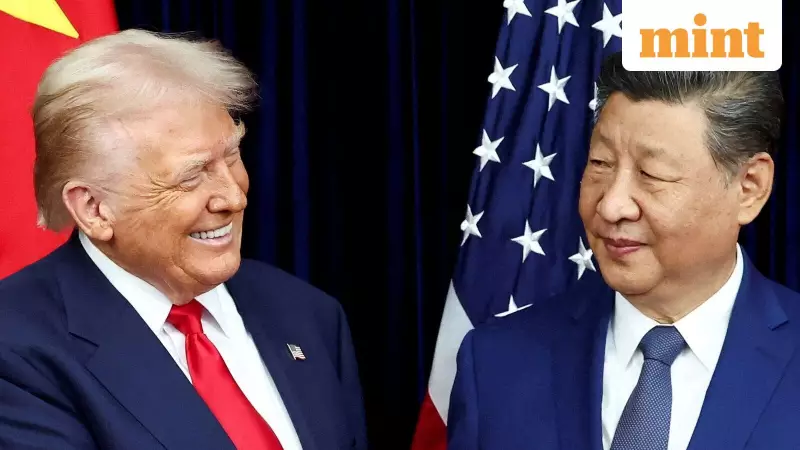
In a dramatic reversal of fortunes, China is now seen as gaining the upper hand in its protracted trade war with the United States. As US President Donald Trump prepares to meet Chinese President Xi Jinping in South Korea next week, the backdrop is one where Beijing has successfully weaponised its industrial dominance, particularly in critical materials, to counter American pressure.
From Self-Criticism to Strategic Dominance
The shift began seven years ago, at the trade war's outset, with an unusual act of introspection from Beijing. China's science and technology ministry published a series of 35 articles titled "What is choking us?" which meticulously catalogued the country's technological weaknesses and dependencies on foreign imports. This marked a pivotal turn. China moved from acknowledging its own "chokepoints" to systematically identifying and exploiting America's.
The foresight is now paying off. Recent months have seen China deploy increasingly aggressive economic tools. In a move that stunned observers two weeks ago, Beijing unveiled sweeping export controls, granting itself the power to disrupt American supply chains at will. This triggered furious counter-threats from the Trump administration and a heated blame game over who is destabilising the global economy.

Rare Earths: China's Trump Card
China's most effective strategy has been to mirror and amplify America's own tactics of export restrictions. A defining moment came in April. Following Trump's announcement of steep tariffs, China retaliated by restricting exports of seven rare-earth elements and related magnets, crucial for weapons, electric vehicles, and electronics. With China controlling the lion's share of global mining and refining, the move caused immediate panic in US industries.
"We just won't tolerate the US hitting us anymore, and we believe we have the capability to fight back," stated Tu Xinquan from the University of International Business and Economics in Beijing. The pressure worked. As inventories outside China dwindled, Washington blinked, agreeing to a tariff truce. China resumed rare-earth flows, demonstrating the potency of this leverage.
The escalation continued on October 9th, when China established a global licensing regime for virtually all rare earths, their production technologies, and lithium-ion batteries. This move, analysts say, allows Beijing to potentially dictate which high-tech goods are made abroad and by whom. "They are sending a message that it's time for payback," remarked Sean Stein of the US-China Business Council.
Industrial Heft and Calculated Risks
China's confidence stems from its unmatched manufacturing scale, which accounts for 35% of global output—triple that of the US. While America leads in high-end semiconductors, China is pouring resources into closing that gap. Conversely, in rare earths, the US has only one active mine and negligible refining capacity, a weakness that could take half a decade to fix.
"China sees this as a near-term leverage asymmetry in its favour," says Feng Chucheng of Hutong Research. Put simply, while US chip controls are a headache for China, China's rare-earth controls threaten to paralyse America.
However, this power carries significant risks. By applying controls globally, China has alarmed third countries. By September, it had approved only 19 out of 141 European licence requests, a deliberate squeeze that risks pushing allies toward Washington. The new licensing system, if enforced strictly, is also more aggressive than the American model, requiring every company to prove its innocence rather than presuming it.
Domestic Triumph and the Path Ahead
Strategically, the trade war's trajectory has bolstered Xi Jinping's domestic standing. The narrative of standing up to American bullying resonates powerfully, fueling a surge of patriotic sentiment online. This contrasts with the Trump administration's belief that a weak Chinese economy would capitulate.

"Instead of coming running for negotiations, Xi is the one that is making moves and the United States is struggling to keep up," notes Jon Czin of the Brookings Institution. The upcoming summit is thus unlikely to yield a grand bargain. Instead, China's goal is "conflict management." A modest deal may see tariffs stabilise, export controls watered down, and China resuming soyabean purchases as a goodwill gesture to Trump.
Looking forward, both nations are preparing for the next phase. The US is painfully aware of its vulnerabilities in batteries, pharma ingredients, and more. Building resilience will require years and vast investment, complicated by Trump's unilateralist tendencies. China, meanwhile, faces its own long road in conquering semiconductors and AI, all while managing the high cost of its self-reliance drive and the diplomatic tightrope of wielding power without creating a united front against itself.
The balance of economic coercion has undeniably shifted. China, once fearing it was being backed into a corner, now holds powerful cards. The challenge for Beijing is to play them without overreaching, ensuring its trade war victories do not become pyrrhic.