

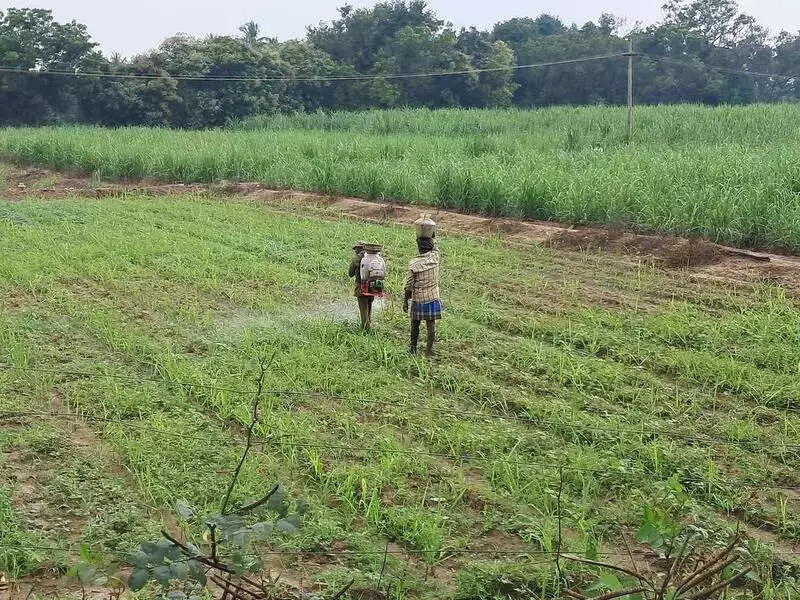
An alarming report on soil health has revealed a critical agricultural challenge in Tamil Nadu's Coimbatore district. Data indicates that the vast majority of farmland in the region suffers from severely depleted organic carbon levels, a key indicator of soil fertility and health.
The Stark Reality of Coimbatore's Soil
According to official statistics from the Department of Agriculture and Farmers Welfare, a staggering 90.5% of the soil in Coimbatore district has an organic carbon level below 0.5%. This marks it as poor quality soil, severely limiting its productivity for farming. Soil health is a composite measure that includes organic matter, micronutrients, pH balance, water infiltration, and microbial activity. Among these, organic carbon is a primary component, followed by essential nutrients like nitrogen, phosphorus, and potassium.
The data paints a grim picture, with only a minuscule 0.1% of the district's soil classified as healthy, possessing an organic carbon level above the 0.75% threshold. This widespread deficiency threatens the long-term sustainability of agriculture in this important region.

Organic Farming: A Proven Path to Recovery
Despite the daunting statistics, success stories from local farmers demonstrate that soil regeneration is possible. Dr. R. Sampathkumar, a natural farmer from Pollachi, has achieved remarkable results on his 10-acre farm. By adopting organic methods since 2012, he has increased the soil organic carbon level to an impressive 2.5%.
"I have been using the nature farming technique, often called the Japanese method," explains Sampathkumar. "The core idea is recycling resources within the farm, practicing multi-cropping, and using only organic manure and compost. We leave fallen and dried leaves on the land to retain moisture and act as natural fertilizer." His innovative, layered farming includes 11 different crops, with coconut as the main cash crop.
The benefits extend beyond soil numbers. "Plant immunity is significantly boosted through these organic methods," he states. "While neighboring coconut farms were hit by whitefly and wilt, my farm remained unaffected. Healthy soil ultimately produces healthy food." His contributions have earned him recognition from Prime Minister Narendra Modi and the 'Nammazhvar award' from the Tamil Nadu government.
New Entrants and Economic Benefits
The shift to organic practices is attracting diverse individuals. K. M. P. Mohankumar, a farmer from Tirupur, transitioned from the textiles business during the COVID-19 pandemic. Starting with shallots on just 10 cents of land, he witnessed a higher-than-normal yield. This success gave him the confidence to expand his organic farming to 50 cents. He highlights a key advantage: "Organic farming is also very cost-effective compared to chemical-based farming," making it an economically viable option for many.
Challenges and Scientific Perspectives
However, the transition is not without significant hurdles. Adhisayam Thirumurthy, a tree consultant from Dharapuram, points out that while large-scale farmers may adopt these methods more easily, the initial investment can be prohibitive for small-scale farmers. Furthermore, consumer preference plays a vital role. "The public often chooses vegetables and fruits based on looks and size, which are traits harder to achieve organically. Although organic produce has superior nutritional value, its higher price deters many buyers," he notes.
The science supports the organic approach. Dr. D. Selvi, head of the Department of Soil Science & Agricultural Chemistry at the Tamil Nadu Agricultural University (TNAU), confirms that research consistently proves organic farming improves soil organic carbon. "On the TNAU campus itself, we have raised organic carbon levels from 0.3% to 0.75% over the past four decades," she shares. She also explains that natural variations exist, with hilly and forest areas typically having higher carbon levels, while regions exposed to intense heat tend to have lower levels.

To encourage change, government authorities are promoting awareness. P. Siddharthan, Deputy Director of Horticulture, says they are actively informing farmers about various government schemes designed to support the adoption of organic methods. The path to restoring Coimbatore's soil health is clear, but it requires concerted effort from farmers, consumers, and policymakers alike.





