Economic Compulsion Overrides Geopolitical Fears as Delhi Gulf Visa Queues Persist
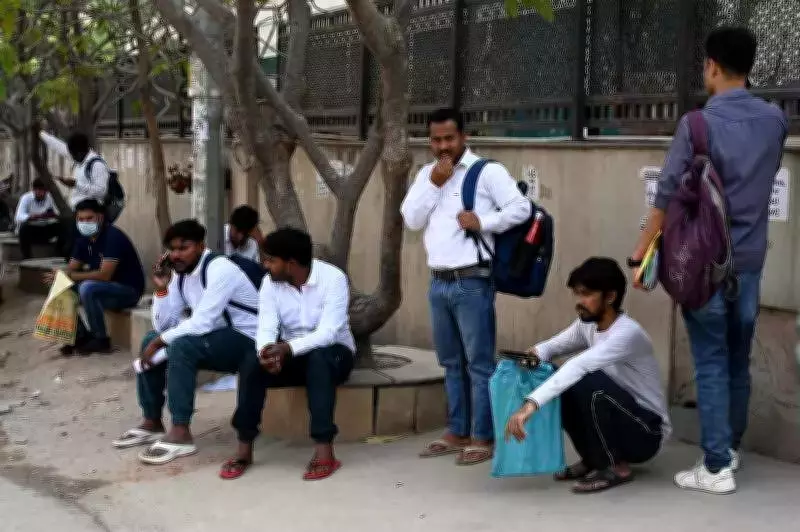
New Delhi: Even as geopolitical tensions escalate across West Asia, the queues outside visa application centers for Gulf countries in India's capital show no signs of abating. A steady stream of applicants continues to navigate the bureaucratic process, with many workers stating that stark economic realities leave them with little choice but to pursue opportunities in the restive region.
Pavements Transformed into Document Processing Hubs
Outside centers processing visas for the United Arab Emirates and Saudi Arabia, dozens of applicants were observed sitting on pavements, meticulously sorting through paperwork. They clutched plastic folders stuffed with essential documents including medical reports and employment contracts. Recruitment agents moved swiftly among them, pockets bulging with passports as they guided workers through the complex application procedures.
Most applicants acknowledged hearing about the regional conflict through media reports but admitted to having a limited understanding of the geopolitical situation or its potential impact on their intended destinations.

"Without Money, We Will Die Here as Well"
Dilip Yadav, a 37-year-old from Bihar's Saharsa district, recently returned to India after nearly a decade working as a mechanical fitter in Dubai. He was at the UAE visa center guiding his younger brother through the application. "I have seen on TV that a war is on, but what can we do?" Yadav explained, highlighting his family's dependence on remittances. "Without money, we will die here as well. People fight for some time and then things settle down. And bombs fall on big buildings, not on labour camps," he added with a wry smile.
Yadav returned to India following his father's passing to care for his mother, wife, and two children. "The kids were becoming wayward in my absence," he noted. Now, his 28-year-old brother is attempting his luck in the Gulf, having previously worked in South African construction. "The salary being offered in Dubai is better," Yadav stated.
The Stark Financial Arithmetic of Migration
For many like Yadav, the financial disparity between working in India and the Gulf decisively outweighs the perceived risks. "Here you get Rs 10,000 a month. There, the pay can go up to Rs 45,000, overtime is extra, and accommodation and food allowances are provided," he detailed, outlining the compelling economic calculus.
Several applicants revealed they had already taken loans or paid significant recruitment fees, making it financially impossible to cancel their plans now. They clarified that current applications are advance filings, with hopes that the regional situation will stabilize by the time their work permits are processed.
First-Time Applicants Driven by Family Needs
A few meters away, Jagdish, a 22-year-old first-time applicant from Jharkhand, was anxiously making phone calls after learning his medical test report had been rejected. Having obtained his passport a year ago, he hopes to travel to the Gulf as a mason. "My mother and unmarried sister are at home. We are poor, and need to build a house and get my sister married. I have no option but to go," he said. When questioned about the conflict, he shrugged: "If death has to come, it can come here as well."
Recruitment Agents Report Unabated Demand
Recruitment agents facilitating the applications confirmed that demand has not been significantly affected by the conflict. Ankit, a contractor guiding a group of applicants, stated that visa processing continues as usual. "Applications are still coming. There may be delays but recruitment is continuing. People don't always get well-paying jobs here, so they look for opportunities in the Gulf," he explained.
Outside the center, families waited while relatives submitted documents inside. Irshad, accompanying a relative, summarized the sentiment: "People go abroad because they have no choice. No one wants to leave the country willingly."

Similar Scenes at Saudi Visa Centers
Parallel scenes unfolded at a Saudi visa processing center. Lakhbeer Singh, a 29-year-old from Punjab's Sangrur with two young children, applied for a driver's job offering Rs 1.5 lakh monthly. "I have two small children. I need money to bring them up. I must go. It may take a month before I get to travel, but whatever happens will happen," he resolved.
Jagjeet Singh, a 40-year-old heavy-duty driver heading to West Asia for the fourth time, emphasized the significant financial difference. "People go there out of compulsion. Without money, we will starve here as well," he said. "You get overtime, insurance and hospital facilities abroad. Here, drivers work round the clock but most of them aren't paid extra."
A Cautious First-Time Female Applicant
Among the applicants was a 35-year-old woman from Kerala, a first-time applicant who expressed more caution. "Friends are saying things are normal there. I am applying for now, I will decide later whether I will go," she stated, reflecting a wait-and-see approach.
Logistical Challenges and the Bigger Picture
Flights to and from Gulf countries like the UAE, Qatar, Bahrain, and Kuwait are currently operating on a limited basis following disruptions. Many of the visa applications being processed are advance filings, with workers hoping to travel in the coming weeks once flight schedules normalize.
Approximately nine million Indians reside in Gulf countries, and the remittances they send home serve as a critical lifeline for countless families across India. According to an official Government of India statement, around 52,000 Indians returned home between March 1 and March 7 due to the evolving regional situation. Most utilized non-scheduled flights, with many enduring lengthy transit delays.
Yet, the persistent flow of applicants outside Delhi's visa centers underscores a harsh reality. For numerous workers, the immediate pressures of unemployment and providing for their families in India carry far more weight than the perceived distant risks of a geopolitical conflict they feel powerless to influence.