

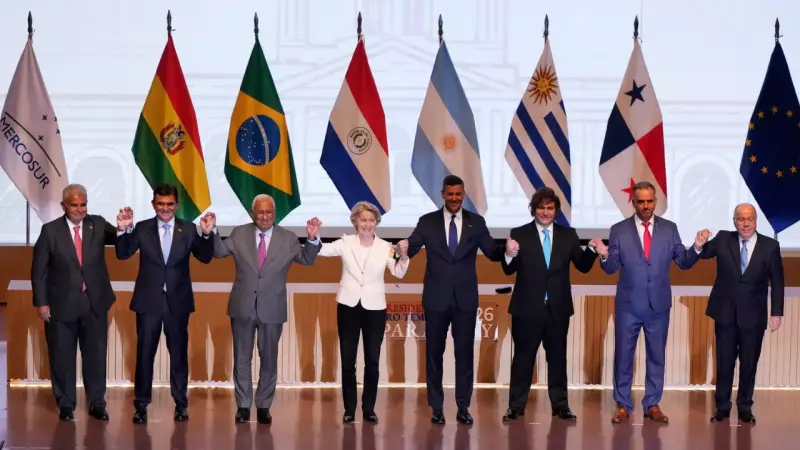
Officials from South America and the European Union gathered in Asuncion on Saturday to sign a landmark trade agreement. They celebrated this deal as a strong statement against rising tariffs, global uncertainty, and protectionist policies.
A Quarter-Century in the Making
The European Union, comprising 27 nations, finalized this pact with Mercosur bloc members Brazil, Argentina, Uruguay, and Paraguay. This agreement establishes one of the planet's largest free trade zones. Negotiations spanned 25 difficult years before reaching this milestone.
Recent actions by the United States administration provided fresh momentum for the deal. President Donald Trump's widespread use of tariffs and trade threats pushed many countries to seek new partnerships. On the same Saturday, Trump threatened several European nations with tariffs as high as 25 percent. He aimed to gain control over Greenland, a Danish territory.

Leaders Voice Their Support
EU chief Ursula Von der Leyen spoke at the signing ceremony in Paraguay's capital. She declared, "We choose fair trade over tariffs, we choose a productive long-term partnership over isolation."
Paraguayan President Santiago Pena also praised the treaty. He called it "a clear signal in favor of international trade" during "a global scenario marked by tensions."
European Council head Antonio Costa highlighted how the deal contrasts with "the use of trade as a geopolitical weapon." Brazil's Foreign Minister Mauro Vieira described the agreement as a "bulwark ... in the face of a world battered by unpredictability, protectionism, and coercion."
Brazilian President Luiz Inacio Lula da Silva played a crucial role in crafting the accord. Scheduling conflicts prevented his attendance at the ceremony. He met with Von der Leyen in Rio de Janeiro on Friday. There, he hailed the deal as a victory for multilateralism.
Paraguayan leaders expressed optimism about the treaty's benefits. They believe it will create jobs, foster prosperity, and open opportunities for people on both sides of the Atlantic Ocean.
Economic Scale and Impact
Together, the EU and Mercosur represent 30 percent of global GDP. Their combined consumer base exceeds 700 million people.
The treaty still requires approval from the EU parliament. Each Mercosur nation must also ratify it. Once implemented, the agreement will eliminate tariffs on over 90 percent of bilateral trade. Officials expect it to take effect by the end of 2026.
European exports of cars, wine, and cheese will gain significant advantages. South American products like beef, poultry, sugar, rice, honey, and soybeans will find easier access to European markets.
Farmer Protests and Concerns
This prospect has angered many European farmers. They fear an influx of cheaper goods produced with lower standards and banned pesticides. Farmers have driven tractors into major cities including Paris, Brussels, and Warsaw to voice their protests.
Trisha Chatterton, a 50-year-old farmer from Ireland, joined protests earlier this month. She stated, "We have good quality Irish beef and good standards here, and they don't have the same standards in South American countries."
A 24-year-old Belgian cattle farmer named Luis participated in a December protest that turned violent. Demonstrators set piles of tires on fire and threw potatoes at police. Luis simply said, "It's not fair."
Germany holds key influence in this matter. Spain and Nordic countries also strongly support the pact. They want to boost exports as Europe faces stiff competition from China and a tariff-focused administration in Washington.
South American Apprehensions
Some South Americans express wariness about the treaty's impact. Luciana Ghiotto, a trade and investment researcher, shared estimates with AFP. She said Argentina could lose 200,000 jobs just from the dismantling of its local automotive industry.
Safeguards and Quotas
The European Commission announced measures to allay fears. They created a crisis fund and safeguards. These allow for the suspension of preferential tariffs if imports surge to damaging levels.
Argentina's libertarian President Javier Milei issued a warning. He said quotas and safeguards "will significantly reduce the economic impact of the agreement and will go against its essential objective."

EU estimates project European exports to Mercosur will rise by 39 percent. Mercosur exports to the EU could increase by 17 percent.
By 2040, the agreement is expected to boost EU GDP by 77.6 billion euros. Mercosur GDP could grow by 9.4 billion euros.





