

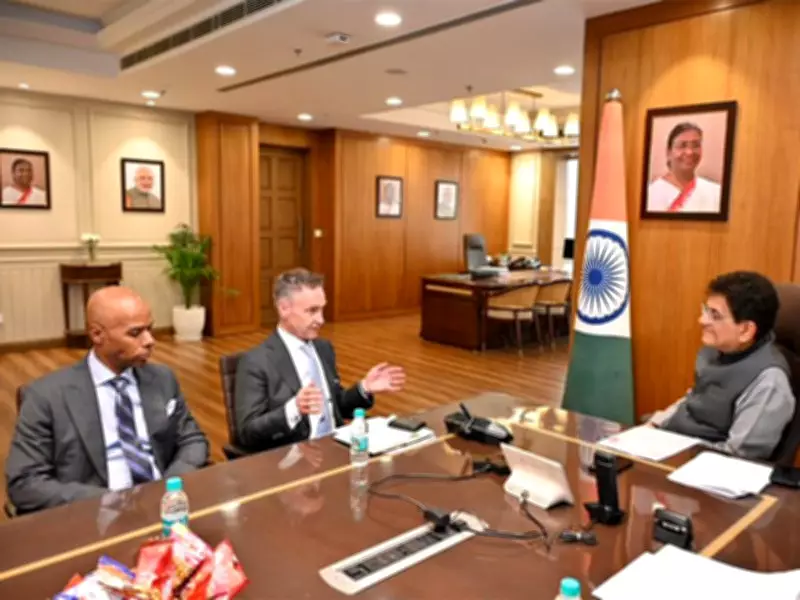
Piyush Goyal Engages with Eli Lilly Leadership to Amplify 'Make in India for World' Efforts
Union Commerce and Industry Minister Piyush Goyal convened a significant meeting with Patrik Jonsson, the Executive Vice President and President of Lilly International, to deliberate on India's burgeoning economic landscape and the pharmaceutical giant's escalating footprint within the nation. The discussions, held on March 20, 2026, centered on fortifying the 'Make in India for the world' initiative, a cornerstone of India's industrial policy aimed at transforming the country into a global manufacturing hub.
Focus on Expanding Operations and Investments
During the meeting, Minister Goyal and Mr. Jonsson explored Eli Lilly and Company's progressive expansion of operations and investments across India. The dialogue underscored the mutual benefits of leveraging India's robust growth trajectory, characterized by a skilled workforce, improving infrastructure, and a conducive business environment. Goyal emphasized the government's commitment to fostering partnerships that align with the 'Make in India' vision, which seeks to not only boost domestic production but also enhance exports to international markets.
In a post on social media platform X, Goyal detailed the exchange, stating, "Held a meeting with Patrik Jonsson, Executive VP and President, Lilly International, USA. We discussed the India growth story, Eli Lilly & Company's expanding operations and investments in India, and the steps to further strengthen Make in India for the world." This engagement highlights the strategic importance of foreign direct investment in sectors like pharmaceuticals, where India already holds a prominent position globally.

Broader Diplomatic and Economic Engagements
Earlier on the same day, Minister Goyal participated in a virtual meeting with Harry Theoharis, Greece's Deputy Minister of Foreign Affairs. The discussions revolved around deepening bilateral cooperation in multiple domains, including trade, investment, tourism, and maritime connectivity. Goyal noted on X that India values its growing partnership with Greece and looks forward to advancing this engagement further, reflecting the government's proactive approach to strengthening international ties.
Additionally, Goyal held a productive interaction with Aadit Palicha, Co-founder and CEO of Zepto, a rapidly growing Indian startup. Their conversation focused on key areas such as:
- Skilling Initiatives: Enhancing training programs for youth to equip them with relevant skills for the modern economy.
- Innovation-Led Entrepreneurship: Leveraging technological advancements to build globally competitive enterprises.
- Supply Chain Integration: Exploring ways to integrate farmers into modern supply chains to improve market access and value realization.
This interaction underscores the government's emphasis on nurturing India's vibrant startup ecosystem, which has become a pivotal driver of economic growth and innovation. The rapid ascent of startups like Zepto exemplifies the potential for homegrown companies to achieve global scale, aligning with the broader 'Make in India' objectives.
Implications for India's Economic Strategy
The series of meetings led by Minister Goyal signal a concerted effort to bolster India's economic diplomacy and industrial capabilities. By engaging with global corporate leaders like Eli Lilly, the government aims to attract higher levels of foreign investment, particularly in high-value sectors such as pharmaceuticals. Eli Lilly's increased presence in India could lead to enhanced research and development activities, job creation, and technology transfer, contributing to the nation's self-reliance goals.
Moreover, the discussions with Greece and Zepto highlight a multifaceted approach to economic development, encompassing international partnerships, startup innovation, and agricultural modernization. These efforts are integral to positioning India as a key player in the global economy, driven by the 'Make in India for the world' mantra that seeks to transform the country into a manufacturing powerhouse while fostering sustainable growth.

As India continues to navigate its growth trajectory, such strategic engagements are expected to play a crucial role in shaping policies that promote investment, innovation, and international collaboration, ultimately reinforcing the nation's stature on the world stage.





