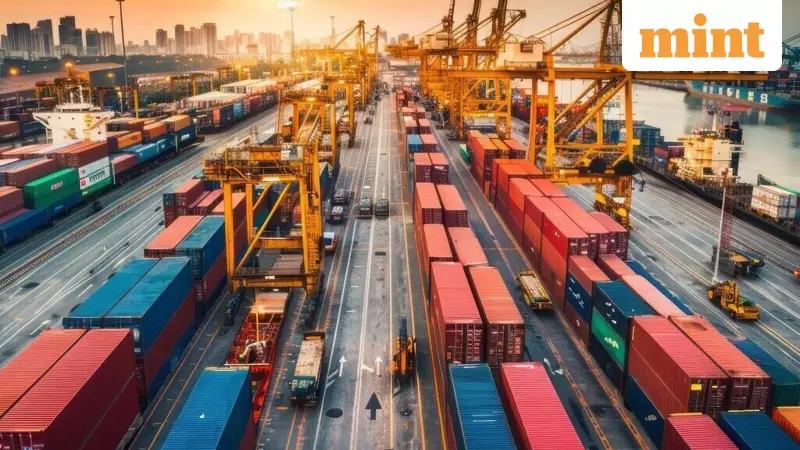
India Streamlines Export Documentation for West Asia and North Africa Trade
The Indian government has taken a significant step to simplify export procedures for businesses trading with West Asia and North Africa. Authorities have authorized the India & Arab Countries Chamber of Commerce, Industry and Agriculture to issue non-preferential certificates of origin. This move directly addresses documentation challenges that exporters frequently encounter.
Easing Business Operations for Exporters
Exporters, especially small and medium enterprises, often face difficulties obtaining necessary certificates during busy export periods. The government's decision specifically targets these bottlenecks. Vinod Kumar, President of the India SME Forum, emphasized this point. He stated that the authorization should improve ease of doing business for exporters. Smaller businesses in particular struggle with securing certificates during peak cycles.
Arun Kumar Garodia, former chairman of the Engineering Export Promotion Council, echoed this sentiment. He noted that authorizing a dedicated agency will help reduce procedural delays. This is especially important for trade with West Asia and North Africa where such documentation is routinely required by customs officials.

Understanding Certificates of Origin
Certificates of origin serve as mandatory trade documents. Importing countries use them to verify where goods originate. This verification happens even when exporters are not claiming preferential tariff benefits. Customs authorities in the WANA region regularly request these certificates. They need them for regulatory compliance, anti-dumping investigations, and compiling trade statistics. Timely issuance becomes critical for exporters to prevent shipment delays and maintain smooth trade flows.
The Role of IACCIA
The India & Arab Countries Chamber of Commerce, Industry and Agriculture holds endorsements from key Indian ministries. Both the external affairs ministry and the commerce and industry ministry support the chamber. International recognition comes from the League of Arab States, the Union of Arab Chambers, and the Council of Arab Ambassadors in New Delhi.
IACCIA actively facilitates business connections between India and Arab nations. The chamber organizes business delegations, buyer-seller meetings, and various trade promotion activities. Its new role as an authorized issuing body provides exporters with a specialized option. Exporters now have access to certification services that focus specifically on the Arab region.
India's Expanding Trade with WANA
This development occurs alongside India's growing commercial relationships with Arab countries. The nation has already established free trade agreements with the United Arab Emirates and Oman. Discussions are currently underway to begin negotiations on a similar agreement with Qatar.
The WANA region represents one of India's most significant trading areas. Commerce ministry data reveals substantial trade volumes. In the 2024-25 fiscal year, India's merchandise exports to key WANA markets surpassed sixty-four billion dollars. Total bilateral trade with the entire region exceeded two hundred sixteen billion dollars.
Key Export Destinations in the Region
The United Arab Emirates remains India's largest export market within West Asia. Exports to the UAE reached thirty-six point six four billion dollars in FY25. This figure shows growth from thirty-five point six three billion dollars in the previous year. The Comprehensive Economic Partnership Agreement has further strengthened bilateral trade between the two nations.
Other important markets show varied performance:
- Exports to Saudi Arabia remained stable at approximately eleven point seven six billion dollars.
- Shipments to Iraq were valued at three point two seven billion dollars.
- Exports to Kuwait declined to one point nine three billion dollars.
- Shipments to Bahrain fell to eight hundred million dollars.
Among FTA partners, exports to Oman stood at four point zero seven billion dollars. Meanwhile, imports from Oman increased sharply, reflecting strong energy purchases.

Exports to Qatar, where FTA discussions have begun, reached one point six eight billion dollars. Shipments to Egypt totaled three point four one billion dollars. Exports to Sudan declined to five hundred ninety million dollars amid the country's economic and political challenges.
Immediate Implementation
The Directorate General of Foreign Trade issued a formal order regarding this authorization. The order adds IACCIA to the official list of agencies authorized to issue certificates of origin. This authorization takes effect immediately, providing exporters with a new option for their documentation needs.
The WANA region encompasses nineteen countries. This group includes Bahrain, Kuwait, Oman, Qatar, Iraq, the UAE, Saudi Arabia, Egypt, Sudan, Algeria, Morocco, Tunisia, Syria, Jordan, Israel, Lebanon, Yemen, Libya, and South Sudan. The government's decision aims to facilitate smoother trade across all these markets.