

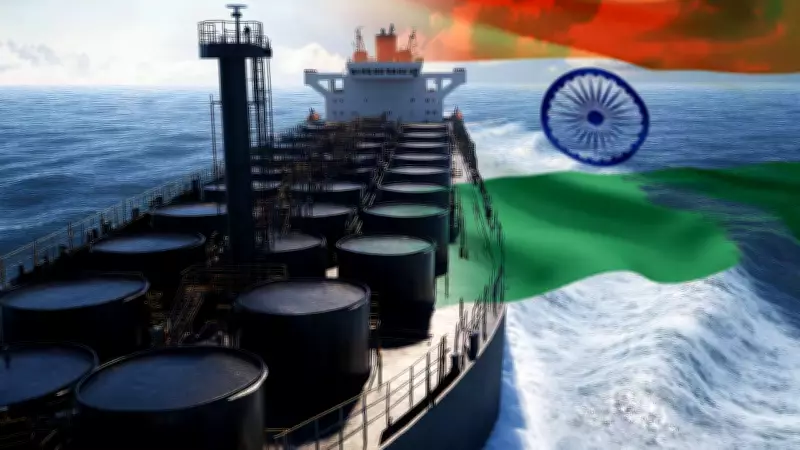
Indian Refiners Turn to Russian Crude as Middle East Oil Supply Halts
In a rapid response to a sudden oil supply shock from the Middle East, Indian refiners have initiated purchases of readily available Russian crude oil. This move comes as ships and tankers have ceased movement through the Strait of Hormuz in the Persian Gulf due to fears of attacks, effectively halting the supply of Middle East oil to India.
Immediate Risk Mitigation Through Russian Imports
Approximately 40-50% of India's crude oil imports traditionally flow through the Strait of Hormuz. With this route now disrupted, the acquisition of Russian crude is seen as a critical step to mitigate immediate risks of supply shortages. According to a Bloomberg report, Indian refiners have acted swiftly to secure supplies, with several million barrels of Russian crude already positioned in Asian waters, offering a quick alternative to offset the disruption in Middle Eastern oil flows.
This shift has been facilitated by a recent announcement from US Treasury Secretary Scott Bessentt, who granted a 30-day waiver on US conditions for India to halt purchases of Russian crude. While India has never officially committed to stopping such imports, volumes had declined earlier this year under US pressure. However, the current Middle East crisis has prompted a reassessment, leading to this temporary relaxation.

Surge in Purchases and Shipping Data
Sources familiar with the transactions revealed to Bloomberg that more than 10 million barrels of Russian crude have been purchased since the onset of the Middle East crisis last weekend. Notably, a significant portion of these deals may have been finalized even before the US administration announced the one-month waiver.
Shipping data compiled by Bloomberg indicates that around 15 million barrels of Russian oil are currently held on tankers in the Arabian Sea and the Bay of Bengal. Additionally, vessels carrying approximately 7 million barrels are anchored near Singapore. These cargoes could reach Indian ports in less than a week, with further shipments moving eastward through the Mediterranean Sea and the Suez Canal toward the Indian subcontinent.
Refiners Re-enter the Market and Price Dynamics
State-run refiners such as Mangalore Refinery and Petrochemicals Ltd. and Hindustan Petroleum Corp Ltd., which had abstained from buying Russian crude since December, have now re-entered the market. Reliance Industries Ltd., India's largest private-sector refiner, is also seeking to procure Russian crude for its domestic fuel production refinery, while its export-oriented facility will continue using crude from other sources.
Even prior to the waiver announcement, multiple tankers carrying Russian crude began altering their declared destinations toward Indian ports. Data from Kpler shows at least 18 vessels loaded with the Urals grade now indicating India as their intended destination. Sumit Ritolia, an analyst at the data intelligence firm, stated, "Refiners could quickly ramp up purchases again, potentially pushing volumes back above 2 million barrels a day in the near term. The steep discounts previously seen on Russian crude could narrow significantly and may even shift toward premiums."
Market activity confirms this trend, with Indian refiners currently paying a premium of $2 to $4 per barrel above Dated Brent for deliveries of Russia's benchmark Urals crude. This marks a reversal from last month, when the same grade traded at a discount of $15 to $20 per barrel compared to Brent, as Indian buyers had scaled back purchases.
Potential Return to Peak Import Levels
With Indian refiners re-engaging in the market, imports of Russian crude could approach the peak level of over 2 million barrels per day recorded in mid-2024. Kpler data reveals that shipments had dropped to an average of 1.06 million barrels per day last month, the lowest since September 2022. This resurgence highlights India's strategic pivot to secure energy supplies amid geopolitical tensions, ensuring stability in its oil imports despite ongoing conflicts in the Middle East.






