

India-EU FTA: A Strategic Leap Beyond Trade to Boost Manufacturing, Says Piyush Goyal
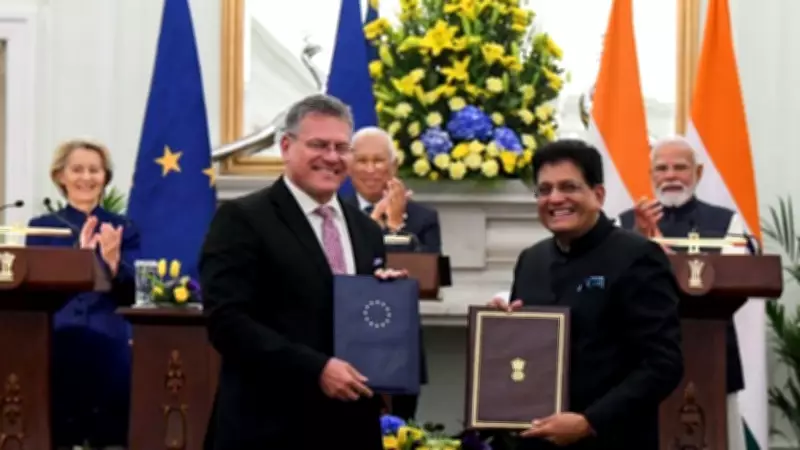
Union Commerce and Industry Minister Piyush Goyal has emphasized that the recently negotiated Free Trade Agreement (FTA) between India and the European Union extends far beyond conventional trade, positioning it as a catalyst for ramping up India's manufacturing sector through technological know-how and investments from European nations. This landmark deal, witnessed by Prime Minister Narendra Modi and EU leaders Ursula von der Leyen and Antonio Costa, marks a significant step in bilateral relations.
More Than Just Trade: A Comprehensive Partnership
In an exclusive interview, Goyal revealed that the agreement encompasses a strategic and defence partnership, financial integration, and potential mobility and investment protection agreements. He stated, "The fact is that this (the deal) is much more than just trade. It is a strategic and defence partnership... Then there is financial integration. Going forward, a mobility partnership, and they (the European Union) have said we would like to do an Investment Protection Agreement." This multifaceted approach underscores the EU's commitment to deepening ties with India.
Defence Opportunities and Industrial Growth
Goyal pointed to the EU's €800 billion 'ReArm Europe' initiative, aimed at strengthening defence readiness by 2030, as a major opportunity for India. With European nations increasing defence spending, India could benefit from outsourcing parts of this budget, leveraging its manufacturing capabilities. He explained, "We have entered into a strategic defence partnership... 800 billion Euros is their budget for the next five years," indicating potential for Indian industry to scale up production and quality to meet these demands.

Addressing Carbon Tax and Decarbonisation Efforts
On the contentious Carbon Border Adjustment Mechanism (CBAM), which imposes taxes on goods with high carbon emissions, Goyal assured that India's carbon taxes will be recognized in the EU, allowing for offsets. He noted that many Indian steel mills are becoming more efficient, reducing their carbon footprint and minimizing tax liabilities. Additionally, he highlighted a joint €500 million fund announced by the EU to support India's decarbonisation efforts, calling it just the beginning of collaborative environmental initiatives.
Automotive Sector and Market Access
Goyal clarified that the FTA's impact on India's automotive sector is minimal for small cars, which constitute about 90% of the market. He said, "The cars (market) that we have opened and given a quota in a graded (manner) are in the luxury bracket," ensuring that mainstream consumers are not adversely affected while creating opportunities in premium segments.
Empowering Industry and MSMEs
To capitalize on the FTA's opportunities, Goyal urged Indian industry to create capacities and enhance production quality. The government is actively engaging with industry associations, including regional chambers in cities like Mumbai, Chennai, Rajkot, and Kolkata, to educate businesses, particularly MSMEs, on tariff reductions and sector-specific benefits. He emphasized, "It (industry) has to ramp up production and ramp up quality," to fully leverage the deal.
Government Procurement and Reciprocity
Despite government procurement being excluded from the EU deal—unlike in agreements with the UK and UAE—Goyal defended this decision based on the principle of reciprocity. He recounted, "I told the EU that, look, you want government procurement, you get me a commitment from all the 27 states that they'll allow government procurement. They said, oh! That's the competence of the European member states. I said, why do I give you my government procurement... Reciprocity is a principle of this government." This stance reflects India's negotiating strength and strategic foresight in trade deals.

A Win-Win for India and the EU
The India-EU FTA is viewed as a mutually beneficial agreement, offering India a chance to scale up manufacturing and emerge as an alternative supplier to China for the 27-member European bloc. Goyal highlighted that India has signed eight FTAs with 37 developed countries, emphasizing that these agreements are forward-looking and based on a position of strength. He concluded, "Because (an) FTA is about the future, not about the past. and we have only done deals with developed countries." This deal not only boosts trade but also fosters long-term industrial and strategic growth, positioning India as a key global player.





