

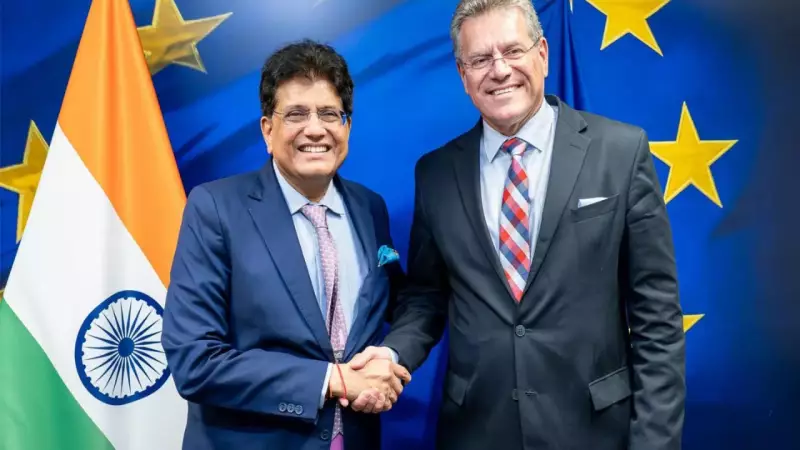
India and EU Close to Finalizing Major Free Trade Agreement
India and the European Union are now in the final stages of negotiating a long-awaited free trade agreement. This deal has been pending for many years. Both sides are working hard to complete the discussions soon.
The agreement promises to significantly boost India's exports to the 27-nation European bloc. It will also deepen economic ties between India and Europe. This comes at a crucial time when global trade faces many disruptions.
Why This Trade Deal Matters So Much
If signed, the India-EU FTA will become India's 19th trade agreement. It stands out as one of the most important deals for India. The European Union currently holds the position as India's largest trading partner for goods.

The agreement offers Indian exporters a valuable chance to diversify their markets. High US tariffs and ongoing geopolitical tensions are reshaping global supply chains. This deal provides a strategic alternative for Indian businesses.
Recent steep US tariffs, some reaching as high as 50%, have disrupted global trade flows. For India, the FTA with Europe presents a clear opportunity to reduce dependence on China. It allows expansion of exports to European markets. The deal can also cushion the impact of protectionist policies seen in other regions.
How Free Trade Agreements Work
Under FTAs, tariffs or import duties are either reduced or eliminated completely. This allows easier market access and better regulatory alignment between trading partners.
The India-EU deal is expected to benefit multiple key sectors. Technology, pharmaceuticals, automobiles, textiles, steel, petroleum products and electrical machinery will likely see advantages.
Labor-intensive sectors deserve special mention. Garments, leather and pharmaceuticals could see improved competitiveness in the EU market. Indian services exports should also grow. Telecommunications, transport, and business services are particularly poised for expansion.
What Europe Gains From This Deal
According to think tank GTRI, the European Union stands to gain substantially from this agreement. Higher exports of aircraft and parts, electrical machinery, diamonds and chemicals to India are anticipated.
European services will likely see expanded access to the Indian market. Intellectual property, IT, telecommunications and business services represent key areas of opportunity for EU companies.
Current Trade Relationship in Numbers
India's bilateral trade in goods with the EU reached USD 136.53 billion in 2024–25. This comprised USD 75.85 billion in exports and USD 60.68 billion in imports. These figures confirm the EU's position as India's largest goods trading partner.
The European Union accounts for around 17% of India's total exports. Meanwhile, India represents about 9% of the bloc's overseas shipments.
In 2023–24, India exported USD 76 billion in goods and USD 30 billion in services to the EU. EU exports to India included USD 61.5 billion in goods and USD 23 billion in services during the same period.
Several European nations stand out as top destinations for Indian exports. Spain, Germany, Belgium, Poland and the Netherlands lead this list.
Economic Profiles of Both Partners
The European Union boasts a GDP of about USD 19.5 trillion. Its population exceeds 450 million people. This makes the EU a major global trade player with substantial economic weight.
India, meanwhile, exported USD 437 billion in goods and USD 387.5 billion in services in 2024–25. During the same period, India imported goods worth USD 720 billion and services worth USD 195 billion.
Key Exports and Import Challenges
India's major exports to the EU include several important categories. Petroleum products, electronics (including smartphones), textiles, machinery, organic chemicals, iron and steel, gems and jewellery, pharmaceuticals and auto parts all feature prominently.
However, Indian textile exports currently face significant tariff barriers in the EU. Rates of 12–16% make these products less competitive. Countries like Bangladesh and Vietnam enjoy preferential access under existing EU trade agreements, putting Indian textiles at a disadvantage.

India's main imports from the EU cover diverse sectors. Machinery, aircraft and parts, electronics, medical devices, scientific instruments, rough diamonds, chemicals, plastics, cars and auto components all come from Europe.
In services trade, India exports business, IT, telecom and transport services to Europe. From the EU, India imports intellectual property and IT-related services.
Alcohol Trade and Investment Flows
Alcohol represents another significant component of bilateral trade between India and Europe. In 2023–24, India exported wines worth USD 1.5 million and spirits worth USD 64.9 million to the EU.
During the same period, India imported wines worth USD 412.4 million and spirits worth USD 22.3 million from European nations.
On the investment front, cumulative FDI inflows from the EU into India tell an important story. Between April 2000 and September 2024, these stood at USD 117.4 billion. This accounts for 16.6% of India's total FDI equity inflows.
Around 6,000 EU companies currently operate in India, demonstrating substantial European business presence.
India's outward FDI to the EU reached about USD 40.04 billion between April 2000 and March 2024. Several European nations stand out as major investors in India. The Netherlands, Germany, France, Spain and Belgium lead this group.
A Long and Winding Negotiation Journey
India-EU FTA talks began way back in 2007. Multiple negotiation rounds continued until 2013. However, significant differences emerged on several key issues.
Tariffs on automobiles, wine and spirits created sticking points. Data security for Indian IT firms proved contentious. Intellectual property rights, labor standards and public procurement requirements also led to deadlock.
Efforts to revive talks between 2016 and 2020 made limited progress. Momentum finally returned after 2020. In June 2022, India and the EU formally re-launched negotiations.
The current talks cover three important agreements. A Free Trade Agreement forms the centerpiece. An Investment Protection Agreement and an Agreement on Geographical Indications complete the package.
After seventeen years of discussions, stops and starts, both sides now approach the finish line. The potential benefits for both economies make this concluding phase particularly significant.





