India-EU FTA: A Strategic Response to Global Shifts, Not Just a Trade Deal
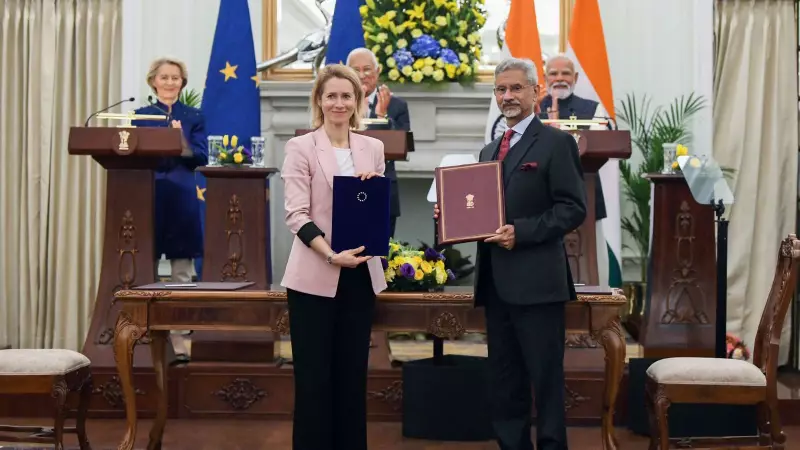
On a crisp January day in 2026, India and the European Union unveiled a landmark Free Trade Agreement (FTA), often dubbed "the mother of all trade deals." This comprehensive pact, culminating 19 years of negotiations since 2007, marks a pivotal moment in international relations. When talks began, the world was vastly different: the iPhone had just launched, India's telecom sector was booming, and global stability seemed assured. Few could have foreseen that nearly two decades later, amid a pandemic and rising geopolitical unpredictability, both sides would finalize this long-elusive agreement.
A Deeper Signal Beyond Trade
The "mother of all deals" metaphor signifies more than just commerce. It represents a strategic alliance between two democratic partners—the EU, which prioritizes standards as protection, and India, which has historically relied on tariffs. By setting aside longstanding differences, they have forged a partnership encompassing trade, investment, defence cooperation, and supply-chain resilience. This evolution underscores not only how India and the EU have changed but also how profoundly the global landscape has transformed.
A critical question arises: Would this deal have been signed if the world had remained as it was in 2007? The answer is almost certainly no. The India-EU FTA is less a triumph of patient diplomacy and more a rational response to a world that has become markedly more dangerous, unpredictable, and multipolar. Yet, its realization is what truly matters, offering significant economic and strategic benefits.

Economic Implications and Competitive Gains
Tariff reductions under this agreement are poised to boost India's economy by fostering competition, improving efficiency, and expanding markets. For instance, India has agreed to slash tariffs on EU-imported cars from peaks as high as 110 percent to 40 percent, with a pathway to eventually reach 10 percent. This move is expected to generate pro-competitive spillovers, benefiting consumers and industries alike.
Similarly, wines and spirits will receive treatment akin to that under FTAs with Australia and New Zealand, while Indian spirits and services gain enhanced access to the EU market. Both sides stand to gain: European buyers secure reliable, cost-competitive supplies, and India gains incentives to upgrade quality standards, not just for exports but for domestic consumers as well.
Addressing Sensitive Sectors and Standards
Sensitive areas in agriculture have been excluded from the FTA, reflecting careful negotiation. In 2024, India exported $4.2 billion worth of food and beverages to the EU, ranking 30th among suppliers—behind nations like Vietnam and Thailand. The primary constraint here is not tariffs but stringent EU standards, including sanitary measures, traceability requirements, and sustainability norms. This agreement should be viewed as an opportunity for India to build capacity and enhance compliance regimes, rather than a mere concession.
Moreover, the FTA will help restore competitiveness in sectors like textiles, garments, gems, and jewellery, which suffered after the withdrawal of EU tariff concessions under the Generalised System of Preferences (GSP). These industries were further impacted by a 50 percent US tariff imposed in response to India's purchase of Russian oil, highlighting the interconnected nature of global trade dynamics.
Strategic Trilemma and Geopolitical Context
India today faces a strategic trilemma: it cannot simultaneously pursue deep economic partnership with the United States, maintain extensive defence and energy ties with Russia, and preserve full strategic autonomy. By signing the EU deal, India signals the constraints it is willing to accept. US tariffs have forced a choice, and the EU FTA provides India with time to gradually reduce dependence on Russia.
For the EU, grappling with economic stagnation, an ageing population, and over-reliance on China, India represents a credible hedge. With 1.4 billion people, a young workforce, and status as the fastest-growing major economy, India offers a strategic alternative. Bilateral trade between India and the EU exceeded $190 billion in 2024–25, with India exporting $76 billion in goods and $30 billion in services, underscoring the partnership's significance.

Modernizing Regulatory Frameworks and Future Prospects
This agreement sends a clear message to Indian industry: the era of protectionism is ending irreversibly. Modern trade deals focus less on tariffs and more on regulatory frameworks, product standards, intellectual property, and investment protection. The EU FTA offers India a chance to modernize its domestic regulatory architecture, aligning with EU benchmarks in food safety, industrial standards, and environmental compliance.
Such upgrades will yield positive externalities, benefiting domestic consumers with higher-quality products and enhancing Indian exporters' credibility in premium markets. Strategically, alignment with EU standards positions India favourably for potential accession to the Comprehensive and Progressive Agreement for Trans-Pacific Partnership (CPTPP), a mega-regional bloc excluding both the US and China. CPTPP membership could integrate India into supply chains accounting for 13.5 percent of global GDP, reducing overdependence on any single great power.
In essence, the EU deal is not an endpoint but a form of institutional preparation. It strengthens regulatory capacity and maintains reform momentum, paving the way for India's next strategic moves within a plurilateral economic architecture. As global dynamics continue to shift, this FTA stands as a testament to adaptive diplomacy and forward-thinking economic policy.