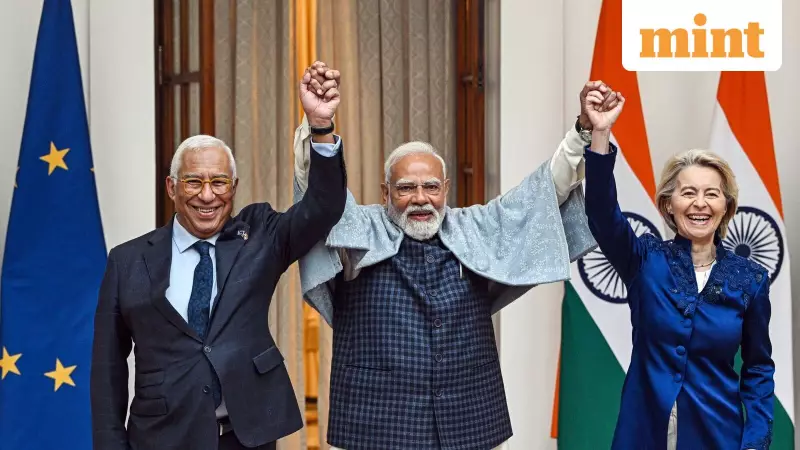
India-EU Free Trade Agreement: Navigating the Path to Implementation
The European Union's recent trade agreement with Mercosur has encountered unexpected legal scrutiny, raising questions about the fate of another major trade pact: the India-EU Free Trade Agreement (FTA). As both deals represent significant milestones in global trade, understanding their similarities and differences becomes crucial for predicting the India-EU FTA's trajectory.
The Mercosur Deal's Unexpected Hurdle
On January 17, 2026, the European Union signed an interim trade agreement with Mercosur, a South American trade bloc comprising Argentina, Brazil, Paraguay, Uruguay, and Bolivia. This landmark deal, resulting from 25 years of negotiations, eliminates tariffs on 90% of bilateral trade between the regions, creating a market of 750 million people representing 20% of global GDP.
However, the European Parliament swiftly referred the agreement to the Court of Justice of the European Union for legal review, seeking to determine its compatibility with EU policies. This unexpected move has cast uncertainty over the deal's implementation timeline and overall viability.

Expert Perspectives on Mercosur's Future
Experts remain divided about the Mercosur agreement's prospects. Some predict the legal process could extend for at least two years, potentially delaying implementation by three years or more. Others suggest the European Commission might pursue provisional implementation, bypassing parliamentary approval, though this approach faces significant challenges given the deal's opposition from several EU member states.
France, Poland, Austria, Ireland, and Hungary have already voted against the agreement in the European Council, reflecting deep-seated concerns about agricultural imports and other sensitive issues. Some analysts even argue the deal may be permanently derailed by these political and legal obstacles.
Comparing the India-EU FTA with Mercosur
Like the Mercosur agreement, the India-EU FTA represents the culmination of approximately two decades of negotiations. Both agreements establish substantial free trade areas, but the India-EU pact operates on a significantly larger scale.
The India-EU FTA encompasses 2 billion people and creates a $27 trillion market, accounting for 25% of global GDP. In terms of tariff concessions, India has offered to reduce tariffs on 97.5% of imports from the EU, while the EU will eliminate duties on 99.5% of Indian exports, creating substantial opportunities for both economies.
Key Advantages for India-EU FTA
The India-EU FTA appears better positioned to avoid the Mercosur deal's challenges for several reasons:
- Avoidance of sensitive sectors: Unlike the Mercosur agreement, which faced opposition due to concerns about low-cost agricultural products, the India-EU FTA has largely excluded agriculture and dairy sectors from negotiations
- Clear tariff framework: The agreement provides absolute clarity on tariff reductions, minimizing one potential source of controversy
- Strategic importance: The sheer scale of the India-EU economic relationship creates stronger incentives for successful implementation
Potential Challenges Remain
Despite these advantages, experts have identified several areas requiring careful navigation:
- Intellectual property rights: Ambiguities in IP protections could create implementation challenges
- Sustainability and environmental standards: Differing approaches to environmental regulations may require careful alignment
- Labor law conventions: Variations in labor standards between India and EU member states could become points of contention
If not addressed effectively, these issues could potentially disrupt the agreement's smooth operation, though they appear less immediately contentious than the agricultural concerns that plagued the Mercosur deal.
The Road Ahead for India-EU FTA
Following the successful completion of negotiations on January 21, 2026, the India-EU FTA now enters a critical implementation phase. The agreement will undergo several procedural steps before becoming operational:

- Legal vetting: The EU will conduct thorough legal review of the agreement text
- Translation process: The document must be translated into all 24 official EU languages
- Member state review: All 27 EU member states will receive the translated agreement for consideration
- Formal signing: The FTA is expected to be formally signed by the end of 2026
- Ratification process: The European Parliament must ratify the agreement, while India's cabinet will provide approval
If this process proceeds smoothly, the India-EU Free Trade Agreement could come into force by early 2027, creating one of the world's largest and most economically significant trade partnerships. The agreement's careful avoidance of the most contentious issues that affected the Mercosur deal, combined with its substantial economic benefits for both parties, suggests it may successfully navigate the complex approval process that has challenged other major trade agreements.