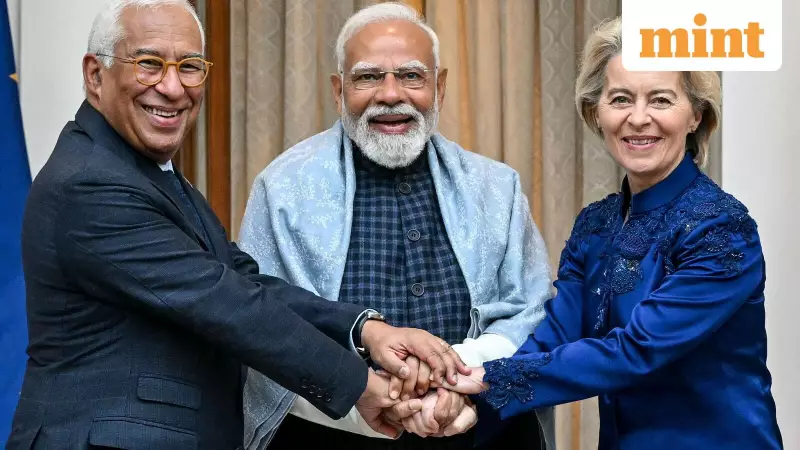
India and European Union Finalize Landmark Free Trade Agreement
After nearly two decades of intensive negotiations, India and the European Union have successfully concluded a sweeping free trade agreement that both sides are hailing as the "mother of all deals." This strategic pact arrives at a crucial moment when global trade patterns are becoming increasingly fragmented, making this agreement as much about geopolitical alignment as it is about economic benefits.
Market Access and Protected Sectors
The European Union represents a market of comparable significance to the United States for Indian exporters, and this agreement fundamentally reshapes access between these two major economies. At its heart, the deal opens vast markets while carefully safeguarding politically sensitive sectors on both sides.
India has secured protection for its sensitive agricultural products including dairy, cereals, and poultry, while the European Union maintains safeguards for beef, sugar, and rice imports. This balanced approach ensures that domestic agricultural interests remain shielded while enabling broader market integration.

Transformative Export Opportunities
Beyond the agricultural safeguards, the agreement delivers dramatic market openings. Over 99% of Indian exports by value will receive preferential or duty-free access to European markets, providing substantial boosts to labor-intensive sectors that form the backbone of India's export economy.
Key beneficiary industries include:
- Textiles and apparel
- Leather goods and footwear
- Gems and jewelry
- Marine and fisheries products
- Engineering goods and machinery
In reciprocal fashion, India will gradually reduce import duties on the majority of European goods, spanning from industrial machinery and automobiles to premium products like wines and olive oil.
Beyond Goods: Services and Strategic Cooperation
The agreement extends well beyond traditional merchandise trade, incorporating provisions that facilitate the movement of professionals and students between India and EU member states. The pact promises deeper access to services markets while strategically keeping the European Union's contentious carbon border adjustment mechanism outside its immediate legal scope, though it establishes pathways for future environmental cooperation.
Sector-Specific Implications
The automotive sector will witness strategic shifts as European manufacturers like Volkswagen and BMW gain flexibility to import newer models for testing Indian market demand without immediate commitments to local manufacturing.
Indian pharmaceutical companies stand to benefit from significant tariff reductions on medicine exports to Europe, while imports of optical, medical, and surgical equipment from Europe to India will become more affordable.
Food and beverage consumers in India will enjoy access to more competitively priced high-quality ingredients including olive oil, gourmet cheeses, and cocoa derivatives, though domestic winemakers are expected to remain largely unaffected by reduced duties on European wines.
Strategic Partnership Between Major Democracies
As Prime Minister Narendra Modi and European Commission President Ursula von der Leyen have emphasized, this agreement represents a strategic alignment between two of the world's largest democracies. The timing reflects mutual recognition of shifting global dynamics and a shared commitment to strengthening economic ties amid increasing trade fragmentation worldwide.
The comprehensive nature of this agreement—encompassing goods, services, investment, and intellectual property—establishes a new framework for India-EU economic relations that will shape bilateral trade patterns for decades to come.