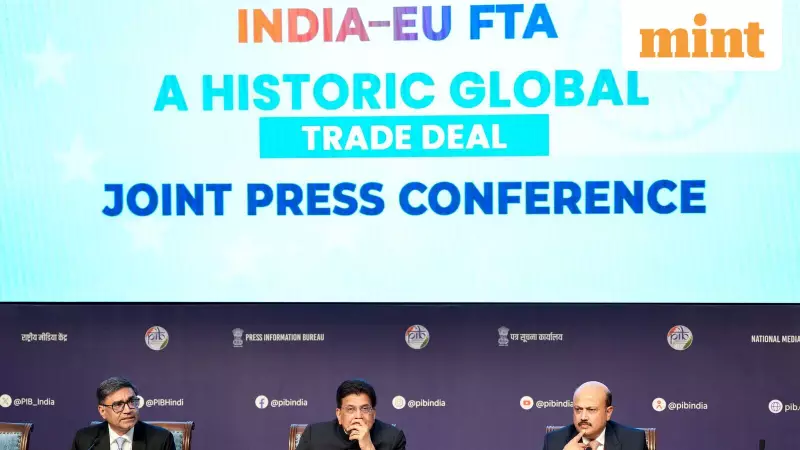
India-EU Trade Agreement: A Comprehensive Win-Win Economic Partnership
The recently concluded trade agreement between India and the European Union has been aptly described as the 'mother of all deals', marking a significant milestone in international economic relations. This landmark pact, negotiated over six months, reflects a mature approach that focuses on mutual complementarities while avoiding contentious red lines, setting the stage for transformative outcomes across multiple sectors.
Creating a Massive Economic Powerhouse
The European Union stands as the world's second-largest economic bloc with a staggering $19.5 trillion GDP and a population of 450 million people. When combined with India's dynamic economy, this partnership creates a colossal market worth approximately $24 trillion encompassing nearly two billion consumers. Indian businesses now gain preferential access to a market that is five times larger than India's own GDP, while European enterprises can tap into the world's fastest-growing major economy.
Tariff Liberalization and Market Access Benefits
Once implemented, the agreement will provide immediate benefits for 99% of India's exports to the EU through reduced or eliminated tariffs, impacting approximately $33 billion worth of outward shipments from day one. Currently, the EU serves as India's second-largest export destination with bilateral trade exceeding $136 billion, yet India's share in EU imports remains modest at just 2.6% compared to China's dominant 22%.

The agreement presents substantial growth opportunities across multiple sectors:
- Apparel and textiles: With EU imports worth $141 billion annually, India currently holds only 3% market share compared to Bangladesh's 16.3%
- Leather and footwear: A $40 billion market with 17% import duties being eliminated
- Gems and jewellery: $51 billion market with 4% import levies
- Marine products: $29.5 billion market with 26% duties
- Organic chemicals: $112 billion market with 12.8% tariffs
Beyond Tariffs: Comprehensive Economic Integration
The agreement extends far beyond simple tariff reductions, addressing critical non-tariff barriers through:
- Streamlined customs procedures
- Enhanced regulatory cooperation
- Measures to overcome sanitary and phytosanitary barriers
- Technical trade barrier resolutions
In a reciprocal arrangement, India will eliminate or reduce tariffs on 96.6% of EU merchandise exports by value, with carefully calibrated provisions for sensitive sectors. The automotive industry will see gradual tariff reductions over multiple years with protective quantitative quotas, while electric vehicles have been strategically excluded from immediate liberalization.
Services Sector Expansion and Professional Mobility
The services trade between India and the EU currently stands at $67 billion, with Indian exports accounting for $38 billion. The agreement secures expanded and predictable market access across crucial sectors including:
- Information Technology and IT-enabled services
- Professional services
- Financial services
- Education and tourism
This enhanced market access is complemented by a mobility agreement facilitating short-term business travel and intra-corporate transfers in both directions, addressing a long-standing need for professional movement.
Innovation and Technology Collaboration
Both India and the EU share strategic interests in achieving sovereignty in emerging technologies, particularly in artificial intelligence, biotechnology, and clean energy. The agreement facilitates:
- India's association with Europe's prestigious 'Horizon Europe' research and innovation program
- Establishment of India-EU startup hubs to bridge technology gaps
- Enhanced opportunities for Indian students, scientists, and researchers
- Knowledge sharing and collaborative innovation ecosystems
Addressing Key Concerns and Future Prospects
The agreement thoughtfully addresses several critical areas of concern:

Regarding the Carbon Border Adjustment Mechanism (CBAM), the EU has committed to providing India with 'most favoured nation' status and establishing a mechanism to recognize Indian carbon credits. Additionally, the pact establishes a framework for bilateral social security agreements with EU member states over five years, relieving Indian professionals from dual social security payments.
While the EU has made no explicit investment commitments, the agreement is expected to significantly boost investment flows into India. European businesses are likely to increase their outsourcing to India as they diversify supply chains, simultaneously promoting 'Make in India' initiatives globally while enhancing quality standards in Indian manufacturing.
Strategic Significance and Implementation Timeline
This comprehensive agreement represents a powerful statement of openness in an era increasingly marked by protectionist tendencies. By combining the India-EU pact with existing agreements with the European Free Trade Association and the United Kingdom, Indian businesses now enjoy preferential access to all of Europe, creating a combined market representing over 33% of global GDP.
The agreement is expected to undergo ratification by the European Parliament following legal vetting by both parties and approval from the European Commission, with implementation anticipated within approximately one year. This strategic partnership not only creates immediate economic opportunities but lays the groundwork for a deeper, more comprehensive relationship that will shape global economic dynamics for years to come.