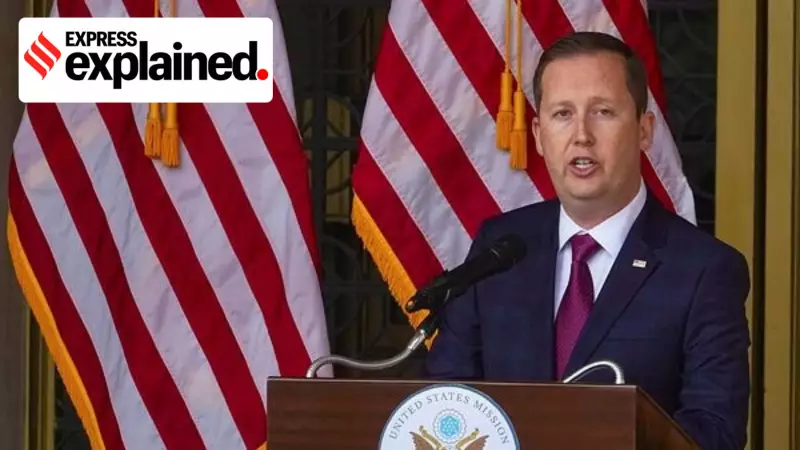
In a significant diplomatic and strategic move, the United States has formally invited India to join its flagship Pax Silica initiative, just a month after notably leaving New Delhi out of the grouping. The invitation, extended by newly appointed US Ambassador Sergio Gor on January 12, 2026, marks a softening of recent tensions and underscores India's growing importance in global technology and supply chain security.
What is the Pax Silica Initiative?
Launched by the US State Department on December 12, Pax Silica is a strategic framework focused on securing the foundational supply chains for artificial intelligence (AI) and advanced technologies. Its core objective is to unite "friendly and trusted" nations to ensure that critical technologies—from semiconductors and AI infrastructure to the underlying critical minerals and logistics—remain safe, reliable, and free from hostile control.
The initiative is widely viewed as a Western countermeasure to China's dominant grip on global manufacturing supply chains. It aims to reduce what the US terms "coercive dependencies" and build a secure, innovation-driven silicon supply chain. Measures under the pact include pursuing joint ventures, strategic co-investments, and protecting sensitive technologies from undue access by countries of concern.

A Month of Diplomatic Recalibration
India's initial omission from Pax Silica in December 2025 raised eyebrows, as the founding members included allies like Japan, South Korea, Singapore, the UK, Australia, Israel, the UAE, and the Netherlands. This exclusion fueled speculation that stalled negotiations on a bilateral trade deal were creating broader strategic friction.
The landscape shifted with Ambassador Gor's announcement at the US Embassy in New Delhi. "Today, I’m pleased to announce that India will be invited to join this group of nations as a full member next month," Gor stated. He also provided an update on the crucial trade talks, revealing that the next high-level call on trade is scheduled for January 13, 2026.
Why Pax Silica Matters for India's Tech Ambitions
India's inclusion in Pax Silica is a major strategic win with tangible economic benefits. As global companies diversify supply chains away from China through "China-plus-one" strategies, India has positioned itself as a prime destination. However, the country currently lacks global-scale AI infrastructure and remains import-dependent in several tech-heavy sectors.
Membership in Pax Silica opens doors to:
- Investment & Partnerships: Access to joint ventures and co-investment opportunities with top-tier tech nations.
- Supply Chain Integration: Collaboration across the entire value chain, from critical minerals to advanced chip manufacturing and AI logistics.
- Technology Safeguards: Cooperation on building trusted technology ecosystems, including securing data centres, fibre-optic cables, and ICT systems.
This move aligns with a surge of US tech investment in India. In December 2025 alone, Microsoft announced a $17.5 billion plan to expand its AI and cloud infrastructure in India over four years. Similarly, Google committed over $15 billion to establish an AI data centre in Andhra Pradesh in partnership with the Adani Group and Airtel.
Broader Implications for Indo-US Relations
The invitation signals a recalibration and warming of ties between Washington and New Delhi, moving past the uncertainty that clouded the trade deal. It reaffirms the comprehensive strategic partnership, extending cooperation beyond trade into critical domains like security, counterterrorism, energy, and health.
For the US, bringing a democratic tech powerhouse like India into its trusted circle strengthens the Pax Silica bloc's credibility and scale. For India, it is a decisive step towards securing its place in the realigned global tech order, reducing vulnerabilities, and harnessing transformative AI growth for long-term prosperity and security.