

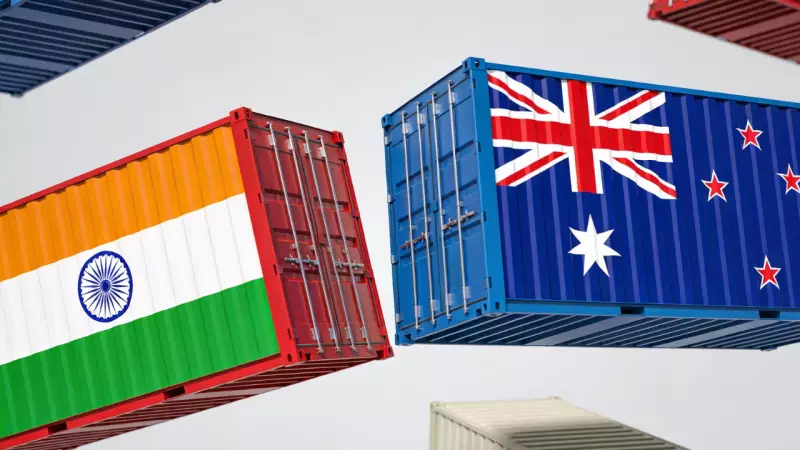
In a significant push to bolster economic ties, a leading think tank has proposed that India and New Zealand set an ambitious target to double their bilateral trade within the next five years. The recommendation comes as the two nations re-engage in negotiations for a comprehensive free-trade agreement (FTA).
Roadmap to a $2.6 Billion Trade Partnership
The Global Trade Research Initiative (GTRI) laid out its recommendations on Sunday, emphasizing the need for strategic cooperation. Bilateral trade between India and New Zealand currently stands at $1.3 billion for the financial year 2025. According to GTRI Founder Ajay Srivastava, achieving a doubling of this figure is feasible through early tariff relief on select products, organized business delegations, and focused sectoral cooperation.
"Both countries could set a target to double two-way trade within five years through early tariff relief on select products, business delegations and sectoral cooperation in agriculture, forestry, fintech and education," Srivastava stated. The renewed FTA talks, which stalled back in 2015, are expected to focus heavily on reducing tariffs on goods and improving access for services.

Navigating Export Strengths and Sensitive Sectors
The trade landscape between the two countries is complementary yet involves protected areas. India's exports to New Zealand are notably diverse. Aviation turbine fuel leads the pack with exports worth $110.8 million, followed by textiles and pharmaceuticals. Other significant export categories include machinery, petroleum products, automobiles, and food items like basmati rice and shrimps.
On the other hand, New Zealand's exports to India are dominated by raw materials and agricultural products, such as wood and metal scraps. However, the dairy sector remains a highly sensitive issue for India, which is firm on protecting its millions of small dairy farmers. Consequently, dairy trade is minimal, with New Zealand's exports to India amounting to just $1.07 million in FY25.
The disparity in average import tariffs is also a key point of discussion. New Zealand's average import tariff is a low 2.3%, compared to India's 17.8%. The prospective deal is anticipated to eliminate or significantly cut duties on many industrial products, textiles, engineering goods, and some agricultural items, while sensitive farm products will likely remain shielded.
Services Trade and Strategic Benefits
Services constitute a vital component of the economic equation. India's services exports to New Zealand were valued at $214.1 million in FY24, primarily in IT, software, and healthcare. Conversely, New Zealand's services exports to India reached $456.5 million, largely driven by education, tourism, and specialized aviation training.
The think tank also advocated for non-trade measures to boost connectivity and people-to-people contact, including more direct flights and easier visa rules. The potential benefits of a strengthened partnership are substantial. For India, it represents a strategic gateway into the high-income markets of the Pacific region. For New Zealand, it offers crucial access to one of the world's fastest-growing economies amid an uncertain global trading environment.
As officials from both sides prepare to finalize the agreement, the focus will be on crafting a balanced deal that unlocks new trade and investment flows while safeguarding domestic priorities.






