

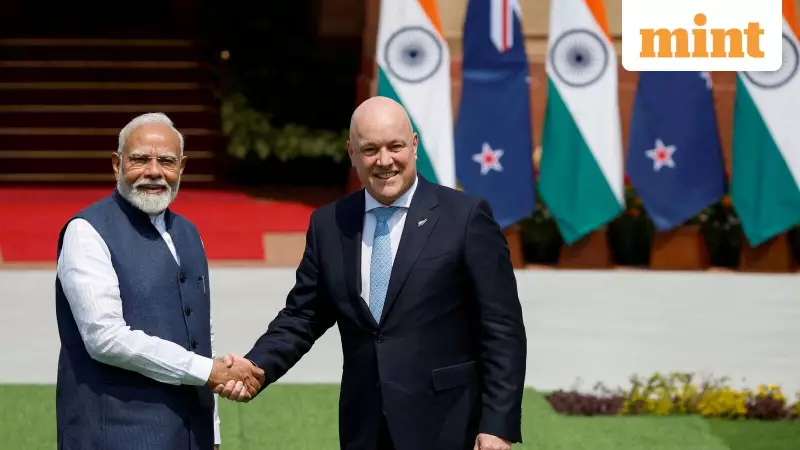
In a significant diplomatic and economic breakthrough, India and New Zealand have successfully concluded negotiations for a comprehensive Free Trade Agreement (FTA). The pact, announced jointly by Prime Minister Narendra Modi and his New Zealand counterpart Christopher Luxon, is set to be formally signed at a later date, following a process similar to the recent UK-India agreement.
A Swift and Strategic Negotiation
The journey to this agreement was notably rapid. Formal negotiations were launched on 16 March 2025 during a meeting between India's Minister of Commerce and Industry, Piyush Goyal, and New Zealand's Minister for Trade and Investment, Todd McClay. The deal was wrapped up after just five intensive rounds of negotiations, supplemented by several in-person and virtual sessions, making it one of India's fastest-concluded FTAs.
Officials from both nations have described the agreement as wide-ranging. It encompasses key areas such as trade in goods and services, investment, rules of origin, customs procedures, and measures to address technical barriers and sanitary standards. The core objective is to establish predictable market access and clear regulatory frameworks for businesses, tackling long-standing trade concerns on both sides.

Boosting Trade and Correcting Imbalances
The FTA arrives at a crucial time for bilateral economic relations. While trade has been growing, the volume remains modest. India's merchandise trade with New Zealand reached $1.3 billion in the 2024-25 financial year, marking a robust 49% increase from the previous year, albeit from a low base. Currently, India primarily exports pharmaceuticals, textiles, and engineering goods to New Zealand, while imports are dominated by agricultural products like wool, fruits, and dairy items.
The new agreement is strategically designed to correct this trade imbalance. A major win for India is the elimination of tariffs on 100% of New Zealand's tariff lines, granting duty-free access for all Indian exports. This provision is expected to significantly enhance the competitiveness of India's labour-intensive sectors, including textiles, leather, footwear, gems and jewellery, handicrafts, and engineering goods. This move is poised to benefit millions of Indian artisans, women entrepreneurs, youth, and MSMEs by integrating them deeper into global supply chains.
Commerce Minister Piyush Goyal emphasised the people-centric nature of the deal, stating it aims to build trade around opportunities for farmers, entrepreneurs, students, and innovators. He highlighted its potential to boost agricultural productivity and farmer incomes while opening regional doors for Indian businesses.
A Gateway to the Indo-Pacific and Services Growth
Beyond immediate trade gains, the FTA is a cornerstone of India's broader strategy to expand its economic footprint in the Indo-Pacific region and diversify export markets amidst global uncertainties. For New Zealand, a major agricultural exporter, the pact serves as a vital gateway to India's vast and rapidly growing consumer market.
The agreement also delivers substantial gains for India's powerhouse services sector. India has secured strong commitments in high-value areas such as Information Technology (IT) and IT-enabled services, professional services, education, financial services, tourism, and construction. This opens up fresh avenues for Indian service providers and is expected to generate high-skill employment opportunities.
Commerce Secretary Rajesh Agrawal termed it a "new generation trade agreement" with complementarity at its heart. He noted that while India's strengths will expand exports and support labour-intensive growth, New Zealand gains predictable access to India's large economy. The facilitated movement of students, professionals, and skilled workers will further converge these strengths, he added.
The conclusion of this FTA marks a pivotal step in strengthening the economic partnership between India and New Zealand, setting the stage for enhanced bilateral trade, investment, and strategic cooperation in the Indo-Pacific.






