

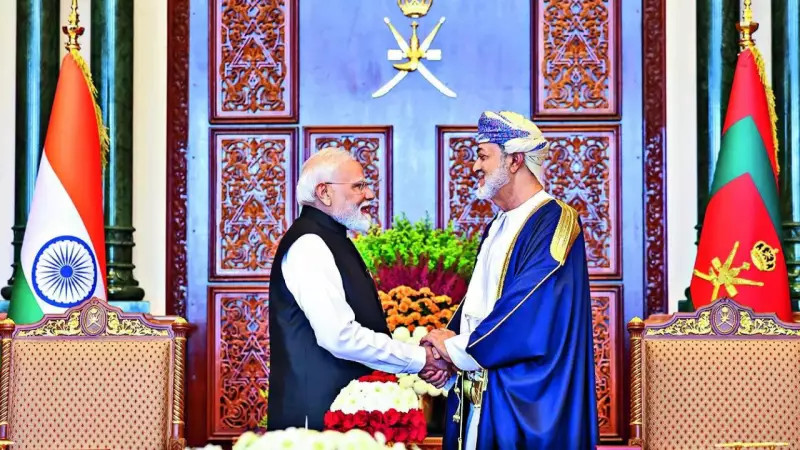
India has inked a significant trade pact with Oman, marking its sixth such agreement in five years. The India-Oman Comprehensive Economic Partnership Agreement (CEPA), signed on December 18, is set to bolster India's economic presence in a crucial Gulf region, though experts suggest its primary impact will be consolidating existing ties rather than dramatically boosting trade numbers.
Key Provisions of the India-Oman Trade Deal
Under the newly signed CEPA, Oman has granted zero-duty access on approximately 98% of its tariff lines. This covers nearly 99% of the value of Indian exports to the Sultanate. In the last financial year, India's exports to Oman stood at around $4.1 billion. Major export items include refined petroleum products like naphtha and petrol, alongside machinery, metals, aircraft, rice, and various consumer goods.
In return, India has offered tariff liberalisation on about 78% of its own tariff lines. This concession is carefully structured, largely through tariff-rate quotas, to shield sensitive domestic sectors from sudden surges in imports. India's imports from Oman were roughly $6.6 billion in FY25, dominated by crude oil, liquefied natural gas (LNG), and fertilisers, as well as key chemical inputs.

Beyond Goods: Services and Strategic Footprint
The agreement extends beyond merchandise trade, featuring substantial commitments in services. Oman has agreed to open sectors including information technology (IT), professional services, education, healthcare, and research to Indian companies. Notable provisions to ease the temporary entry of Indian professionals and streamline pharmaceutical approvals are expected to reduce regulatory hurdles and costs for Indian firms operating in Oman.
According to Ajay Srivastava, founder of the Global Trade Research Initiative (GTRI), the broader significance of the CEPA lies in India's substantial investment and strategic footprint in Oman. Indian companies have established more than 6,000 joint ventures in the country, with cumulative investments surpassing $7.5 billion. These investments are concentrated largely in the Sohar and Salalah free zones.
Analysis: Consolidation Over Breakthrough
While the duty elimination improves competitiveness, Srivastava notes that the scope for a massive expansion in trade volume is constrained by the size of the Omani market. "While more than 80% of Indian goods already enter Oman at an average tariff of around 5%, duties on some items go up to 100%. Their removal improves competitiveness, but the scope for large trade expansion remains limited by Oman’s market size," he stated.
He characterizes the pact as "less a trade breakthrough and more a consolidation of India’s economic position in a critical Gulf corridor." Given Oman's pivotal location at the entrance to the Gulf and its role as a logistics and energy hub, the CEPA strengthens India's long-term interests in areas like energy security, logistics, services exports, and regional connectivity, even if immediate trade gains are modest.
The pact is anticipated to come into force in the coming months, following the completion of necessary domestic procedures. It follows India's recent trade deals with Mauritius, the United Arab Emirates (UAE), Australia, the European Free Trade Association (EFTA) bloc, and the United Kingdom.






