

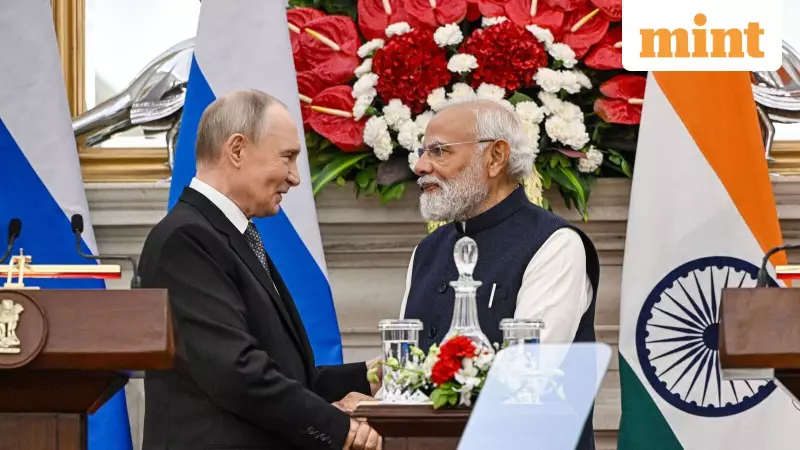
The strategic partnership between India and Russia entered a significant new phase as leaders from both nations committed to dramatically expanding their economic engagement beyond traditional sectors. The landmark 23rd India-Russia Annual Summit, held in New Delhi on December 4 and 5, marked Russian President Vladimir Putin's first official visit to India since the onset of the Russia-Ukraine conflict in February 2022.
Key Agreements Forge a Broader Partnership
During the two-day summit, the two countries inked several crucial agreements spanning trade, energy, and technology, which analysts believe will have a profound medium to long-term impact on the Indian economy. The centerpiece of the new ambition is a target to increase bilateral trade to $100 billion by the year 2030.
Sugandha Sachdeva, Founder of SS WealthStreet, highlighted the summit's outcomes, stating they "demonstrate a renewed push to widen the strategic, economic, and high-technology dimensions of the India–Russia partnership." She added this has the potential to reshape supply chains, deepen defence cooperation, and significantly expand India’s export footprint over the coming decade.

Major Takeaways from the Summit
1. Trade and Economic Partnership: Prime Minister Narendra Modi and President Putin reaffirmed their commitment to expanding trade in a balanced way. They agreed to boost India’s exports to Russia, strengthen industrial cooperation, and forge new partnerships in advanced high-technology areas. A key document adopted was the Programme for the Development of Strategic Areas of India-Russia Economic Cooperation till 2030 (Programme 2030).
2. Energy Security Assured: President Putin assured India of "uninterrupted shipments" of fuel, solidifying energy cooperation as a pillar of the strategic relationship.
3. Defence Manufacturing Push: A critical agreement was reached to promote the joint manufacturing in India of spare parts and components for Russian-made defence equipment. This will be achieved through technology transfer and joint ventures under the Make-in-India programme, aiming to meet Indian Armed Forces' needs and enable exports to friendly third countries.
4. Nuclear and Fertiliser Collaboration: The sides discussed building a second nuclear power plant in India with Russian reactors. Separately, a Memorandum of Understanding (MoU) was signed between Indian fertiliser companies RCF, IPL, NFL and Russia's Uralchem to establish a greenfield urea plant with an estimated investment of $1.2 billion.
Can Russia Ties Mitigate US Tariff Pain?
The summit occurred against the backdrop of India facing punitive tariffs from the United States, including a 50% tariff burden on some imports, linked to New Delhi's purchase of Russian oil. Experts weighed in on whether the new Russian agreements can cushion this blow.
VK Vijayakumar, Chief Investment Strategist at Geojit Investments, noted the $100 billion trade target by 2030 appears optimistic. While welcoming the removal of non-tariff barriers, he pointed to practical hurdles like the lack of a robust rupee-rouble settlement system and Russian banks' exclusion from SWIFT. "Russia-India agreements are good, but they can’t compensate for trade issues with the US. A fair India-U.S. trade deal is a must," he concluded.
Manoranjan Sharma, Chief Economist at Infomerics Ratings, identified high-potential new cooperation areas like fertilisers, critical minerals, maritime logistics, and space technologies. He stated that progress on rupee-ruble settlements and a potential Free Trade Agreement with the Eurasian Economic Union (EAEU) could reduce dollar dependence and lower forex risks.
However, Sharma underscored limitations: "American markets remain central to several labour-intensive Indian sectors... Russian demand cannot substitute for all categories of Indian exports." Sanctions-related risks in shipping, insurance, and finance may also constrain the full potential of bilateral trade.

G Chokkalingam of Equinomics Research believes these bilateral pacts can only mitigate risks from the US trade war to a limited extent. He suggested that strengthening ties with Russia might pressure the US to reconsider its aggressive trade stance towards India.
The summit has unequivocally shown that the India-Russia relationship is evolving, building new pillars beyond its traditional foundations of energy and defence, with an eye on long-term strategic and economic dividends.





