

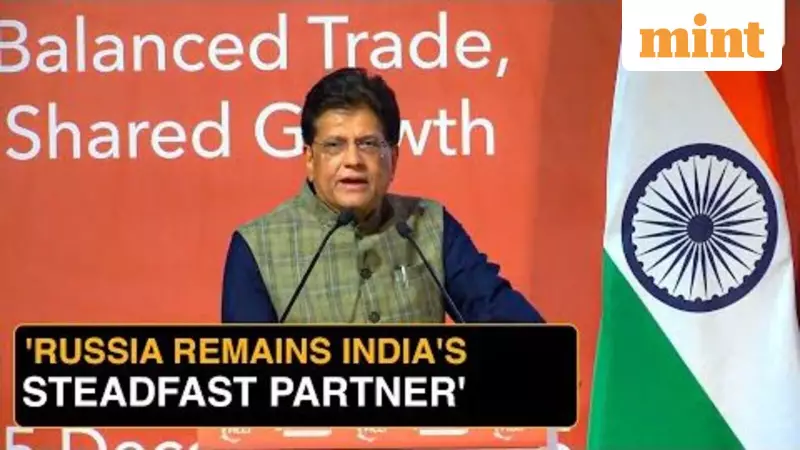
Commerce and Industry Minister Piyush Goyal has highlighted the robust but lopsided economic partnership between India and Russia, setting the stage for President Vladimir Putin's upcoming visit to Delhi. Speaking at a business forum, Goyal praised the "time-tested" bilateral ties but stressed an urgent need to rebalance a trade relationship that has soared past $65 billion yet remains heavily skewed.
Addressing the $65 Billion Trade Imbalance
The minister pointed out that while bilateral trade has exceeded $65 billion, the current structure is unsustainable. India is now pushing aggressively to correct this imbalance by flooding the Russian market with a diverse range of goods and services. The focus is on sectors where India holds a competitive edge.
India is ready to significantly increase exports of automobiles, electronics, pharmaceuticals, textiles, machinery, and food products. Additionally, services exports, particularly in Information Technology (IT) and pharmaceutical research, along with agricultural products, are key areas identified for growth.

Roadmap for a Diversified Partnership
Goyal outlined a clear strategy to achieve a more equitable trade relationship. The primary goals are to diversify the trade basket, reduce non-tariff barriers, and bolster payment mechanisms using national currencies. The push for increased use of rupee-rouble transactions is a critical step to streamline commerce and mitigate external dependencies.
This recalibration is not seen as a reduction in ties but as an evolution towards mutual and sustainable growth. The minister's statements reflect a confident India, leveraging its economic growth rate of over 8%, to build a partnership based on shared prosperity and long-term stability.
Shared Prosperity in Focus
The dialogue comes at a significant moment, just ahead of the high-level visit from Moscow. Both nations are eyeing a future where economic cooperation is broad-based and resilient. India's proposition moves beyond traditional exchanges, aiming to integrate its booming manufacturing and digital capabilities with Russia's needs.
The call for a balanced and diversified trade portfolio underscores a mature phase in the India-Russia relationship, where strategic ties are being reinforced with a stronger, more multifaceted economic foundation. The success of this effort could define the next decade of cooperation between the two nations.






