

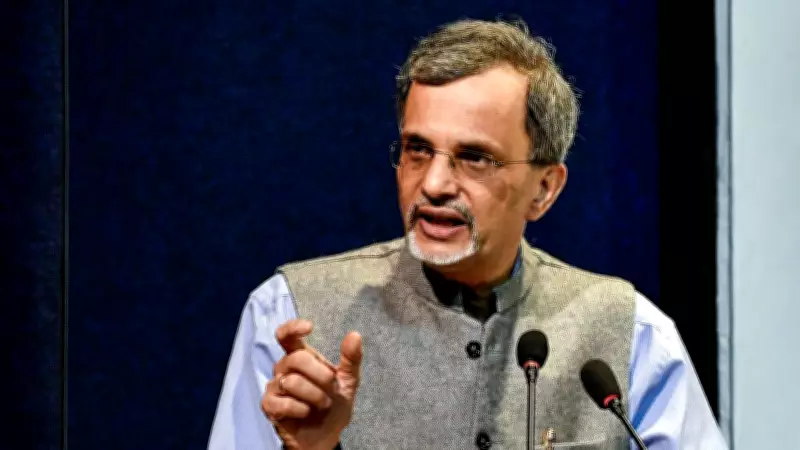
In a significant development for bilateral economic relations, Chief Economic Advisor V Anantha Nageswaran has stated that the reduction of United States tariffs on India to 18% by President Donald Trump eliminates "the biggest stumbling block" for foreign capital inflows into the country. This assessment comes as per a detailed report in the Indian Express, highlighting a potential turning point for India's investment landscape.
Removing Uncertainty for Investors
Nageswaran emphasized that this tariff adjustment fundamentally alters the outlook on capital flows. "This undoubtedly changes the picture on capital flows. This was the biggest stumbling block for capital flows. This makes a huge, huge difference," he told the publication. He further noted that the reduced tariff rate will "remove all uncertainty" from the minds of both direct and portfolio investors, creating a more predictable environment for international capital.
Reviving the China+1 Strategy
A crucial aspect highlighted by the Chief Economic Advisor is the revival of the "China+1" strategy. "In terms of foreign direct investment (FDI), the China plus one strategy was the one that was going to drive FDI inflows. Now, China+1 is back in the game," Nageswaran added. This strategic shift positions India more favorably as an alternative manufacturing and investment destination for companies looking to diversify beyond China.

Trump's Announcement and Terms
The tariff reduction comes months after the US imposed combined 50% tariffs on India, comprising a 25% reciprocal tariff and an additional 25% "punishment" tariff for India's purchase of Russian oil. In a post on Truth Social, Donald Trump announced the duty would be lowered to 18%, citing friendship and respect for Prime Minister Narendra Modi.
"Out of friendship and respect for Prime Minister Modi and, as per his request, effective immediately, we agreed to a Trade Deal between the United States and India, whereby the United States will charge a reduced Reciprocal Tariff, lowering it from 25% to 18%," Trump wrote. He claimed that India has agreed to stop buying Russian oil, reduce tariffs and non-tariff barriers against the US to zero, commit to 'Buy American' policies, and purchase $500 billion worth of US agricultural, coal, energy, and technology products.
While Prime Minister Modi confirmed on X that the US has cut tariffs on Indian products to 18%, he did not disclose specific details of the broader trade agreement.
Market Reaction and Wealth Creation
The announcement triggered an immediate and powerful response in Indian financial markets. After prolonged negotiations, stock markets rejoiced, with investors gaining approximately ₹13 lakh crore in wealth within the first 15 minutes of trading. The total market capitalization of companies listed on the Bombay Stock Exchange (BSE) surged to ₹468.32 lakh crore, indicating widespread buying across multiple sectors.
Key benchmark indices recorded substantial gains. The Nifty 50 reached an intraday high of 26,341, climbing 1,253 points shortly after the opening bell. Similarly, the BSE Sensex opened strong and touched an intraday high of 85,871, marking an impressive gain of 4,205 points during the early morning session.
Expert Analysis on Foreign Investment
Market experts attribute this dramatic surge to the confirmation of the India-US trade deal, which has eliminated uncertainty and fostered investor optimism. Aligning with Nageswaran's perspective, analysts anticipate that foreign institutional investors (FIIs) will re-enter the Indian stock market in significant numbers.
This development is particularly noteworthy given that since August 2025, foreign portfolio investors (FPIs) have withdrawn around $12 billion net from Indian equities. With the recent India-European Union trade agreement also in place, India now has solidified trade partnerships with two of its largest trading partners, sending a strong signal to FPIs about market stability and growth potential.
India's Competitive Position in Asia
When examining the "China+1" advantage, India emerges with a favorable position. Within Asia, India now has the second-lowest tariffs from the United States, trailing only Japan, a long-standing US ally. This competitive edge strengthens India's appeal as an alternative investment destination.

Compared to its BRICS counterparts, India has secured a more advantageous rate. Brazil faces a 50% tariff, China 37%, and South Africa 30%. Trump has been engaged in disputes with the leaders of these nations—Brazil's President Luiz Inácio Lula da Silva, Chinese President Xi Jinping, and South Africa's President Cyril Ramaphosa—further highlighting India's relatively privileged position.
India also compares favorably against other countries vying for "China+1" investments. Vietnam and Bangladesh have a 20% tariff rate, while Malaysia, Cambodia, and Thailand face 19%. Brazil and South Africa, as mentioned, have significantly higher rates of 50% and 30% respectively.
Disclaimer: This story is for educational purposes only. The views and recommendations made above are those of individual analysts or broking companies, and not of Mint. We advise investors to check with certified experts before making any investment decisions.





