

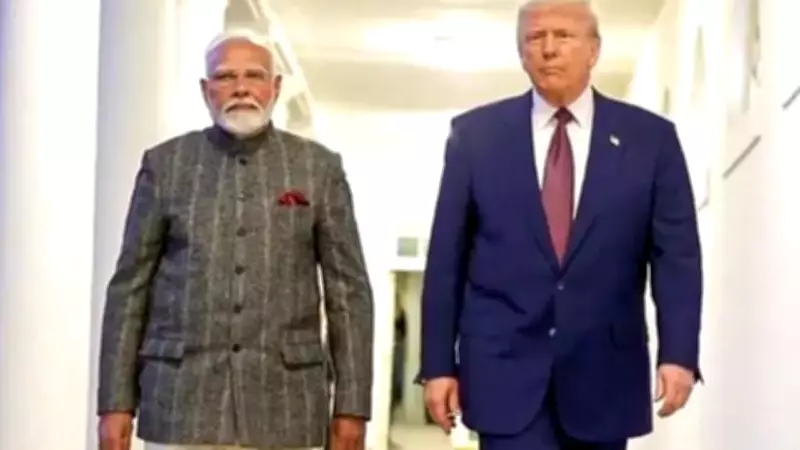
Trump Announces Major India-US Trade Agreement with Tariff Reductions and Strategic Conditions
In a significant development for bilateral economic relations, US President Donald Trump has announced a breakthrough trade deal between India and the United States. The agreement features a sharp reduction in tariffs on Indian exports to the United States, bringing them down to 18%. This move signals a fresh momentum in economic ties between the world's two largest democracies.
Modi Welcomes the Agreement as Boost for Cooperation
Prime Minister Narendra Modi welcomed the announcement, describing it as a substantial boost for cooperation between India and the United States. The deal comes after weeks of uncertainty, during which the US had imposed tariffs of up to 50% on certain Indian goods. This action was reportedly aimed at pressuring New Delhi to halt its crude oil imports from Russia.
In a post on his Truth Social platform, President Trump claimed that India had agreed to stop purchasing Russian oil. However, Prime Minister Modi, in his public response to the trade deal, made no specific mention of Russian crude imports.

Key Conditions and Market Access Provisions
The trade agreement comes with several important conditions set by the Trump administration. A central requirement is that India will reduce tariffs and non-tariff barriers on US imports to zero, thereby opening its market further to American companies and products.
Referring to India's commitment to lower tariffs to 18%, President Trump stated, "They will likewise move forward to reduce their Tariffs and Non Tariff Barriers against the United States, to ZERO."
Shift from Russian Oil to US and Venezuelan Supplies
A critical component of the agreement involves India's energy procurement policies. The United States has made the rollback of the 25% penal tariff contingent on India completely ceasing its purchases of Russian oil. According to a New Delhi-based source quoted by Bloomberg, the US has agreed to withdraw this 25% penal tariff that was imposed on India over its procurement of Russian crude.
Reuters also cited a White House official indicating that the 25% punitive tariff would be removed, though official confirmation is still pending. President Trump further announced that India would now purchase oil from the United States and potentially from Venezuela instead of Russia.
Strategic Alignment on Ukraine Conflict
President Trump explicitly linked the trade deal to India's cooperation in efforts to end the Russia-Ukraine war. He argued that halting Russian oil purchases would apply economic pressure on Moscow.
"We spoke about many things, including Trade, and ending the War with Russia and Ukraine. He agreed to stop buying Russian Oil, and to buy much more from the United States and, potentially, Venezuela. This will help END THE WAR in Ukraine, which is taking place right now, with thousands of people dying each and every week!" Trump stated in his announcement.
Substantial Purchase Commitments from India
India has committed to purchasing over $500 billion worth of US goods across multiple sectors, according to President Trump. This substantial commitment includes American energy products, technology, agricultural goods, coal, and various other products.
"The Prime Minister also committed to 'BUY AMERICAN,' at a much higher level, in addition to over $500 BILLION DOLLARS of US Energy, Technology, Agricultural, Coal, and many other products," the US President announced.
According to a government official's statement reported by Reuters, the goods that India has committed to purchase include:
- Petroleum products
- Defense equipment
- Electronics
- Pharmaceuticals
- Telecommunications products
- Aircraft
This comprehensive trade agreement represents a significant shift in India-US economic relations, with implications for global trade patterns, energy markets, and geopolitical alignments. The deal's implementation will be closely watched by economic observers and policymakers in both countries and around the world.






