

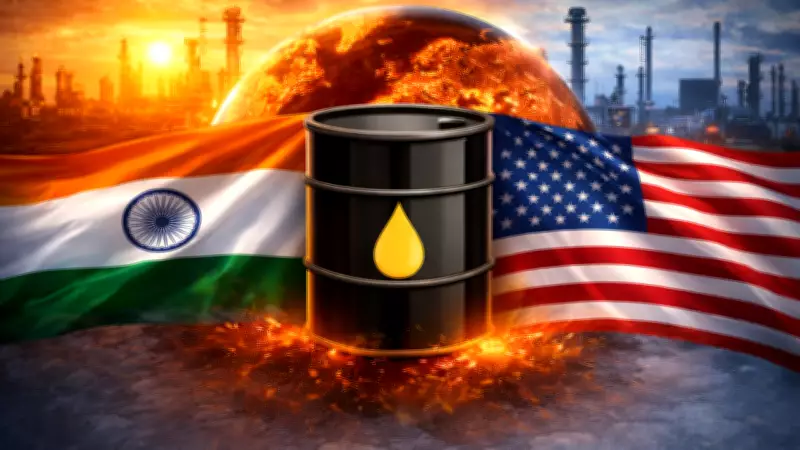
India-US Trade Agreement: Tariff Breakthrough Masks Deeper Geopolitical Oil Dynamics
When India and the United States unveiled a landmark trade agreement this week, ending months of tense negotiations, the immediate focus was on tariff reductions. However, beneath the celebratory announcements and numerical adjustments lies a far more politically charged issue: oil procurement. The question of where India sources its crude—and from whom it might purchase in the future—has emerged as a subtle yet significant subtext to the deal, highlighting how energy transcends mere commerce to become a tool of global strategy.
The Trade Deal That Reset Bilateral Relations
US President Donald Trump and Prime Minister Narendra Modi surprised many by announcing an agreement that slashes tariffs on Indian goods entering the US market to 18 percent, down from a previous high of 50 percent. While Trump asserted that India would drop its tariffs to zero, the finer details remain under negotiation, and the pact awaits formal signing. Nevertheless, this development effectively breaks a prolonged stalemate, restoring predictability to one of the world's most critical trade relationships.
Rudra Kumar Pandey, partner at Shardul Amarchand Mangaldas & Co, emphasized the strategic importance of this move in an interview with TOI. "The US decision to reduce tariffs on Indian goods to a headline rate of 18 percent marks a clear de-escalation in bilateral trade frictions and reflects aligned strategic intent on both sides," he stated. "This reinforces India's export-competitive posture, supported by recent customs duty rationalisation, and aligns with broader US efforts to recalibrate supply chains away from China."

Pandey further noted that Indian industry has demonstrated resilience through market diversification. "Exports to Spain, for instance, reportedly rose by over 56 percent to about USD 4.7 billion during April–November FY 2025–26, underscoring the ability of Indian exporters to scale in alternative markets," he explained. "The reopening of the US market, alongside improving access to Europe through the momentum of the India–EU trade agreement, positions these sectors for stronger and more sustained growth."
Immediate Economic Impact and Sectoral Gains
The United States stands as India's single largest trading partner, and the steep tariffs imposed earlier had significantly hampered Indian exporters. With the new rate set at 18 percent, India is poised to regain competitiveness, particularly in labour-intensive sectors such as:
- Garments and textiles
- Leather and footwear
- Carpets and handicrafts
- Seafood and marine products
- Gems and jewellery
Pandey elaborated on the export impact: "The immediate gains will concentrate in tariff-sensitive and labour-intensive sectors that respond swiftly to marginal duty changes. Textiles and apparel, gems and jewellery, leather and footwear, engineering goods, and auto components stand to benefit disproportionately, as these sectors compete directly with Vietnam and Bangladesh in the US market."
He added that lower effective tariffs improve India's relative cost position, likely translating into higher order flows and sourcing diversification in India's favour. Export performance toward the US has already shown strength, with shipments rising 11.3 percent to about $59 billion between April and November 2025, and smartphone exports alone doubling to $16.7 billion.
The Oil Question: A Geopolitical Bargain Emerges
While tariffs formed the centrepiece of the agreement, Trump's social media post hinted at a broader geopolitical bargain. "We spoke about many things, including Trade, and ending the War with Russia and Ukraine. He agreed to stop buying Russian Oil, and to buy much more from the United States and, potentially, Venezuela," Trump wrote.
This claim immediately sparked scrutiny. India has not publicly announced any decision to halt purchases of Russian crude, and Russian officials have stated they are unaware of such a move. Kremlin spokesperson Dmitry Peskov confirmed that Moscow has received no official communication from New Delhi and intends to continue strengthening ties across all areas of cooperation.

The Ministry of External Affairs addressed the issue on Thursday, emphasizing energy security. Indian refiners have also indicated they have received no government directive to stop buying Russian oil. According to refinery sources, any winding down of existing transactions would require time due to ongoing contracts.
Why Oil Remains a Strategic Commodity in Global Diplomacy
Oil is far more than a traded commodity; it is the backbone of transport networks, industrial production, defence preparedness, inflation control, and overall economic stability. For rapidly growing economies like India, access to cheap and assured oil supplies is critical to maintaining growth momentum, managing price pressures, and securing energy security amid global geopolitical uncertainties.
Conversely, for global powers like the United States, oil supplies serve as a potent tool of foreign policy. Sanctions, trade agreements, and diplomatic manoeuvring are routinely employed to influence where countries source their energy and at what price. This dynamic has been evident in US sanctions on Russian oil traders and Washington's efforts to limit adversaries' access to global energy markets.
In this context, energy sourcing decisions transcend commercial or technical considerations, becoming measures of strategic alignment and geopolitical positioning. Trade talks, sanctions policy, and foreign policy are increasingly shaped by energy considerations, often rivaling the importance of tariffs or market access.
India's Evolving Reliance on Russian Crude
Following intensified Western sanctions after the Russia-Ukraine war, India significantly increased its intake of discounted Russian crude, particularly the Urals grade. These discounts made Russian oil economically attractive, especially for India's complex refining system.
However, data indicates a recent decline in Russian oil imports. According to Kpler, Russia's share of India's crude imports fell to 33.7 percent between April and November 2025, down from 37.9 percent in the same period the previous year. In absolute terms, Russian crude imports dropped from about 1.8 million barrels per day in November to 1.2 million barrels per day in December, and further to 1.16 million barrels per day in January 2026.
Over the same period, the US share of India's crude imports rose from 4.6 percent to 8.1 percent. Despite this trend, analysts caution against viewing the trade deal as an immediate turning point. Sumit Ritolia, lead research analyst at Kpler, noted that Russian volumes are largely locked in for the next 8–10 weeks and remain economically critical for India. He added that Russian imports are likely to remain broadly stable through the first half of 2026–27, with any moderation offset by higher inflows from West Asia.
Can the US and Venezuela Replace Russian Oil?
Trump's assertion that India would substitute Russian oil with supplies from the US and/or Venezuela presents a complex scenario. While US crude exports to India have been rising, Venezuelan oil introduces additional logistical and refining challenges.
A recent SBI Research report estimated that India could save nearly $3 billion annually by replacing a portion of its Russian oil imports with Venezuelan heavy oil, assuming a discount of $10-12 per barrel. Venezuelan heavy oil currently trades around $51 per barrel.
However, real gains depend on multiple factors:
- Distance and logistics of transportation
- Insurance costs
- Refinery capacity to process Venezuelan heavy oil
Only Reliance Industries and Nayara Energy possess the capacity to process large quantities of Venezuelan oil, while state-owned refineries would struggle to replace even 10 percent of their current Russian imports. This suggests any shift in sourcing would be gradual and partial, driven as much by commercial feasibility as diplomatic signalling.
Energy Security and Broader Economic Implications
The India-US trade deal delivers significant economic benefits, including tariff reductions on nearly 60 percent of Indian exports to the US. Goldman Sachs projects an additional GDP growth of 20 basis points if reduced tariffs are strictly applied, while Barclays estimates the effect at 30 basis points.
Markets responded positively, with equities rallying and the rupee appreciating sharply post-announcement. Investor sentiment improved as uncertainty receded considerably.
Yet the oil question introduces a layer of strategic complexity. India has maintained a delicate balance, strengthening ties with the US while continuing cooperation with Russia and managing energy dependencies across West Asia, Africa, and South America. For New Delhi, oil procurement prioritizes energy security and cost considerations. For Washington, it aligns with broader geopolitical objectives, including sanctions enforcement and pressure on adversaries.
Oil's Historical Role in Global Conflicts and Diplomacy
Oil's centrality in international relations extends far beyond India. Throughout history, it has fueled consequential wars and geopolitical confrontations. Recent developments in Venezuela illustrate this dynamic: less than a month after a US military operation led to the capture of President Nicolás Maduro, Venezuelan lawmakers approved a landmark law opening the country's long state-controlled oil sector to private and foreign companies.
This reversal of over two decades of nationalisation aims to attract US and other investors, following pressure from the Trump administration, which has eased some sanctions and signalled strong involvement of American energy firms in revitalising Venezuela's oil production.
Historical conflicts further underscore oil's strategic importance:
- Japan's attack on Pearl Harbor in 1941 was partly triggered by an American-led oil embargo threatening its naval and air capabilities.
- Nazi Germany's push toward the oil-rich Caucasus during World War II reflected Hitler's obsession with securing fuel supplies, a gamble that contributed to defeat at Stalingrad.
- The Iran-Iraq War in the 1980s featured attacks on oil tankers and export facilities, drawing the US into the conflict to safeguard shipping routes.
- Iraq's 1990 invasion of Kuwait, fueled by disagreements over oil production, led to the Gulf War and reshaped West Asian geopolitics.
These examples reinforce a recurring pattern: oil consistently functions as leverage, shaping wars, alliances, and international disputes far beyond its role as a traded commodity.
Conclusion: Navigating the Tightrope of Strategic Autonomy and Pragmatism
The India-US trade agreement serves as a stark reminder that in an era of geopolitical uncertainties and fragmented global supply chains, oil remains a crucial bargaining chip. It sits at the intersection of politics, economics, and security, influencing decisions well beyond trade negotiations.
While the minutiae of the trade pact are still being finalized, one reality is clear: oil will continue to factor not only in trade agreements but in the broader politics of power. For India, this necessitates a careful balancing act between strategic autonomy and economic pragmatism, as energy sourcing decisions increasingly reflect geopolitical alignments in a multipolar world.





