

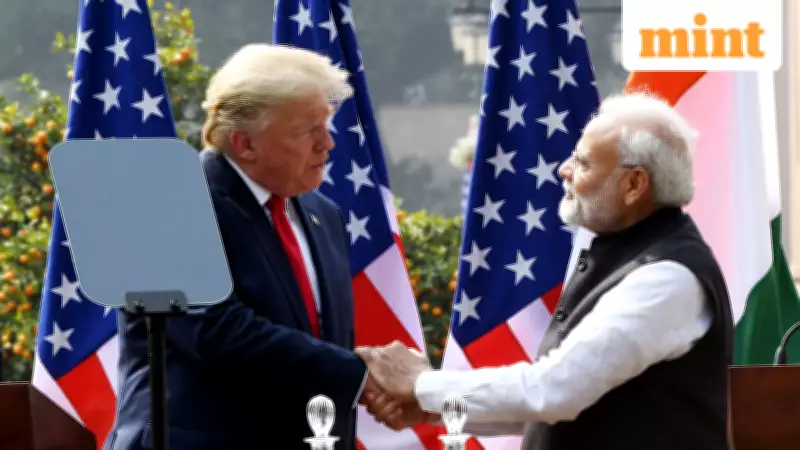
Historic India-US Trade Agreement Reached After Prolonged Negotiations
A landmark trade agreement between India and the United States has finally materialized after extensive negotiations spanning multiple administrations. On February 2, US President Donald Trump publicly announced that Washington and New Delhi had successfully concluded a comprehensive trade deal following direct discussions with Prime Minister Narendra Modi.
Substantial Tariff Reductions Announced
President Trump revealed significant reductions in reciprocal tariffs, lowering them substantially from 25% to 18%, while simultaneously announcing expanded economic cooperation frameworks between the two strategic partners. The American leader elaborated on the agreement through official channels, stating: "We agreed to a Trade Deal between the United States and India, whereby the United States will charge a reduced Reciprocal Tariff, lowering it from 25% to 18%. They will likewise move forward to reduce their Tariffs and non-tariff barriers against the United States to ZERO."
Market Experts Weigh In on Economic Implications
Financial analysts and market specialists have overwhelmingly welcomed the development as a major positive for India's economic landscape. While acknowledging that markets will require greater clarity regarding implementation details, experts agree the agreement removes a significant uncertainty that had been weighing on domestic equities for months.

Nilesh Shah, Managing Director of Kotak Mahindra AMC, offered his perspective: "India-US trade deal has gone through ups and downs like a roller coaster. While devil is in the details, it removes a hanging sword over rupee, equity and rates market. Let us hope that it is a win-win deal for both countries as they have a lot to gain through cooperation."
Immediate Market Response and Sectoral Benefits
The announcement triggered an immediate market response, with GIFT Nifty surging nearly 600 points as investors repriced risk in anticipation of improved trade competitiveness and stronger bilateral alignment. Sonam Srivastava, Founder and Fund Manager at Wright Research PMS, observed: "The reduction in tariffs from 25% to 18% under the newly signed India–US trade deal is a meaningful positive for Indian equities, both from a sentiment and earnings visibility standpoint. The sharp surge reflects expectations of improved trade competitiveness, lower input costs for exporters, and stronger bilateral economic alignment."
While market expectations had centered around tariffs falling to the 10–15% range, the directional shift toward constructive engagement between the two economic powers has been particularly encouraging. This development follows closely on the heels of India's free trade agreement with the European Union, creating momentum for New Delhi's broader trade diplomacy.
Comprehensive Economic Impact Assessment
Garima Kapoor, Deputy Head of Research and Economist at Elara Capital, emphasized the broad-based positive implications: "The development is immensely positive for every Indian asset class. Even though full tariffs are not yet removed, the direction is positive." Kapoor's analysis suggests the policy-implied effective tariff rate for India post-deal stands at approximately 14.1%, assuming removal of Russia-related tariffs.
She further explained: "The 18% tariff brings the rate in line with India’s peers that have nearly 20% rates. Removal of Russian oil is likely to happen, and a related penalty is likely to generate a positive tariff differential for India."
Sector-Specific Advantages Identified
Multiple industrial sectors stand to benefit significantly from the revised trade framework:

- Traditional Export Sectors: Gems and jewellery, textiles, apparel, and select engineering goods
- Manufacturing Segments: Machinery, electronics, and automobile components
- Knowledge-Based Industries: IT services, pharmaceuticals, and specialty chemicals
Srivastava highlighted that reduced tariff barriers enhance price competitiveness for Indian companies in the crucial US market, which remains India's largest export destination. Over the medium term, this improved access could translate into better order inflows, margin stability, and higher capacity utilization across export-oriented industries.
Long-Term Strategic Implications
The agreement reinforces domestic manufacturing themes tied to global supply chain diversification, positioning India favorably amid ongoing worldwide trade realignments. Srivastava noted: "At a macro level, the deal signals strategic continuity in India’s trade policy and strengthens India’s positioning as a preferred partner amid ongoing global trade realignments."
Ajit Mishra, Senior Vice President of Research at Religare Broking, pointed to potential market movements: "It is possible that the domestic market breaks its range. Earnings have failed to provide a fresh trigger, which the market was expecting. So, global cues will now be key."
Future Outlook and Implementation Focus
While the immediate market reaction has been pronounced, sustainability will depend on execution efficiency, sector-specific uptake, and whether earnings upgrades materialize across beneficiary industries. Srivastava concluded: "While the near-term market reaction is understandably sharp, sustainability will depend on execution, sector-specific uptake, and whether earnings upgrades follow. Still, as a signal, this is a clear risk-on trigger."
The agreement represents a significant milestone in India-US economic relations, potentially supporting economic growth, lending stability to the Indian rupee, and attracting renewed foreign institutional investment flows as bilateral cooperation deepens across multiple dimensions.





