

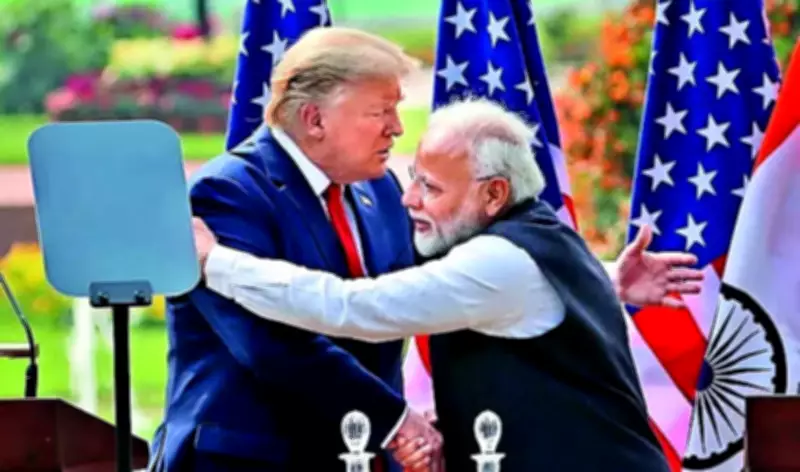
NEW DELHI: The recently concluded trade agreement between India and the United States has successfully steered the bilateral relationship back onto a more stable course, providing much-needed relief to both nations. This development allows India and the US to avoid an immediate diplomatic and economic crisis that had been looming over their partnership. However, whether this agreement can translate into long-term stability in their complex ties remains an open question that analysts are actively debating.
The Immediate Relief and Lingering Concerns
The importance of this trade deal, even with its conditional nature, cannot be overstated. For India, it represents the removal of a significant burden that was threatening to undermine cooperation across various strategic domains with its most crucial partner. The estrangement between the two countries since Donald Trump's return to the White House extends far beyond mere trade disputes, encompassing multiple friction points that continue to challenge the relationship.
Pakistan Re-Hyphenation: A Delicate Diplomatic Challenge
One of the primary concerns for India is the renewed hyphenation with Pakistan that Trump's administration has introduced through its engagement with Rawalpindi. US Ambassador to India Sergio Gor, who played a key role in resolving the trade impasse shortly after his arrival, now faces the delicate task of navigating this sensitive issue. His dual role as Trump's special envoy for South Asia adds complexity, and any misstep that equates India with Pakistan or suggests external mediation will likely face strong resistance from New Delhi.

India has consistently maintained a bilateral approach to Pakistan-related matters, firmly rejecting any third-party involvement in what it considers internal regional affairs. This position remains non-negotiable for Indian policymakers.
Indo-Pacific Commitment Under Scrutiny
The second major area of concern involves the United States' commitment to the Indo-Pacific strategy under the current administration. While Trump has expressed interest in engaging with Chinese counterpart Xi Jinping for "stable peace, fair trade and respectful relations," India watches closely how this affects regional dynamics. The previous trade differences between India and the US were seen as obstacles to progress within the Quad framework, and the recent reset was expected to facilitate higher-level meetings.
However, the US 2026 National Defence Strategy, while emphasizing balance of power in the Indo-Pacific, notably omits any mention of the Quad or India specifically, raising questions about Washington's strategic priorities in the region.
Strategic Autonomy: India's Non-Negotiable Principle
India's commitment to strategic autonomy continues to serve as both a guiding principle and a limiting factor in its foreign policy. This autonomy allows India to navigate the complex geopolitical landscape involving the United States, Russia, and China according to its national interests. Despite Trump's announcement about India ceasing Russian oil purchases, New Delhi maintains close defense cooperation with Moscow and active participation in multilateral forums like the SCO and BRICS.
India hopes Russia will interpret its energy diversification as a market-driven adjustment rather than any dilution of its independent strategic posture.
Ongoing Irritants and Transactional Diplomacy
The structural changes in the US approach to H-1B visa programs remain a significant concern for India, which hopes for Washington's attention to this issue. More fundamentally, India is wary of the transactional nature that characterizes Trump's approach to bilateral relations. Several claims made in Trump's announcement—including India's alleged agreement to purchase $500 billion worth of US energy and products, elimination of tariffs on American goods, and complete cessation of Russian oil imports—have not been officially confirmed by the Indian government.
This discrepancy suggests potential complications in the details of the agreement. Indian officials hope that some of Trump's statements represent political messaging rather than concrete demands, as New Delhi seeks to maintain a balanced and mutually respectful partnership that transcends mere transactional exchanges.






