

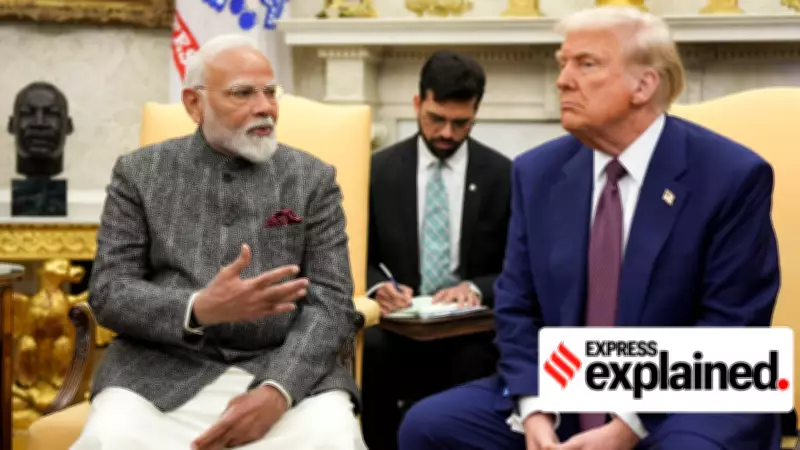
India-US Trade Deal: The Tumultuous Path to Agreement
India and the United States have finally inked a trade agreement, concluding a journey fraught with political hurdles, economic flip-flops, and intense negotiations. This landmark deal arrives after India was among the initial nations to commence talks with the US, yet it materializes following numerous global counterparts and a series of dramatic ups and downs.
The Announcement and Immediate Impact
US President Donald Trump declared on Monday that the United States, "effective immediately", has slashed tariffs on India from 50 per cent to 18 per cent. This pivotal decision emerged after India proactively addressed several American demands in its recent Budget and embarked on an aggressive campaign to secure trade pacts with other major economies, including the United Kingdom and the European Union.
In a post on Truth Social, Trump articulated, "Out of friendship and respect for Prime Minister Modi and, as per his request, effective immediately, we agreed to a Trade Deal between the United States and India, whereby the United States will charge a reduced Reciprocal Tariff, lowering it from 25 per cent to 18 per cent. They will likewise move forward to reduce their Tariffs and non-tariff barriers against the United States to zero."

Prime Minister Narendra Modi responded enthusiastically on X, stating, "Wonderful to speak with my dear friend President Trump today. Delighted that Made in India products will now have a reduced tariff of 18%. Big thanks to President Trump on behalf of the 1.4 billion people of India for this wonderful announcement."
Key Concessions and Strategic Shifts
As part of the agreement, India has committed to significant concessions. Trump highlighted that India agreed to cease purchasing Russian oil and instead increase imports from the United States, with potential additional sourcing from Venezuela. Furthermore, India pledged to procure $500 billion worth of US energy, agriculture, coal, and other products under the terms of the trade deal.
In the lead-up to this outcome, a substantial recalibration of trade relations occurred. India amplified its crude oil imports from the US, which now constitute nearly 10 per cent of its total oil imports. Additionally, New Delhi sealed a liquefied petroleum gas (LPG) agreement, wherein Indian public sector refiners have entered into a one-year contract for American LPG imports.
Concurrently, the passage of the Sustainable Harnessing and Advancement of Nuclear Energy for Transforming India (SHANTI) Bill, 2025, has been instrumental. This legislation permits private entities to participate in the operations of the strictly regulated nuclear power sector, thereby fulfilling a critical demand from the United States.
The Rocky Road to Negotiations
The journey toward this trade deal commenced with Prime Minister Modi's visit to Washington, which marked the initiation of formal negotiations. Trump had consistently criticized India for its elevated tariffs, even prior to assuming office. During their meeting in February of the previous year, Modi announced the start of bilateral trade agreement (BTA) negotiations, aiming for completion by year's end.
Despite being an early starter, India's trade deal with the US arrives after agreements with numerous other nations, including China. The initial indications of India addressing Trump's concerns surfaced even before Modi's visit. In response to Trump's persistent labeling of India as the "tariff king" and complaints about American companies like Harley Davidson struggling due to high tariffs, India implemented duty reductions on over two dozen items in the Union Budget.
Notably, tariffs on motorcycles with engine capacities exceeding 1,600cc were reduced from 50 per cent to 30 per cent. Just days preceding the Prime Minister's visit, the government also slashed duty on bourbon whisky from 150 per cent to 50 per cent, a move that faced protests from the domestic industry advocating for a phased reduction over a decade.

Escalating Tensions and Tariff Wars
The path was far from smooth. Shortly after releasing a report on non-tariff barriers encountered globally, including in India, the US imposed 27 per cent "reciprocal" tariffs on India on April 3. The United States Trade Representative (USTR) report criticized India's high applied tariffs on various goods such as vegetable oils, apples, maize, motorcycles, automobiles, flowers, natural rubber, coffee, raisins, walnuts, and alcoholic beverages.
The report also flagged India's regulations on importing milk, pork, and fish products, which mandate genetically modified (GM)-free certificates "without providing a scientific or risk-based justification." It reiterated longstanding American concerns regarding India's agricultural support programs, which the US claims distort markets.
Despite the 27 per cent tariff, India remained in relatively favorable standing compared to other Asian nations. The US imposed steeper tariffs on competitors: 54 per cent on China, 46 per cent on Vietnam, 37 per cent on Bangladesh, and 36 per cent on Thailand. Tariffs on Indonesia and Laos were set at 32 per cent and 48 per cent, respectively. However, India's tariffs were higher than those on Japan (24 per cent) and South Korea (25 per cent), with the EU facing 20 per cent and the UK 10 per cent.
Political Pitfalls and Missed Opportunities
As the US paused the implementation of "liberation day" tariffs for 90 days, hopes were raised that New Delhi would seize this window to finalize a deal, attract investments, and shift export opportunities away from China. However, this period instead ignited fresh tensions, ultimately leading to India confronting the steepest tariffs imposed on any country worldwide.
Following a terrorist attack by the Pakistan-based group "The Resistance Front" (TRF) in Pahalgam, India launched "Operation Sindoor" on May 7–8, neutralizing terrorist installations in Pakistan. A ceasefire was agreed upon between the Director Generals of Military Operations of both nations, effective from May 10. The Trump administration, however, claimed credit, asserting that US tariff leverage facilitated the cessation of hostilities.
Subsequently, US officials defended the use of emergency powers to impose sweeping tariffs, arguing in court that revoking these powers would disrupt trade negotiations and jeopardize the India-Pakistan ceasefire. This assertion exacerbated diplomatic strains, as India maintained that the ceasefire resulted from bilateral military communication, not US intervention.
Final Hurdles and Resolution
While the US continued to secure trade deals with entities like the EU, Japan, and Vietnam, an agreement with India remained elusive, primarily due to American demands for greater agricultural market access. In a move to ramp up pressure, Trump doubled tariffs on India to 50 per cent on August 7, citing India's purchases of Russian oil as justification.
This action was perceived as discriminatory, given that China, the largest buyer of Russian oil at approximately 2 million barrels per day, faced lower tariffs. India, purchasing just under 2 million barrels daily, and Turkey were similarly affected. Notably, the US had reduced tariffs on Chinese goods from 145 per cent to 30 per cent in May, highlighting the complex dynamics at play.
The culmination of these tumultuous events has now yielded a trade deal that not only reduces tariffs but also signifies a strategic realignment in India-US economic relations. This agreement underscores the intricate interplay of diplomacy, economic policy, and geopolitical considerations that characterized its arduous journey.





