

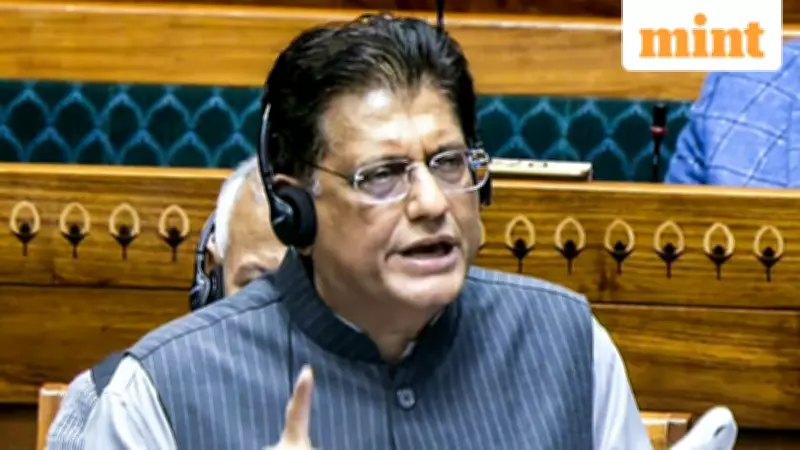
India-US Trade Agreement Key to Expanding Strategic Sectors and Boosting Exports: Goyal
Union Commerce and Industry Minister Piyush Goyal has emphasized that the trade agreement with the United States is pivotal for India to strengthen its global standing and enhance capabilities across critical sectors. In a statement delivered in the Lok Sabha, Goyal outlined how this deal aligns with India's long-term strategy to diversify supply sources amid evolving international conditions.
Strategic Engagement with a Global Leader
Goyal highlighted that the United States serves as a global leader in numerous strategic areas, including energy, aviation, data centers, critical minerals, and nuclear energy. He stressed that engagement with Washington is not merely about meeting procurement needs but also about creating new opportunities for Indian exports. This approach, according to Goyal, is part of a broader vision to position India more robustly on the world stage.
"All actions taken by India are aligned with the objective of diversifying supply sources in line with changing international strategic conditions," Goyal stated. He urged members of Parliament to view the agreement comprehensively, rather than focusing narrowly on individual sectors or tariff lines.

Protection of Sensitive Sectors
The minister assured that the government has diligently protected sensitive domestic sectors during the negotiations. He noted that just as India safeguarded its interests in agriculture and dairy, the United States also shielded certain sensitive areas, indicating a balanced and mutually beneficial outcome. This reassurance came amid parliamentary questions regarding the agreement's impact on farmers and allied sectors.
Goyal explained, "The government's assessment shows that India's exports to the US are already significant across several sectors and are expected to grow further as economic engagement deepens." He described the understanding with Washington as a structural, long-term arrangement that could support global growth and innovation in the coming years.
Enhanced Export Competitiveness
Following a phone call between Prime Minister Narendra Modi and US President Donald Trump on February 2, 2026, Trump announced a reduction in tariffs on Indian goods to 18% from the previous 50%. Goyal pointed out that this revised tariff structure places Indian products in a more competitive position compared to other major exporting nations.
According to data from the White House, India's 18% tariff is lower than rates imposed on key competitors such as Bangladesh and Vietnam (20%), China (37%), and Brazil (50%). This advantage is particularly beneficial for labor-intensive sectors like textiles, apparel, leather, and seafood.
"The relatively lower tariff on Indian goods compared with competing manufacturing hubs would improve India's price competitiveness in the US market and support higher demand for Indian exports," Goyal asserted. Trade economist Abhash Kumar added that this tariff reset comes at an opportune time as global buyers seek to diversify supply chains away from high-tariff and high-risk locations.
Growth in Bilateral Trade
Recent trade data underscores the positive trajectory of India-US economic relations. Exports to the US rose month-on-month in December, reaching $7.01 billion despite previous tariff challenges. For the first nine months of the current fiscal year (April–December), exports increased by approximately 10% to $65.88 billion.
Bilateral goods trade between India and the US stood at $105.31 billion during April–December, with India recording a trade surplus of $26.45 billion. This represents growth from the previous fiscal year's corresponding period, where trade was $94.97 billion and the surplus was $25.09 billion.
Long-Term Vision and Global Partnerships
Goyal reiterated that the trade agreement is part of a broader effort to enhance India's global economic standing, expand exports, and reinforce the goals of a developed India and an Aatmanirbhar Bharat (self-reliant India). He emphasized that the government will continue to work towards realizing this vision through deeper global partnerships.

The minister noted that following Prime Minister Modi's visit to Washington on February 13, India and the US have engaged closely for nearly a year to arrive at a balanced trade agreement. "Negotiators from both sides held several rounds of intensive and high-level discussions aimed at addressing market access concerns while safeguarding sensitive domestic interests," Goyal concluded.





