India Emerges as Top Beneficiary in Landmark EU Free Trade Agreement, US Official Reveals
In a significant assessment of global trade dynamics, United States Trade Representative Jamieson Greer has declared that India stands as the bigger winner in its newly concluded free trade agreement with the European Union. Greer framed this monumental deal as a strategic realignment directly influenced by escalating global trade tensions and Washington's recent tariff policies under the Trump administration.
Strategic Shift Driven by US Trade Policies
"First of all, strategically it's important to understand that because President Trump has prioritized domestic production and essentially started charging a fee for other countries to access our market, these countries are trying to find other outlets for their overproduction and so the EU is turning to India to try to find a place," Greer explained during an interview with Fox Business.
The US trade representative elaborated that the European Union, which maintains substantial reliance on international trade relationships, has been compelled to seek alternative markets as access to the American market becomes increasingly costly. This geopolitical maneuvering has created unprecedented opportunities for India to strengthen its economic partnerships.

India's Substantial Gains in Market Access
Greer provided detailed analysis of the agreement's provisions, stating: "I've looked at some of the details of the deal so far. I think India comes out on top on this frankly. They get more market access into Europe." He further highlighted potential immigration benefits for Indian workers, referencing comments by European Commission President Ursula von der Leyen regarding enhanced mobility provisions.
"It sounds like they have some additional immigration rights. I don't know for sure but President von der Leyen of the EU has talked about mobility for Indian workers into Europe," Greer noted, adding: "So I think on net India is going to have a heyday with this. They have low cost labor and it looks like the EU is doubling down on globalization when we're trying to fix some of the problems of globalization here in the US."
Historic Agreement Concluded After Years of Negotiation
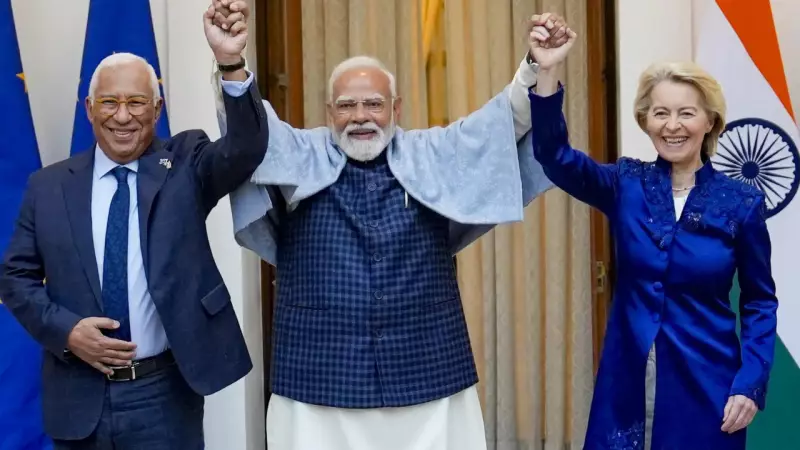
India and the European Union officially announced the conclusion of their long-running free trade agreement negotiations on Tuesday, marking the culmination of a process that began in 2007. These discussions had previously faced years of deadlock over critical issues including:
- Market access provisions
- Automobile industry regulations
- Wines and spirits tariffs
- Data protection rules
- Public procurement policies
Negotiations were successfully relaunched in 2022 alongside parallel discussions concerning investment protection frameworks and geographical indications recognition.
Comprehensive Market Access Provisions
Under the finalized agreement, India secures preferential access to the European Union across an impressive 97 percent of tariff lines, covering 99.5 percent of total trade value between the two economic powers. The immediate benefits include:
- Elimination of duties on a substantial portion of labor-intensive Indian exports including textiles, leather products, footwear, gems and jewellery, marine products, tea, coffee and various spices
- Zero-duty access for goods valued at approximately $33 billion that currently face EU tariffs ranging from 4 to 26 percent
- Protection for sensitive domestic sectors including dairy and certain agricultural products
Reciprocal Concessions from India
In return, India has offered concessions on over 92 percent of tariff lines affecting European imports, with many products receiving immediate or phased duty reductions. European exports expected to benefit significantly include:

- Olive oil and processed food products
- High-technology goods and advanced machinery
- Wines and spirits with reduced tariffs
- Certain meat products with improved market access
European Commission President Ursula von der Leyen characterized the agreement as "a decisive moment that sends a strong signal to the world," positioning it as the foundation for a deeper economic and strategic partnership between the European Union and India.
This landmark trade agreement represents one of the most significant economic partnerships established in recent years, with implications that extend far beyond bilateral trade to influence global economic alignments and strategic relationships in an increasingly multipolar world economy.