Kolkata Auto Operators Implement Fare Hikes Amid LPG Price Surge
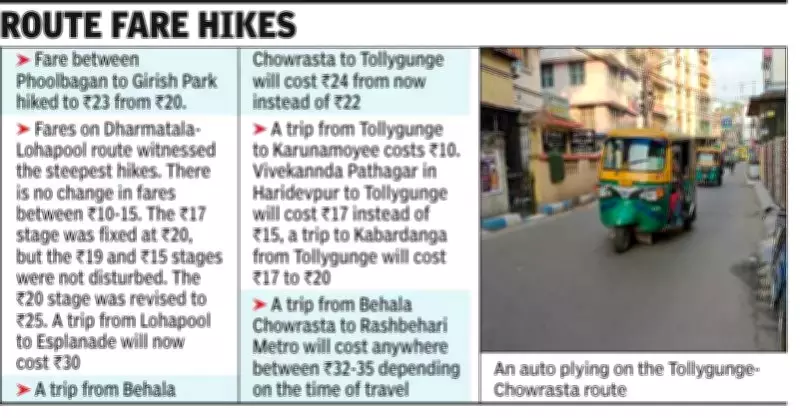
In a move that has sparked significant commuter distress, auto-rickshaw operators across Kolkata have raised fares by Rs 2 to Rs 5 per stage, following days of resistance from union leaders and route committees. The fare adjustments, introduced over the past 48 hours, primarily target longer-distance journeys where fares range between Rs 15 and Rs 25, while basic fares of Rs 10 to Rs 15 remain unchanged.
Key Routes Affected by Fare Revisions
Several major auto routes have witnessed fare increases, impacting daily travel for thousands. On the popular Phoolbagan-Girish Park route in the north, fares have risen from Rs 20 to Rs 23. The Dharmatala-Lohapool route in the city center experienced the steepest hikes, with the Rs 20 stage revised to Rs 25, and a trip from Lohapool to Esplanade now costing Rs 30. In the south, fares from Behala Chowrasta to Tollygunge increased to Rs 24 from Rs 22, and from Vivekananda Pathagar in Haridevpur to Tollygunge rose to Rs 17 from Rs 15.
Notably, some routes such as those originating from Garia, Hazra, Ballygunge, and Sarsuna have yet to revise their fares, creating a patchwork of pricing across the city.

Drivers Cite LPG Price Hike and Fleet Shortages
Auto operators attribute the fare hikes to a recent Rs 13 increase in LPG prices this month, which has severely impacted operations. Raktim Saha, an auto driver on the Kabardanga-Tollygunge route, explained, "Auto gas prices rose by Rs 13 this month. Moreover, we are getting only 10 litres of LPG, which is insufficient for an entire day. Our route committees were initially not allowing us to raise fares, but we explained that the only other option was to stop services."
The financial strain has forced 60-70% of the auto fleet off the roads, exacerbating commuter struggles. Even with the fare hikes, operators report that less than 90% of fleets are operational, leading to long queues at gas pumps and reduced availability during peak hours.
Commuters Face Longer Waits and Higher Costs
The fare increases and fleet shortages have resulted in significant inconveniences for passengers, particularly during office hours. Tathagata Banerjee, an IT engineer, shared his experience, "I had to wait around 18 minutes at 11 am to get an auto from Chowrasta to Tollygunge. Usually, the wait is always less than five minutes. When I got off, the auto operator said I had to pay Rs 24 instead of Rs 22. He claimed the fares will be reversed once auto prices stabilised, but I have serious doubts as this has never happened before."
Many commuters are now considering alternatives like buses, which offer similar travel times at lower costs. Auto operators have also insisted on carrying four passengers per trip to maximize earnings, further delaying journeys as passengers wait for full loads.
Impact on Kolkata's Last-Mile Connectivity
Autos serve as a critical backbone for last-mile connectivity in Kolkata, especially linking Metro stations to areas such as Kankurgachi, Behala, Dum Dum, and Khidderpore during crowded office hours. The current disruptions threaten to worsen urban mobility, with reports of long waits and expensive alternatives becoming commonplace.
The situation highlights broader challenges in public transport affordability and reliability, urging authorities to address fuel pricing and regulatory measures to stabilize services.