

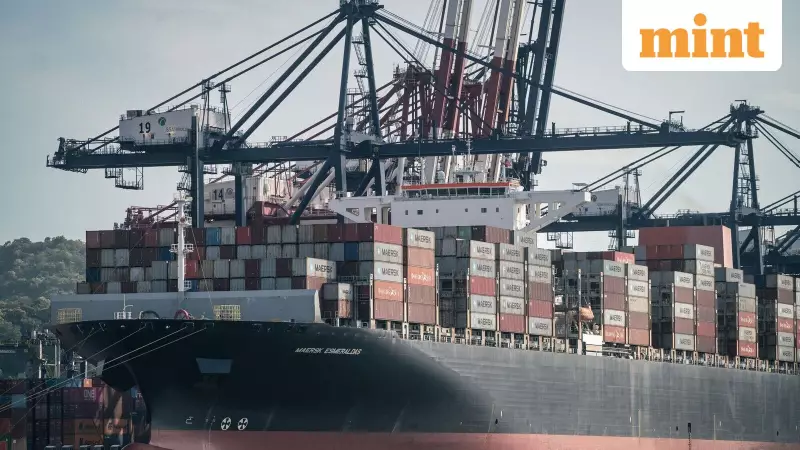
In a surprising twist to global trade dynamics, Mexico has emerged as an unexpected beneficiary of the sweeping tariff increases imposed by the United States this year. Contrary to widespread fears that its export-driven economy would suffer, Mexico has seen a significant surge in shipments to its northern neighbour, capitalising on its competitive advantages and a relatively favourable tariff position.
From Fear to Record Trade Figures
When former President Donald Trump began raising import duties earlier in 2025, officials and economists in Mexico City braced for a severe economic blow. The reality, however, has been strikingly different. Mexican manufacturing exports to the U.S. rose almost 9% from January to November 2025, compared with the same period in 2024, according to government data. While auto exports dipped by close to 6%, exports of other manufactured goods skyrocketed by 17%.
The pivotal moment came on April 2, a date Trump dubbed "Liberation Day." While announcing new tariff rates for almost every country, Mexico was conspicuously absent from the list. This clarity unleashed a wave of pent-up investment. Jorge Gonzalez Henrichsen, co-CEO of The Nearshore Co., described an "avalanche of calls" from clients eager to restart manufacturing projects in Mexico. "In fact, it was Liberation Day for us," he stated.

The Competitive Edge: Proximity, Costs, and USMCA
Mexico's resilience stems from a powerful combination of inherent strengths. Producers highlight its proximity to the vast U.S. market, a low-cost manufacturing base, and the continued framework of the U.S.-Mexico-Canada Agreement (USMCA). Even with high tariffs on specific sectors like autos, steel, and aluminium, nearly 85% of Mexico's total exports to the U.S. remain tariff-free under the trade pact.
The disparity in tariff rates has been crucial. According to the Penn Wharton Budget Model, Mexico's effective tariff rate stands at 4.7%, compared to a staggering 37.1% for China. This gap has allowed Mexican goods to fill the void left by Chinese products facing higher levies. U.S. Trade Representative Jamieson Greer noted that Mexico has captured about 25% of the reduction in the U.S. trade deficit with China, highlighting its role in supply-chain resilience.
President Claudia Sheinbaum's government has played a strategic role by actively engaging with the Trump administration. Actions like tightening border drug enforcement and imposing its own 50% tariffs on Chinese-made vehicles have helped defuse threats of harsher U.S. measures.
Deep Integration and a Look to the Future
The economic ties are profound and mutually reinforcing. Total goods trade between the two nations is on track to hit a record of nearly $900 billion in 2025. Mexico, which overtook China as the top foreign goods supplier to the U.S. in 2023, is also America's largest buyer, thanks to deeply integrated regional supply chains. Many U.S. imports into Mexico are intermediate goods later assembled and exported back north.
New growth sectors are also booming. Shipments of data-processing equipment more than doubled this year, fueled by the U.S. build-out of data centres and artificial intelligence infrastructure. This demand has led to rapid expansion for companies operating in Mexico, with one Nearshore Co. client growing from one plant and 18 employees in 2019 to four plants and 600 workers today, with plans to hire another 1,000 next year.
Looking ahead to the USMCA review in 2026, experts like Antonio Ortiz-Mena of AOM Advisors believe Mexico and Canada will continue to enjoy lower average tariffs than the rest of the world. "While it won't be a perfect agreement, we are heading in that direction," he said. Despite facing the highest tariffs in a generation on some products, Mexico's economy is now projected to expand by 0.3% in 2025—a weak but positive growth that avoids the predicted contraction, proving the country has successfully navigated the initial storm of the trade war.






