

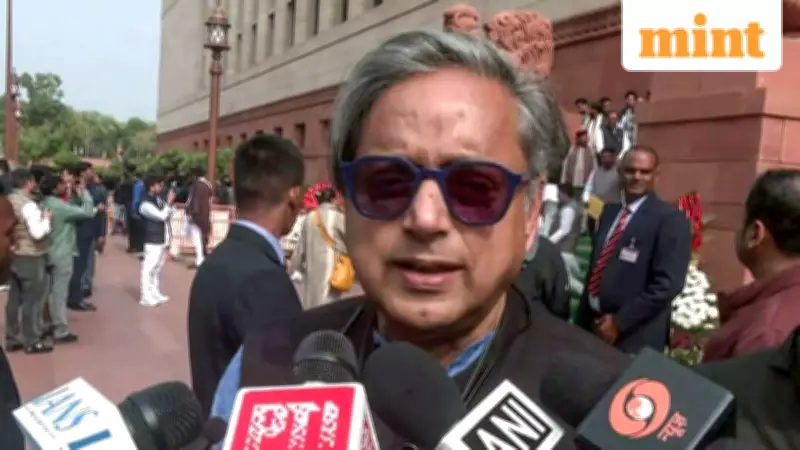
Congress Leader Shashi Tharoor Raises Concerns Over India-US Trade Deal Transparency
Senior Congress parliamentarian Shashi Tharoor has intensified his demand for comprehensive clarity regarding the recently announced India-United States trade agreement, questioning whether governance through social media posts constitutes adequate parliamentary procedure. The prominent opposition figure, whose recent political positioning has drawn considerable attention, emphasized that while tariff reductions might appear beneficial, the government must provide detailed explanations to the public and Parliament.
Questioning the Sufficiency of Social Media Announcements
In pointed remarks to news agency ANI, Tharoor articulated his concerns about the lack of official documentation surrounding the trade pact. "We have Mr Trump's tweet and Mr Modi's tweet; is that enough in a parliamentary democracy?" he questioned rhetorically. The Congress MP stressed that the opposition is merely seeking transparency about the agreement's specific provisions and implications for various economic sectors.
Tharoor elaborated on his position, stating "I want to know what it contains. The Opposition is only asking for clarity. We don't know what the deal contains." He emphasized that the government should formally explain the agreement's terms to Indian citizens rather than relying on social media announcements from political leaders.

Specific Concerns About Agricultural and Economic Impacts
The former Union Minister raised particular questions about how the trade deal would affect vulnerable sectors of the Indian economy. "Mr Trump says it's for agriculture, so what are the protections for Indian farmers?" Tharoor inquired, highlighting the need for safeguards for agricultural communities. He further questioned the scale of proposed American purchases, noting "Mr Trump says USD 500 billion, our entire import bill is USD 700 billion, so do we stop buying from every other country?"
While acknowledging that positive trade developments should be celebrated, Tharoor insisted that such celebrations must be based on complete information. He asserted that the government should provide full transparency regarding the deal's impact on farmers, trade dynamics, and agricultural policies before any endorsement could be offered.
The Core Issue: Lack of Parliamentary Consultation
Tharoor identified the fundamental problem as the government's failure to properly consult with Parliament and clearly communicate what has been agreed upon with American counterparts. "Right now, there is concern because there is no clarity—the Congress is asking questions, and the BJP is not providing answers," he described, characterizing this communication gap as the central issue fueling political controversy.
The Congress leader underlined the constitutional necessity for the executive to "take Parliament into confidence and clearly explain what has been agreed to." He argued that the absence of an official government statement has created unnecessary uncertainty and speculation about the trade agreement's actual provisions and consequences.
Background of the India-US Trade Agreement
The trade deal emerged after extended negotiations between the two nations, with former US President Donald Trump announcing that Washington would reduce reciprocal tariffs on Indian goods to 18 percent from 25 percent. This reduction followed New Delhi's reported agreement to cease purchasing crude oil from Russia, according to Trump's statements.
Trump further claimed that Prime Minister Narendra Modi had committed to significantly increased purchases of American products across multiple sectors:
- Energy products including coal exceeding $500 billion
- Agricultural goods and technology
- Various other American products
The former US President also asserted that India would move toward eliminating tariffs and non-tariff barriers against United States exports, potentially reducing them to zero. While Prime Minister Modi welcomed the new 18 percent tariff rate in a social media post, his announcement notably omitted reference to Russian oil or Trump's claim about India eliminating levies on American goods, creating additional ambiguity about the agreement's complete terms.

This discrepancy between the two leaders' public statements has amplified calls for official clarification from the Indian government regarding the precise nature of commitments made during trade negotiations.





