

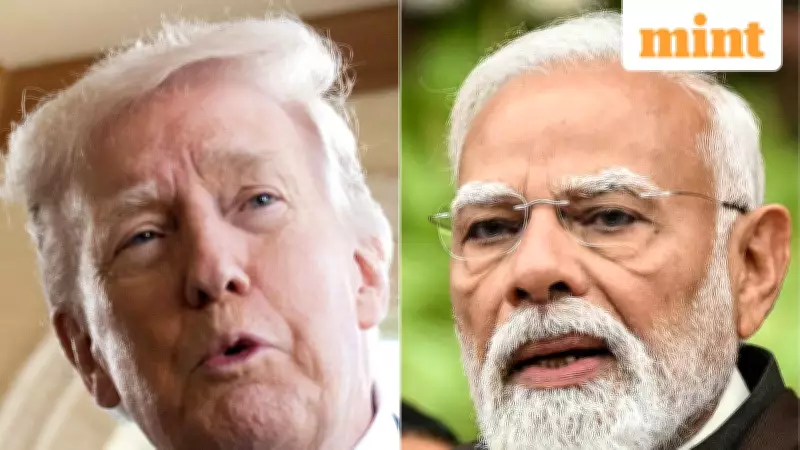
Trump Announces India-US Trade Deal with Russian Oil Shift and Tariff Reduction
In a significant development, former US President Donald Trump claimed on Monday that Prime Minister Narendra Modi has agreed to stop buying Russian oil as part of a newly negotiated India-US trade agreement. Trump made this announcement while detailing the terms of the deal, which includes substantial changes to energy imports and tariff structures.
Key Components of the Trade Agreement
According to Trump, the trade deal involves a major shift in India's oil procurement strategy. He stated that India will now purchase significantly more oil from the United States and, potentially, Venezuela, moving away from Russian supplies. This aligns with Trump's earlier comments from a few days prior, where he mentioned India would buy Venezuelan oil instead of Iranian oil, though Indian authorities have not officially confirmed this aspect.
In addition to the energy provisions, Trump announced a reduction in US tariffs on Indian goods. The tariffs have been lowered from 25% to 18%. Previously, the US had imposed a 25% tariff as a penalty, on top of a 25% reciprocal tariff, against India for its purchases of Russian oil during the Ukraine war. This tariff cut is seen as a move to ease trade tensions and foster better economic relations between the two nations.

India's Stance on Russian Oil Imports
Indian officials have provided context on the country's oil import trends in recent statements. Last week, Oil Minister Hardeep Singh Puri noted in an interview that India's imports of Russian crude are expected to continue declining. As the world's third-largest oil buyer, India is actively diversifying its suppliers, currently sourcing from 41 countries.
Puri emphasized that there has been no government mandate on Russian oil purchases, with companies making independent decisions based on market conditions. He reported that shipments from Russia have decreased to 1.3 million barrels per day from an average of 1.8 million barrels last year, indicating a declining trend driven by market factors.
In August last year, External Affairs Minister S. Jaishankar addressed Western criticism by highlighting that India is not the largest purchaser of Russian oil—that distinction belongs to China. He also pointed out that India buys oil from the US, with those imports increasing, and expressed perplexity at the logic of arguments against India's energy strategy.
Historical Context and Current Trends
India emerged as the largest buyer of Russian seaborne oil at its peak, importing over 2 million barrels per day. However, data shows a decline, with daily flows dropping to around 1.2 million barrels in January 2026. Industry estimates suggest imports could fall further to 800,000 to 1 million barrels per day in the coming months, a level considered acceptable to the US.
A European think tank reported in early January that India imported about 144 billion euros' worth of crude oil from Russia since the start of the Ukraine war, with Russia supplying about 35% of India's crude oil imports. However, this share has since dropped to less than 25% and may decrease further, especially as major buyers like Reliance Industries reduce their reliance on Russian oil.
The trade deal comes amid ongoing diplomatic engagements, including Prime Minister Modi's meeting with Russian President Vladimir Putin at a regional summit in China, underscoring the complex geopolitical landscape influencing these economic decisions.






