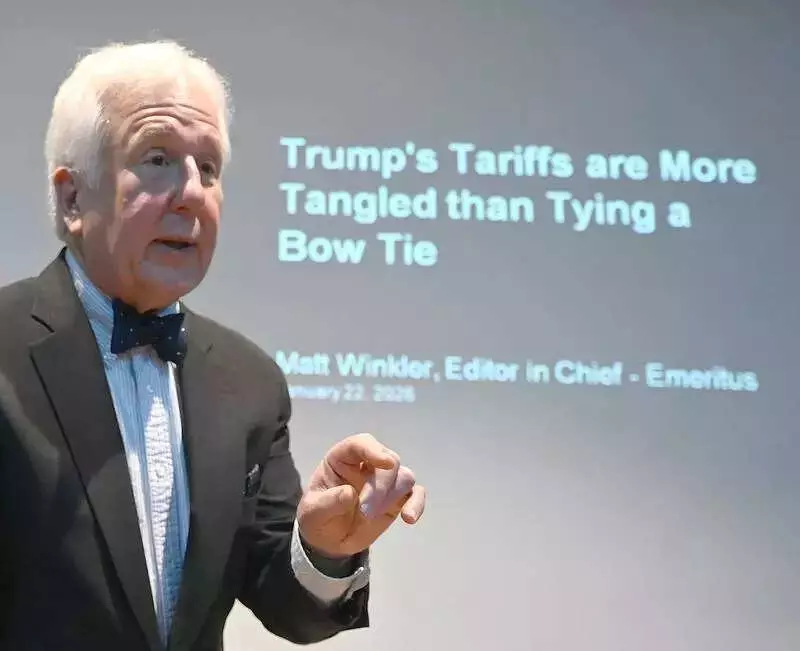
Matt Winkler, the editor-in-chief emeritus of Bloomberg News, delivered a critical assessment of former President Donald Trump's tariff policies during a speech in Chennai, highlighting their counterproductive impact on American consumers and significant repercussions for Indian exports.
The Burden on American Consumers
Speaking at the Asian College of Journalism on Thursday on the topic 'Trump's tariffs are more tangled than tying a bow tie', Winkler cited compelling studies indicating that Americans bore a staggering 96% of the cost burden from the Trump-era tariffs. He emphasized that this imposition, particularly in light of recent developments at the Davos forum, serves as a prime example of why such tariffs are largely punitive and ultimately harmful to consumers in the United States.
"The reason for that is the US buys as much from Europe as Europe buys from the US," Winkler explained. "So if Europe, as it actually threatened to do, were to cut off American companies from selling products in Europe, that would be a devastating blow to the American economy."

Global Trade Tensions Escalate
These remarks arrive amidst heightened global trade friction. The European Union Parliament has recently frozen its approval of a major US trade deal. This decisive action is a direct response to President Trump's controversial threat to seize Greenland, showcasing how trade policy is increasingly being leveraged in geopolitical disputes.
Severe Impact on Indian Exports to the US
Shifting focus to India, Winkler presented alarming data on the tariff's fallout. He revealed that India's monthly exports to the United States plummeted by a substantial $3.4 billion, or 30%, declining to $7.8 billion during the critical five-month period from April to August 2025.
"This is the biggest five-month export decline since data was compiled in 1960," Winkler stated, underscoring the historical severity of the drop. The financial strain extended to the corporate sector, with at least 25 publicly traded Indian companies that derived 25% or more of their revenue from the US market seeing their shares lose 11% over the past year. This decline starkly contrasts with the broader Indian stock market, which gained 4% during the same period.
Eroding Confidence in US Financial Stability
Later, addressing a question on whether the US risks its reputation as a stable capital destination due to the weaponization of trade policy, Winkler pointed to concerning market signals. He noted that the decline of the US dollar already reflects significant investor anxiety about committing funds to the American market.
"When you combine the dollar's decline and the ascendancy of gold at the same time, that's a signal that confidence in US assets—primarily financial assets—is no longer prized the way they were just a little more than a year ago, in 2024 and before," he elaborated. Highlighting this shift, Winkler observed that gold appreciated more in 2025 than at any point since 1979, a clear indicator of investors seeking safer havens away from perceived US market volatility.
The analysis presented by the veteran Bloomberg editor paints a picture of interconnected global economic strain, where tariff policies designed for political leverage are creating tangible financial pain for consumers and exporters alike, while simultaneously shaking the foundations of international confidence in US economic leadership.