

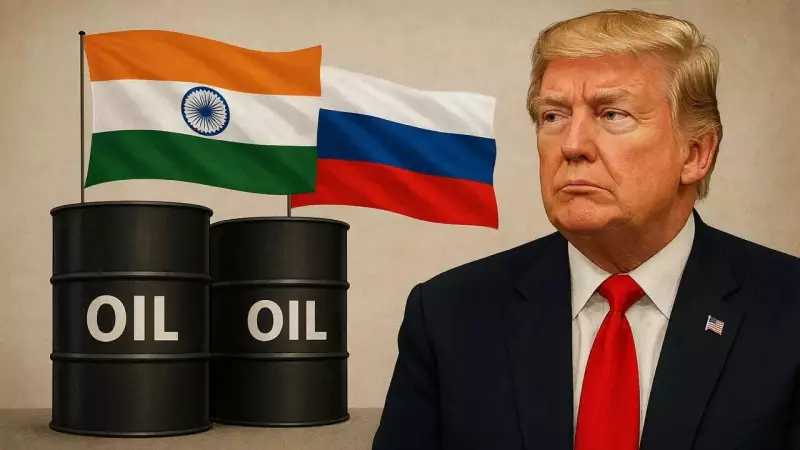
US President Donald Trump has issued a stark warning to India, threatening to impose significantly higher tariffs on Indian goods if the country does not align with American concerns regarding its imports of Russian crude oil. This warning amplifies the pressure on Indian exports, which are already grappling with substantial trade penalties in the US market.
The Tariff Threat and Modi's Awareness
Speaking to reporters aboard Air Force One while traveling from Florida to Washington DC, Trump explicitly linked trade relations to India's energy policy. He stated that Prime Minister Narendra Modi was fully aware of his dissatisfaction over India's continued purchases of Russian oil. Trump emphasized that Washington possesses the capability to raise tariffs on Indian goods "very quickly," a move he described as potentially "very bad for them."
"They wanted to make me happy, basically. Modi is a very good man; he is a good guy. He knew I was not happy, and it was important to make me happy. They do trade and we can raise tariffs on them very quickly," the US President remarked. Currently, shipments from India to the US face a 50% tariff, with half of this burden directly attributed to India's ongoing procurement of Russian crude.

India's Shifting Oil Import Landscape
This political pressure comes amidst a complex shift in India's crude oil sourcing. According to data from the Ministry of Commerce and Industry, India imported a total of 178.1 million tonnes of crude oil between April and November 2025. During this period, Russia remained the largest supplier, providing approximately 60 million tonnes. However, imports from the United States saw a dramatic surge, jumping by over 92% year-on-year to about 13 million tonnes in the first eight months of the fiscal year.
This change is reflected in the share of each country in India's crude basket. The US share rose to 7.6% in the current fiscal period from 4.3% a year earlier. Conversely, Russia's share declined to 33.7% from 37.9% over the same comparative period. The full impact of recent US sanctions on key Russian suppliers like Rosneft and Lukoil, imposed in October, is yet to be fully visible in official figures, but has already prompted major refiners like Reliance Industries to announce plans to halt Russian crude purchases.
Strategic Grey Zone and the Need for Clarity
Analysts argue that India's current approach has placed it in a precarious position. Ajay Srivastava, founder of the Global Trade Research Initiative (GTRI), notes that while imports of Russian crude have reduced, they have not stopped entirely, creating a "strategic grey zone." He asserts that this ambiguity is weakening India's negotiating stance.
"If New Delhi plans to stop Russian oil imports, it should do so clearly and decisively. If it intends to continue buying from non-sanctioned Russian suppliers, it must say so openly and support the stance with data. What no longer works is ambiguity," Srivastava stated. The GTRI further highlights that India's decision-making is complicated by the lack of any guarantee that halting Russian oil would end US pressure, as demands could simply shift to other sectors like agriculture, dairy, or digital trade.
The think tank concludes that with Indian exports to the US already falling by 20.7% between May and November 2025, further tariff escalation could trigger a steeper decline. It urges India to take a definitive stand on Russian oil, own that decision, and communicate it unambiguously to Washington. The situation is further underscored by legislative efforts in the US, such as those by Senator Lindsey Graham, to impose secondary tariffs on nations importing Russian energy if Moscow does not agree to a ceasefire in Ukraine.






