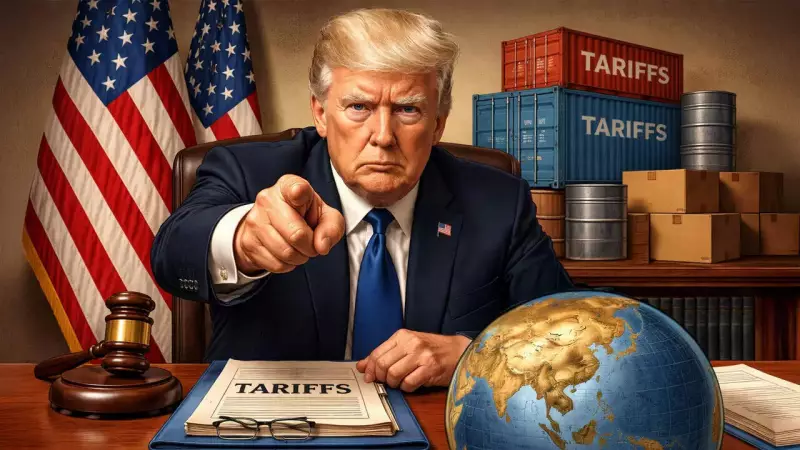
Trump's Greenland Tariff Threat Carries Crucial Warning for India
Former US President Donald Trump just issued a stark warning to European Union countries. He linked new tariffs directly to Greenland. This move holds important lessons for India as it negotiates a trade deal with the United States.
The Tariff Announcement and Its Political Roots
On January 17, 2026, Trump announced a 10% import duty on goods from eight European nations. The list includes Denmark, Norway, Sweden, France, Germany, the United Kingdom, the Netherlands, and Finland. These tariffs will take effect on February 1. They are scheduled to increase to 25% starting June 1.
Trump stated the tariffs will remain until the United States achieves what he called the "complete and total purchase of Greenland." He made this declaration in a lengthy social media post. Trump argued that Denmark and the EU have received US subsidies for years by not facing tariffs. He claimed world peace is at stake because China and Russia want Greenland.

"Only the United States of America, under PRESIDENT DONALD J. TRUMP, can play in this game," Trump wrote. He described Greenland as a "sacred piece of Land" crucial for national security. Trump said the US has tried to acquire Greenland for over 150 years. He now believes modern weapons systems make the acquisition especially urgent.
European Reactions and Broader Implications
European leaders responded quickly with concern. A senior German member of the European Parliament said the threat casts doubt on the EU-US trade agreement concluded last year. European Commission President Ursula von der Leyen and European Council President Antonio Costa issued a joint statement. They warned such measures would weaken transatlantic ties and could trigger a harmful escalation cycle.
The European leaders stressed that Europe would act collectively and defend its sovereignty. This episode highlights a clear pattern. Trump deploys tariffs and sanctions as tools of economic pressure to access other nations' resources. He often disregards established international norms.
Why India Must Pay Close Attention
According to Ajay Srivastava, founder of the Global Trade Research Initiative (GTRI), this situation delivers a critical message for India. Trade deals with the United States offer no guaranteed protection when economic measures serve political leverage. India is currently negotiating a trade deal with the US. The country already faces 50% tariffs on some exports.
Srivastava points to several key lessons:
- Europe's experience shows that even close allies face sudden tariff actions.
- Canada, part of the Five Eyes intelligence alliance, previously faced 35% US tariffs.
- Australia has moved to repair ties with China after trade disruptions.
"India has already paid a price by stepping back from Chabahar, altering energy imports and limiting engagement within BRICS, yet continues to face pressure in trade talks," Srivastava notes.
The Strategic Path Forward for India
The Greenland episode underscores that agreements with the United States do not insulate partners from coercive measures. Tariffs and sanctions can be reimposed regardless of existing deals. GTRI advises India to avoid making unilateral concessions to the US. This includes concessions on energy sourcing, regional projects, technology platforms, or strategic alignments.
India should not trade away strategic autonomy hoping a US trade deal will ensure stability. In a volatile global order, restraint, diversification and sovereign decision-making matter more than promises that can be withdrawn overnight.
GTRI recommends a clear approach for New Delhi:

- Diversify trading partners to reduce dependence on any single nation.
- Ring-fence sovereign decision-making processes.
- Insist on reciprocity in all international agreements.
- Retain leverage across energy, technology, and regional connectivity sectors.
The think tank also sounds a cautionary note on technology. It references how Starlink services operated in Iran until authorities disrupted access. "As India considers allowing Starlink, it should factor in these strategic risks," GTRI states. Satellite-based networks can bypass national oversight, limiting government response capabilities.
The Bottom Line for Indian Policymakers
Trump's latest tariff threat over Greenland sends an unambiguous signal. Even recently negotiated trade arrangements do not shield partners from fresh US measures. Nations worldwide are responding by cushioning themselves against unpredictable US policy moves.
Surveys indicate 76% of Germans now regard America as unreliable. Canada has broadened its external relationships, concluding eight agreements with China. Australia is repairing ties with China after trade reprisals. The United Kingdom's new administration is preparing a visit to China.
For India, the consequences are already being felt. With limited room to pivot toward China due to border tensions and Beijing's support for Pakistan, India's safest course is principled neutrality. The most important takeaway remains clear: India should not trade strategic autonomy for promises that recent history shows can be withdrawn without warning.