

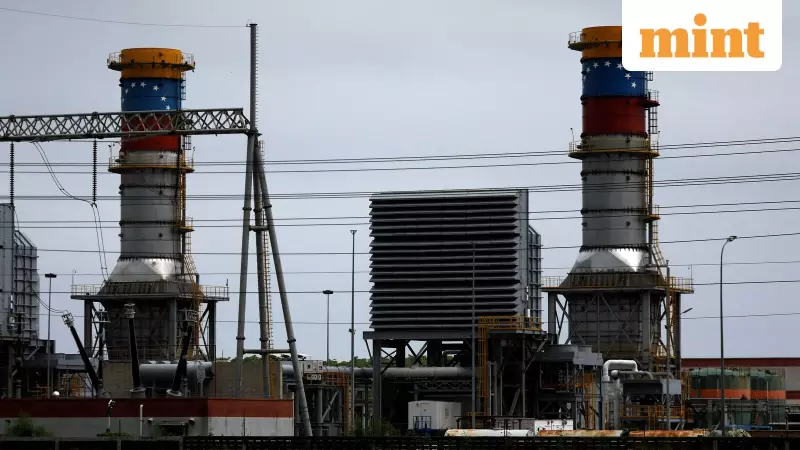
In a dramatic move with significant implications for global energy markets, the United States, under President Donald Trump, has set its sights on revitalising Venezuela's crippled oil industry following the capture of its dictator, Nicolás Maduro. Hours after the January 3rd raid, Trump declared his intent for major US oil firms to invest billions to fix the country's broken infrastructure and "start making money for the country." This bold plan targets the world's largest petroleum reserves but faces monumental hurdles.
The Promise and the Payback
The declaration carries a strong undercurrent of geopolitical and economic retribution. Nearly two decades ago, under Hugo Chávez, Venezuela nationalised assets belonging to American and other Western companies, leading to claims worth a combined $60bn against the state and its national oil company, PDVSA. On December 16th, Trump had demanded the return of "all of the oil, land and other assets that they previously stole from us." However, the ambition extends beyond payback. Venezuela's production has plummeted by two-thirds since the late 2000s to around 1 million barrels per day (b/d). Restoring it could enrich Venezuela while profiting American interests.
The potential prize is enormous: Venezuela sits on roughly 300 billion barrels of oil, accounting for a fifth of global reserves. Its heavy, sour crude is also a perfect match for US refineries that are chronically short of this type, especially as relations with traditional supplier Canada remain strained.

Immediate Hurdles and Long-Term Challenges
Despite the grand vision, the immediate reality is grim. A US blockade on shipments using blacklisted tankers, including the seizure of one vessel, has cratered Venezuelan exports. A critical shortage of naphtha, a dilutant previously sourced from Russia, further complicates moving its thick crude. Analysts warn production could soon fall below 700,000 b/d.
Even with a smooth political transition and lifted sanctions—a big "if"—recovery will be slow. Data firm Kpler estimates basic repairs could lift output to 1.2 million b/d by end-2026, still far below its peak and behind Libya's production. To truly pump more, Venezuela must conquer three colossal problems: a dire funding crisis, a severe labour shortage, and a saturated global market.
Consultancy Rystad Energy estimates that $110 billion in capital expenditure is needed just on exploration and production to return to 2008 output levels—double what US oil majors invested worldwide in 2024. While Chevron, already operating there under a waiver, may expand, other firms are wary of past expropriations. Banks, insurers, and traders remain hesitant, casting doubt on Trump's call to arms.
The Human Capital and Market Reality
The industry's brain drain is catastrophic. Tens of thousands of skilled engineers and geologists have fled. PDVSA is now largely military-run and would require wholesale reform to be a viable partner for Western joint ventures, a process likely taking years.
Furthermore, any extra oil would enter a market already awash with supply. The International Energy Agency expects global supply to outstrip demand until at least 2030, driven by strong output from Brazil, Guyana, and the US itself. Analysts predict prices could fall towards $50 per barrel, below the breakeven point for most existing Venezuelan fields, making new projects even less competitive.
In an optimistic scenario, Kpler forecasts Venezuelan output might reach 1.7-1.8 million b/d by 2028. This could reshuffle trade flows, with US refiners buying more and traditional buyers like Cuba and China's "teapot" refineries seeking alternatives. While this offers marginal commercial and geopolitical benefits for America, a return to its late-2010s output of 2.5-3 million b/d—akin to Kuwait's current production—remains a distant, long-term project. Trump's capture of Maduro was swift, but the economic rewards will be anything but.






