

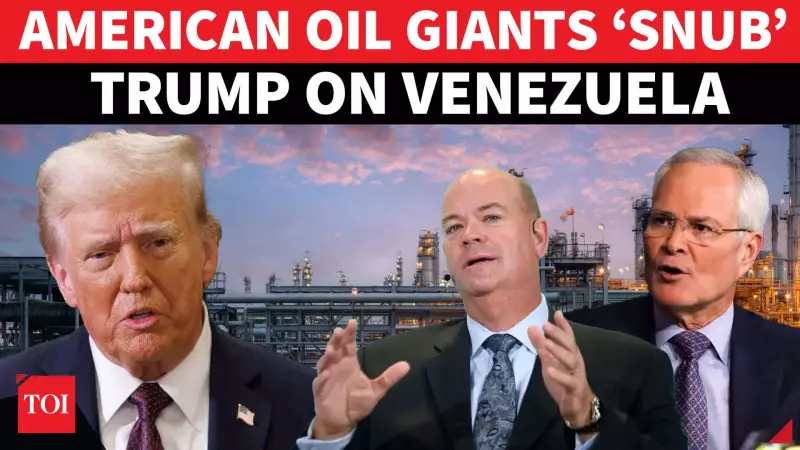
In a significant setback to former US President Donald Trump's grand energy vision, America's largest oil corporations are pushing back against a proposed $100 billion project to rebuild and dominate Venezuela's battered petroleum industry. Despite Trump's promises of complete security and a massive reconstruction fund, deep-seated skepticism prevails among the very companies needed to execute the plan.
Corporate Skepticism Overrides Political Promise
The bold proposal, which aims to place US firms at the heart of the world's largest oil reserves, is meeting stiff resistance. Chevron, currently the sole American oil company with operations in Venezuela, has expressed serious concerns. The company has raised alarms regarding operational safety, the complexities of navigating international sanctions, and the uncertain rule of law in the country.
Other industry behemoths are even more blunt. Giants like ExxonMobil and ConocoPhillips have effectively labeled Venezuela as "un-investable." Their stance is rooted in painful history, notably the large-scale asset seizures carried out under the late President Hugo Chávez, coupled with years of relentless political and economic turmoil that have crippled the nation's infrastructure.

The $100 Billion Dream Versus Harsh Reality
Trump's pitch, reportedly made in early 2026, envisioned a total overhaul of Venezuela's dilapidated oil infrastructure. The goal was to boost production to record levels and secure a dominant American foothold in a region rich with crude. However, the reluctance of the private sector poses a fundamental challenge to this geopolitical and economic ambition.
The core issues cited by the companies include:
- Safety and Security: Physical risks to assets and personnel.
- Sanctions Compliance: Navigating the web of US and international restrictions.
- Legal Uncertainty: Fear of future nationalization or asset grabs.
- Political Instability: The ongoing volatile climate in Venezuela.
What This Means for the Future
This corporate revolt highlights the vast gap between political proposals and on-ground investment realities. For the plan to have any chance of success, it would require not just promises but concrete, enforceable guarantees that address the decades of risk that have accumulated in Venezuela's energy sector. The refusal of Exxon, ConocoPhillips, and the hesitancy of Chevron signal that capital will follow certainty, not just opportunity, leaving Trump's $100 billion Venezuela dream in a precarious state.
The development underscores a critical lesson: even the world's most resource-rich nations cannot attract major investment without a stable and predictable legal and operational environment. For now, the world's largest oil reserves remain largely untapped by the very American companies once poised to develop them.






