

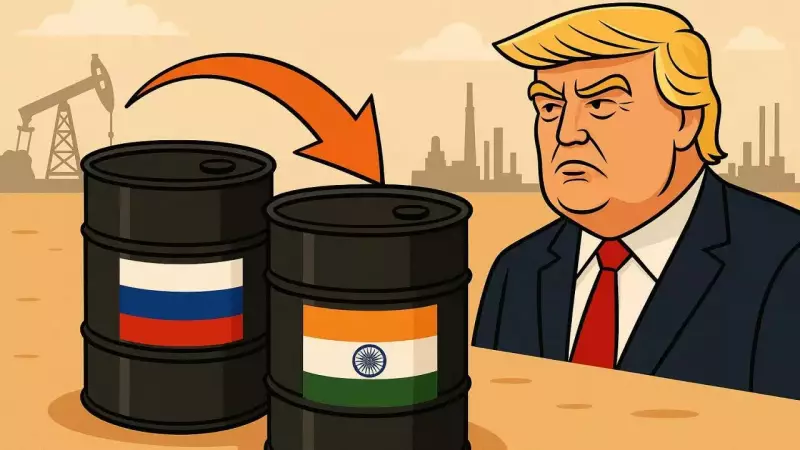
The United States government, under the Trump administration, is exerting significant pressure on India to curtail its substantial imports of crude oil from Russia. This geopolitical friction has become a central and contentious issue in the ongoing trade negotiations between the two democracies.
The Core of the Dispute: Tariffs and War Financing
Washington has explicitly linked a portion of its trade actions against India to the South Asian nation's energy purchases from Moscow. Of the 50% tariffs recently imposed by the US on Indian goods, a substantial 25% are designated as punitive measures directly targeting India's crude oil trade with Russia. American officials have accused India of indirectly providing financial support for Russia's ongoing military campaign in Ukraine through these energy transactions.
This stance has complicated efforts to finalize a broader trade deal. While Indian refiners have been compelled to seek alternative sources following the latest US sanctions on major Russian firms like Rosneft and Lukoil, procurement of Russian oil not under specific sanctions has continued.

Russia's Reassurance: A "Reliable" Energy Partner for India
Amid this external pressure, Russian President Vladimir Putin has publicly reinforced his country's commitment to being India's steadfast energy supplier. During a recent media briefing alongside Prime Minister Narendra Modi, Putin offered strong assurances.
"Russia is a reliable supplier of oil, gas, coal and everything that is required for the development of India's energy," President Putin stated. He emphasized readiness for "uninterrupted shipments of fuel for the fast-growing Indian economy," highlighting the longstanding and successful partnership in the energy domain.
Russia's capacity to back this promise is rooted in its vast resources. As of early 2024, it holds its position as the world's third-largest oil producer, with daily output of 10.8 million barrels and confirmed reserves of around 80 billion barrels. It is also the global leader in natural gas reserves, boasting 1,600 trillion cubic metres.
Beyond Oil: Expanding the Strategic Partnership
President Putin outlined that the bilateral cooperation extends far beyond traditional fossil fuels into advanced and strategic areas.
Nuclear energy collaboration is a major pillar, with Russia currently executing a flagship project to construct the largest nuclear power plant in India. Future prospects include potential ventures into small modular reactors, floating nuclear power plants, and non-energy applications of nuclear technology in fields like medicine and agriculture.
Transport and logistics are another critical focus. Both nations are actively developing new international trade corridors, with a key aim being the creation of the International North-South Transport Corridor (INSTC) stretching from Russia and Belarus to the Indian Ocean.
Furthermore, Putin highlighted deepening ties in sophisticated sectors such as joint industrial projects, machine manufacturing, digital technologies, and space exploration, marking a comprehensive and multi-faceted strategic relationship.
The situation presents India with a complex diplomatic and economic balancing act. It must manage its crucial strategic autonomy and energy security needs, fostered by its partnership with Russia, while navigating its equally vital trade and geopolitical relationship with the United States.






