

India's automobile industry is witnessing a historic transformation in its export profile, moving decisively beyond its long-standing identity as a hub for small cars. In a significant milestone, exports of utility vehicles (UVs) such as SUVs and MPVs have, for the first time, overtaken the shipment of passenger cars, reflecting a domestic boom that is now resonating globally.
A Historic Export Inflection Point
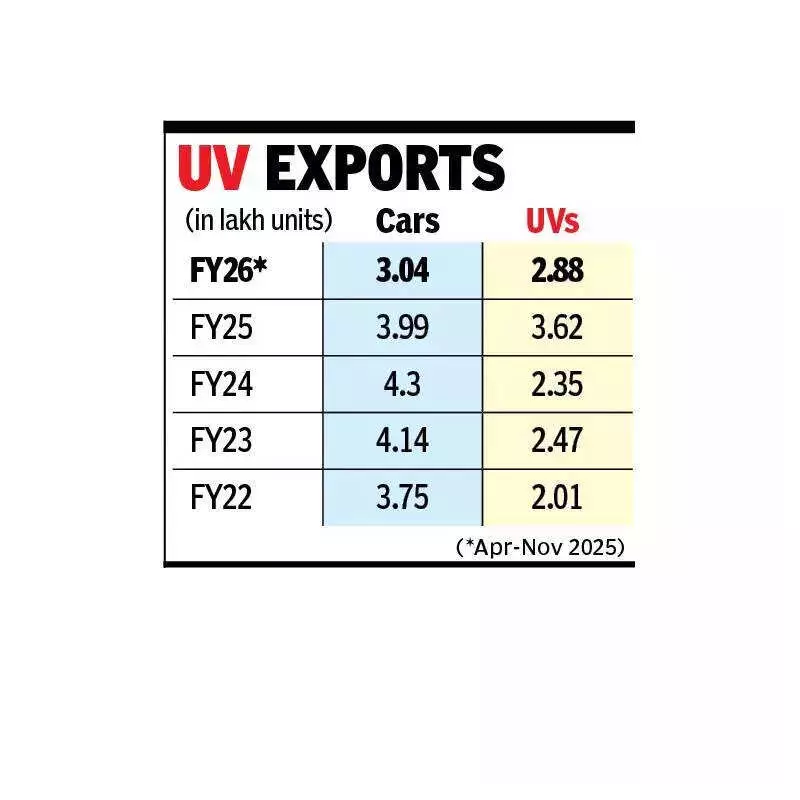
The turning point came in November 2025, when exports of India-built utility vehicles reached 42,993 units, surpassing passenger car exports which stood at 40,519 units. This marks the first instance where the export balance has tipped in favour of UVs. The gap is expected to widen in the coming months, with the full fiscal year 2025-26 (FY26) poised to become the first financial year to formally record this shift.
This surge is part of a broader trend. For the April to November 2025 period, total car exports were at 3.04 lakh units, up from 2.71 lakh units a year ago. However, UV exports saw a sharper rise, jumping to 2.88 lakh units from 2.22 lakh units in the same period last year. This contrasts with the figures from the previous full fiscal year (FY24), where car exports (4.3 lakh units) were nearly double that of UV exports (2.3 lakh units).

Market Leaders and the Compact Advantage
The export market continues to be dominated by a few key players. Maruti Suzuki leads the pack, contributing over 47% of all passenger vehicles exported from India. The company, along with Hyundai, accounts for roughly 81% of total passenger car shipments this fiscal year.
In the utility vehicle segment, Maruti Suzuki's dominance is even more pronounced. Its UV export volumes are almost equal to the combined exports of all other manufacturers, with Nissan, Toyota, and Hyundai emerging as other significant players. Between April and November 2025, Maruti exported 2.83 lakh units, followed by Hyundai at 1.32 lakh units and Nissan in third place with about 52,000 shipments.
A spokesperson for Maruti Suzuki highlighted that compactness remains a defining trait of India's export success. "Compact vehicles are inherently more fuel-efficient and emit lower levels of CO₂," the spokesperson noted, adding that this principle applies across body styles, from hatchbacks to SUVs. Reflecting this, sub-4-metre SUVs accounted for about 62% of total UV exports. Furthermore, eight of the top ten passenger vehicles exported from India are small or compact models under four metres in length.
What This Shift Means for India's Auto Industry
This export milestone underscores a fundamental change in India's role in the global automotive supply chain. The country is steadily evolving from being primarily a manufacturing base for small, budget-friendly cars to becoming a competitive hub for higher-value vehicles like SUVs and multi-utility vehicles.
The growing domestic appetite for utility vehicles, which now includes a significant number of first-time buyers, has provided the scale and manufacturing expertise necessary to cater to international markets. This shift not only enhances the value of India's export basket but also strengthens the country's position as a versatile and sophisticated auto manufacturing destination. The momentum suggests that utility vehicles are set to drive the next phase of growth for India's automobile exports.






