

West Asia Crisis Severely Disrupts Mangaluru's Coffee Export Operations
The bustling coastal coffee export hub of Mangaluru in Karnataka is grappling with significant operational disruptions as a direct consequence of the ongoing crisis in West Asia. Shipments destined for Gulf countries have been delayed, and freight costs have experienced a dramatic surge, creating a challenging environment for exporters in this vital region.
Freight Costs Skyrocket Amid Port Closures and Rerouting
Exporters based in Mangaluru have reported that cargo bound for Gulf nations, which is typically routed through the Jebel Ali Port in the United Arab Emirates, has been placed on hold following the escalation of tensions. This logistical bottleneck has forced a sharp increase in shipping expenses.
The freight cost for a standard 20-ton container to Jebel Ali Port has escalated from approximately $578 to a staggering $3,800. Similarly, shipments utilizing the Shuwaikh Port have seen costs rise from $850 to $4,500, representing an increase of over five times the original rates.

Ganesh Chakrapani, a prominent coffee exporter from Mangaluru, highlighted that the closure of the UAE port has compelled exporters to seek alternative routes. One such alternative is the Sohar Port in Oman. Under this revised logistical arrangement, coffee is first shipped to Sohar and then transported overland to various Gulf countries. Chakrapani confirmed that this rerouting has resulted in freight charges shooting up sixfold, placing immense financial pressure on the export community.
Mangaluru's Pivotal Role in India's Coffee Export Landscape
The New Mangalore Port Authority is a cornerstone of India's coffee export industry, handling an estimated 90% of the nation's total coffee exports. In comparison, Cochin in Kerala manages around 8%, and Mumbai accounts for approximately 2%. Chakrapani emphasized that West Asia and its neighboring countries collectively represent 30% to 35% of India's total coffee export volume, underscoring the region's critical importance.
This export corridor primarily involves large volumes of Arabica coffee shipped to Gulf markets, alongside other varieties such as Robusta, instant coffee, and the distinctive Monsooned Malabar coffee produced in coastal Karnataka.
Detailed Breakdown of Gulf Coffee Imports from India
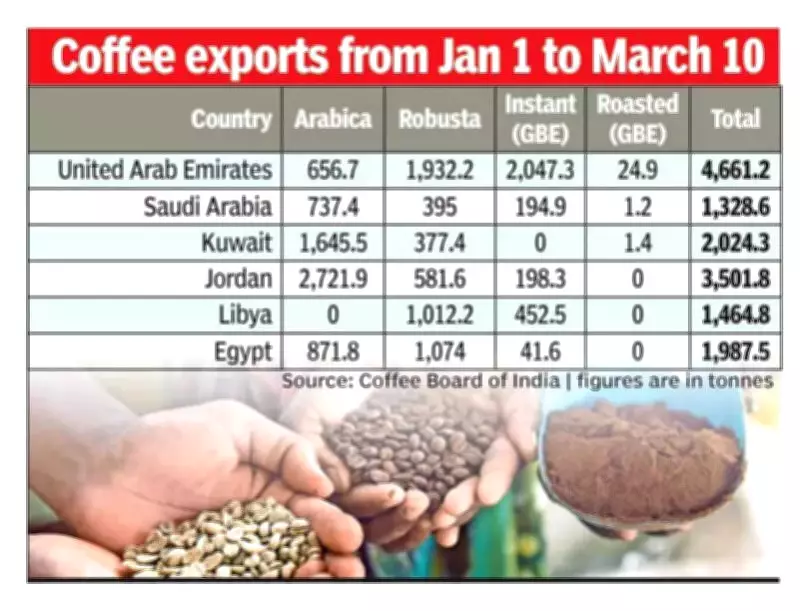
According to recent data from the Coffee Board of India, the United Arab Emirates stands as the largest Gulf importer, having received 4,661 tonnes of coffee. This figure is bolstered by a strong demand for instant coffee, exceeding 2,000 tonnes. Other key importers in the region include:
- Jordan, which imported 3,501 tonnes, predominantly Arabica.
- Kuwait, with imports of 1,645 tonnes, also largely consisting of Arabica.
- Saudi Arabia, importing 1,328 tonnes with demand spread across various coffee varieties.
Libya and Egypt also emerged as significant buyers. Libya demonstrated a stronger preference for Robusta coffee, while Egypt imported both Arabica and Robusta varieties.
Collectively, between January 1 and March 10 of this year, these countries imported a total of 14,965 tonnes of coffee from India. A detailed variety-wise breakdown of these imports is as follows:
- Arabica: 6,633 tonnes
- Robusta: 5,373 tonnes
- Instant coffee: 2,935 tonnes
- Roasted coffee: 28 tonnes
Exporters have noted that the ongoing crisis has not only disrupted logistics but has also contributed to a rise in coffee prices in the affected markets, compounding the challenges faced by the industry.






