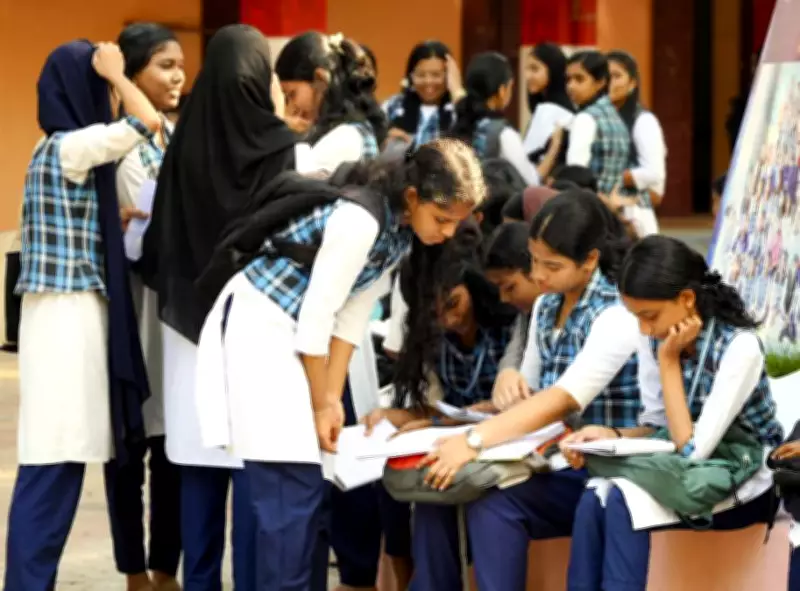
CBSE Class 12 Maths Paper 2026: A Comprehensive Analysis
The Central Board of Secondary Education (CBSE) conducted the Class 12 Mathematics examination for the academic year 2025-2026 on March 9, 2026. This high-stakes exam, a crucial component of the board assessments, has garnered significant attention from students, parents, and educators across India. Following the completion of the paper, initial reactions and detailed analyses have emerged, providing insights into the difficulty level, question patterns, and overall student experience.
Student Reactions to the Maths Paper
Students who appeared for the CBSE Class 12 Maths exam reported a mix of emotions. Many described the paper as moderately challenging, with a balanced distribution of questions across various topics. According to feedback, the paper included a blend of straightforward and complex problems, testing both conceptual understanding and application skills.
Key Points from Students:- The paper was perceived as fair but time-consuming, with some lengthy calculations required.
- Sections on calculus and algebra were highlighted as particularly demanding, requiring careful problem-solving.
- Multiple-choice questions (MCQs) were considered manageable, offering opportunities for scoring.
- Several students expressed relief over the inclusion of familiar question types from previous years' papers.
Overall, student sentiment leaned towards cautious optimism, with many believing that consistent preparation would yield satisfactory results. However, some voiced concerns over the pressure to complete the paper within the allotted time, citing the need for efficient time management during the exam.

Teacher Analysis and Expert Opinions
Educators and subject experts have provided a thorough analysis of the CBSE Class 12 Maths paper 2026. Teachers noted that the paper adhered to the prescribed syllabus and followed the expected pattern, aligning with CBSE guidelines. The difficulty level was assessed as moderate, designed to differentiate between average and high-performing students.
Highlights from Teacher Feedback:- The paper emphasized application-based questions, encouraging critical thinking over rote learning.
- Topics such as integrals, differential equations, and probability were well-represented, reflecting their importance in the curriculum.
- Teachers appreciated the clarity of questions, reducing ambiguity and potential confusion for students.
- Suggestions were made for future papers to include more real-world problem-solving scenarios to enhance practical knowledge.
Experts also pointed out that the paper's structure aimed to assess a wide range of skills, from basic computations to advanced analytical abilities. This approach is in line with CBSE's objective of promoting holistic education and preparing students for higher academic pursuits.
Paper Difficulty and Question Pattern Overview
The CBSE Class 12 Maths paper 2026 comprised multiple sections, including objective-type questions, short-answer questions, and long-answer questions. The overall difficulty was rated as moderate, with a slight inclination towards challenging problems in certain sections. This balance is intended to maintain academic rigor while ensuring accessibility for a diverse student population.
Notable Aspects of the Question Pattern:- Adequate weightage was given to all units of the syllabus, preventing any topic from being overlooked.
- The inclusion of diagram-based questions in geometry sections was praised for testing visual-spatial skills.
- Some questions required integrated knowledge from multiple chapters, promoting interdisciplinary understanding.
This analysis suggests that students who focused on understanding concepts rather than memorizing formulas were likely to perform better. The paper's design underscores the importance of comprehensive preparation and regular practice in mathematics.

Implications for Future CBSE Exams
The feedback from the CBSE Class 12 Maths paper 2026 offers valuable insights for upcoming board examinations. It highlights the need for students to develop strong problem-solving abilities and time management skills. Educators recommend incorporating more practice tests and mock exams to familiarize students with the exam format and reduce anxiety.
Furthermore, this analysis serves as a resource for parents and tutors to guide students in their preparation strategies. By focusing on weak areas and leveraging feedback from this paper, future candidates can enhance their performance and achieve academic success in mathematics.