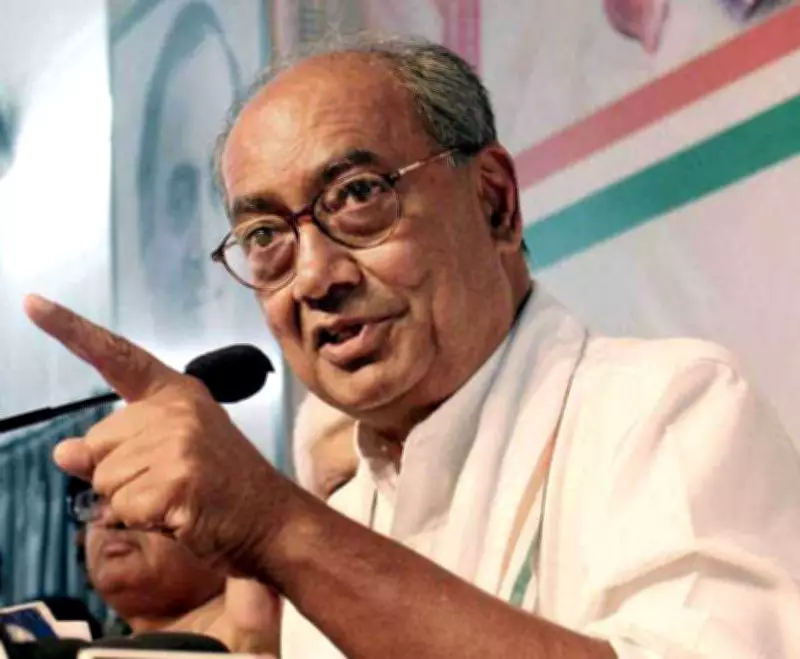
Senior Congress leader and Chairman of the Parliamentary Standing Committee on Education, Digvijaya Singh, has written to Prime Minister Narendra Modi urging him to immediately put on hold the mandatory implementation of the three-language policy for CBSE Class IX students. Singh warned that the move risks causing widespread academic disruption for lakhs of students across the country.
Concerns Over Mid-Session Implementation
In a letter dated June 6, Singh highlighted that he had received representations from parents of CBSE Class IX students who raised objections to the policy being enforced in the middle of the academic session. He wrote, 'I am forwarding herewith a representation received from a group of parents concerned of CBSE Class IX students, opposing the mandatory implementation of the Three-Language Policy in the current mid-session,' adding that the issue deserves the Prime Minister's personal attention.
Singh argued that introducing such a major academic change without adequate preparation could create confusion and place unnecessary pressure on students and schools. He cautioned against repeating mistakes seen during the rollout of the Continuous and Comprehensive Evaluation system, stating, 'The sudden enforcement of this policy mid-session – without adequate teachers, textbooks, or transition time – is likely to create serious disruption.'

Lack of Preparedness and Resources
The Congress leader questioned the preparedness of authorities to implement the move, pointing out that the CBSE Governing Body had, in its December 2025 meeting, directed the Curriculum Committee to recommend suitable schools for testing the effectiveness of third-language instruction before the release of graded language textbooks by NCERT. Despite this, CBSE issued a circular on May 15, 2026, asking for implementation of third-language instruction in Grade IX from July 2026.
Singh also noted that NCERT had not yet released graded textbooks for the languages prescribed under the National Curriculum Framework for School Education for Class IX students. He questioned why CBSE appeared to have moved ahead despite its own earlier decisions.
Regional and Linguistic Challenges
The letter highlighted regional concerns, particularly in southern and north-eastern states, where linguistic diversity and local language priorities could make implementation more difficult. 'The situation is particularly untenable for students in the Southern and North-Eastern States, where Hindi is not spoken and local tribal languages feature in CBSE's recognised language list,' Singh wrote.
He further flagged a shortage of qualified Sanskrit teachers and inadequate textbooks, warning that such gaps could defeat the objective of promoting linguistic diversity.
Call for Immediate Hold
Calling for intervention, Singh recommended that implementation for current Class IX students should be 'put on hold immediately.' He argued that delaying implementation by one academic cycle would not harm the larger objective of multilingual education, as the first board examination linked to the new instruction pattern would be held only in 2031.
'Therefore, I earnestly hope that the matter will receive your urgent and sympathetic consideration in the interest of the millions of students whose academic futures depend on sound and well-prepared policy decisions,' the letter concluded.