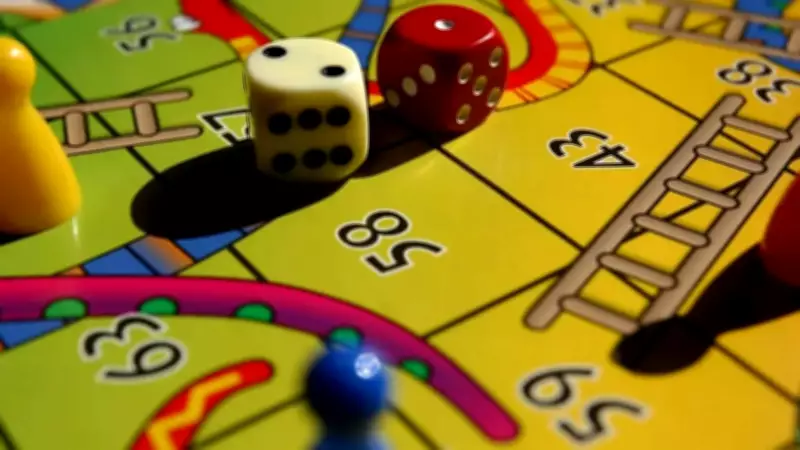
Remember how board games used to light up drawing rooms before Instagram reels and TikToks took over childhood? The Snakes and Ladders game was a hot pick for an eventful evening. What is more intriguing is how, despite being childhood trauma painted on a board game, Snakes and Ladders never really dipped in popularity. Instead, during gatherings of cousins and playdates, the game peaked. One minute you are climbing toward victory with a lucky ladder, the next a giant snake eats your dreams and sends you back to the start. Families have laughed, cried, accused dice of cheating, and learned early that life is not fair.
Here is what most people miss: Snakes and Ladders began as a spiritual game in ancient India. It was not just something to keep kids busy but a lesson in karma, morality, destiny, and liberation. Your cousin's refusal to share the dice was living by centuries-old philosophy.
The Philosophical Idea Behind the Popular Board Game
Called Moksha Patam, Mokshapat, or Parama Padam, according to Hindu Blog, versions of modern Snakes and Ladders date back as far as the 2nd century BCE or CE. Most credit the 13th-century poet-saint Gyandev, also known as Dnyaneshwar, with making the game popular. Moksha means liberation in Hindu philosophy, while Patam means board. So, the game was essentially The Game of Liberation, a concept much deeper than cartoon snakes rocking sunglasses.

The game was designed to teach kids morals. Ladders represented virtues such as kindness, faith, humility, generosity, and wisdom. Meanwhile, snakes symbolized vices like greed, arrogance, lust, theft, anger, and dishonesty. Imagine five-year-olds learning that lying is not just bad but sends you into an existential crisis.
Ancient boards had specific squares: square 12 stood for faith, 57 for generosity, 76 meant knowledge, pride lived on square 95, and lust lived near 99. So, you could almost win, only to be wrecked at the last second, just as it is even now. All this tied into Hindu karma: do good, rise up; do bad, slide down. The 100th square was Moksha, liberation from the cycle of rebirth. In other words, ancient India put the rules of life into a board game long before motivational podcasts existed.
More Snakes Than Ladders
Another key aspect of the original game was that there were more snakes than ladders. This was intentional because goodness is tough, while temptation is easy. Ancient designers were wise, perhaps even smarter than today's algorithms.
British Adaptations
Britain picked up the game in the late 19th century during colonial times, brought it home, and renamed it Snakes and Ladders. However, staying true to their pattern of modifying things, the British made changes. They dialed back the spiritual elements, removing karma and Moksha. In came Victorian morals: thrift, discipline, obedience, and punctuality. The snakes and ladders stayed, but the cosmic lessons faded. They also made the game less harsh by introducing equal numbers of snakes and ladders. The Indian version punished harder, while the Brits believed in more second chances.
American Transformation
Then America stepped in. In 1943, Milton Bradley released Chutes and Ladders. Americans thought snakes were too scary for kids, so they swapped them for playground slides. A spiritual game about escaping suffering turned into don't slide down after you steal cookies. That is perhaps the best remix in board game history.
Modern Legacy
The game is still played in India today. South Indian versions exist as Vaikuntapali or Paramapada Sopanam, and Jain communities have their own take with unique spiritual themes. Researchers remain fascinated by Snakes and Ladders. Mathematicians and historians study old boards to understand how people once viewed morality and fate. One academic paper even ran simulations to see how ancient societies balanced virtues and vices.
Every roll, every climb, every slide is messy and unpredictable, just like life. Sometimes you rise fast thanks to luck, sometimes you stumble hard because of one mistake. And sometimes, no matter how close you are, there is always a snake waiting on square 99.