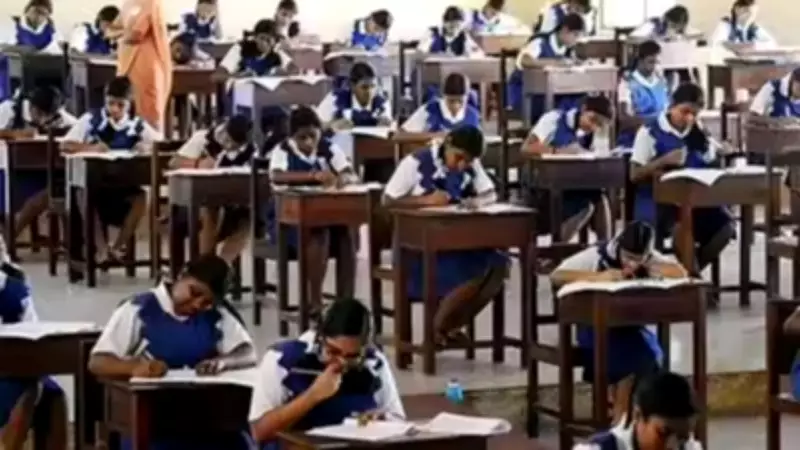
A new report by Niti Aayog has highlighted that while India's school education system has largely succeeded in getting children into school, it now faces a more difficult challenge: retaining them through secondary and higher secondary education.
Enrolment Declines Sharply at Higher Levels
According to the report titled 'School Education System in India: Temporal Analysis and Policy Roadmap for Quality Enhancement', the gross enrolment ratio (GER) drops sharply from 90.9% at the primary level to 58.4% at the higher secondary level. The dropout rate at the secondary stage rises to 11.5%, compared to just 0.3% at the primary level.
Systemic Weaknesses Beyond Elementary Stage
The report describes the current system as 'strongest on basic access and weakest on continuity, inclusion, and learning depth'. It encompasses 14.71 lakh schools, 24.69 crore students, and about 1.01 crore teachers, with the most significant cracks now appearing beyond the elementary stage.

Transition rates weaken steadily as students progress. While 92.2% of students move from primary to upper primary, this rate falls to 86.6% between upper primary and secondary, and further to 75.1% between secondary and higher secondary. The secondary stage has emerged as the biggest stress point.
Infrastructure Improvements Not Enough
Despite significant infrastructure gains over the past decade—with functional electricity in 91.9% of schools, girls' toilets in 94%, computers in 64.7%, internet connectivity in 63.5%, and smart classrooms in 30.6%—structural inefficiencies persist. More than one-third of schools have fewer than 50 students, and over 1.04 lakh schools still function as single-teacher institutions serving nearly 34 lakh students.
Policy Recommendations
The report argues that the next phase of reform must move beyond expanding enrolment or infrastructure. It should address fragmented school structures, foundational learning deficits, inequities in inclusion, gaps in teacher and leadership ecosystems, infrastructure disparities, and governance weaknesses. Strengthening transition rates at each stage, particularly after upper primary, is crucial to ensuring smoother progression and sustained engagement in schooling.
The findings underscore the need for targeted interventions to improve retention and quality at the secondary and higher secondary levels, as near-universal access at the primary stage has not translated into similar outcomes higher up the ladder.